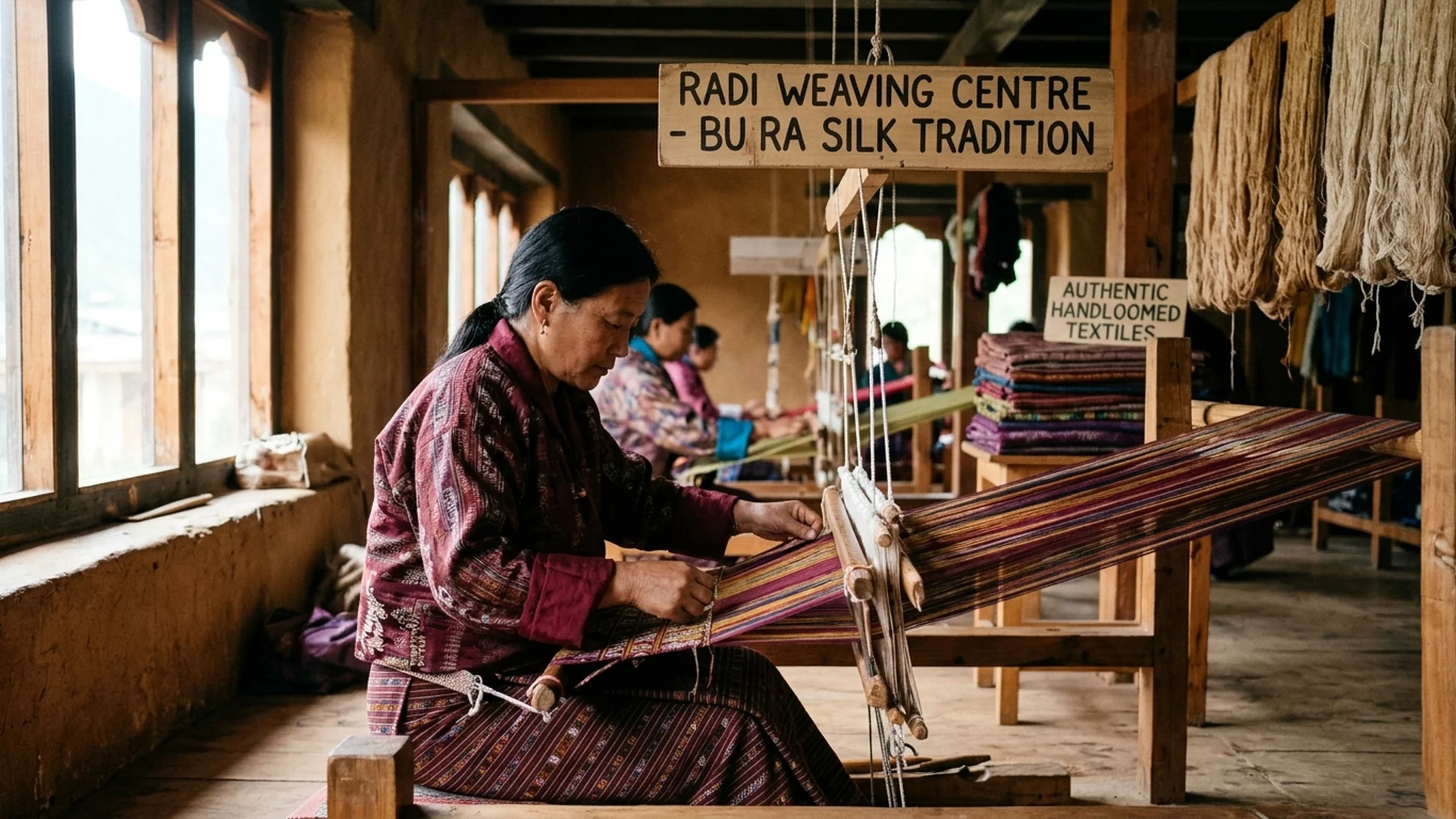
When the morning mist slowly lifts from the serene valleys of Trashigang, tiered rice terraces emerge like emerald-green jewels, accompanied by the rhythmic, hypnotic clatter of ancient wooden looms echoing from bamboo dwellings. This is the heartbeat of Radi, a quiet Himalayan village celebrated as the premier sanctuary for raw silk production in the eastern reaches of the kingdom.
At the Radi Weaving Centre, craftsmanship is never merely commercial; it is a living cultural heritage woven with profound patience, unwavering faith, and ancestral wisdom passed down through generations. Each length of Bura silk is far more than a garment—it is a mirror reflecting the unvarnished spirit of eastern Bhutan, where time seems to slow down so we may truly absorb the beauty of unhurried existence.
The Allure of Bura Silk: Masterpieces Woven from Eastern Valleys
If western Bhutan is regarded as the political and monastic core of the kingdom, the eastern territories—particularly the district of Trashigang—represent the beating heart of folk arts and fine craftsmanship. Within this region, the villages of Radi and Kamsaingkar are revered as the undisputed epicenters of Bura Silk. This prized raw silk is distinguished by its organic texture, balancing a rustic, tactile authenticity with effortless natural elegance. Unlike mass-produced synthetic textiles, authentic Bura requires master artisans to hand-reel individual silk filaments, spinning them into threads before executing complex weaving sequences that honor the profound bond between mountain communities and their surrounding ecology.
Ancient Wisdom on the Back-Strap Loom: Natural Dyes and Narrative Patterns
Behind the luminous aesthetic of Bura silk lies a completely chemical-free creation process rooted in deep environmental stewardship. The weavers of Radi adhere strictly to ancestral practices, utilizing natural dyes extracted from local tree barks, roots, leaves, and wild blossoms. Rich yellows emerge from heartwood, vibrant terracotta tones from roots, and verdant greens from gathered leaves, each boiled and steeped meticulously by hand until the raw fibers absorb the earthy hues entirely.
Once dyed, these threads are mounted onto a back-strap loom—a wonderfully compact, portable weaving apparatus where the artisan regulates thread tension using the posture of her own body. With astonishing concentration, the weaver introduces intricate geometric motifs. These are never arbitrary decorations; every single line and crossing encodes blessings, wishes for prosperity, and cosmological myths preserved across centuries.
The Rhythms of Trashigang: The Rice Bowl of the East
A pilgrimage to the Radi Weaving Centre transcends simple craft appreciation; it is an intimate doorway into an agrarian lifestyle framed by monumental topography. Affectionately known as the ‘Rice Bowl of the East,’ Radi encompasses rare expanses of fertile river flats dedicated to elaborate terraced agriculture. Whether the paddies surge with emerald shoots in warmer months or ripple with golden grain just prior to harvest, the valley vistas resemble classical landscape paintings.
Here, visitors encounter mothers and daughters plying their shuttles beneath traditional timber eaves, sharing gentle laughter and quiet conversation. This atmosphere of unfeigned warmth and abiding tranquility offers a deeply restorative cultural immersion, far removed from the breathless pace of the modern world.