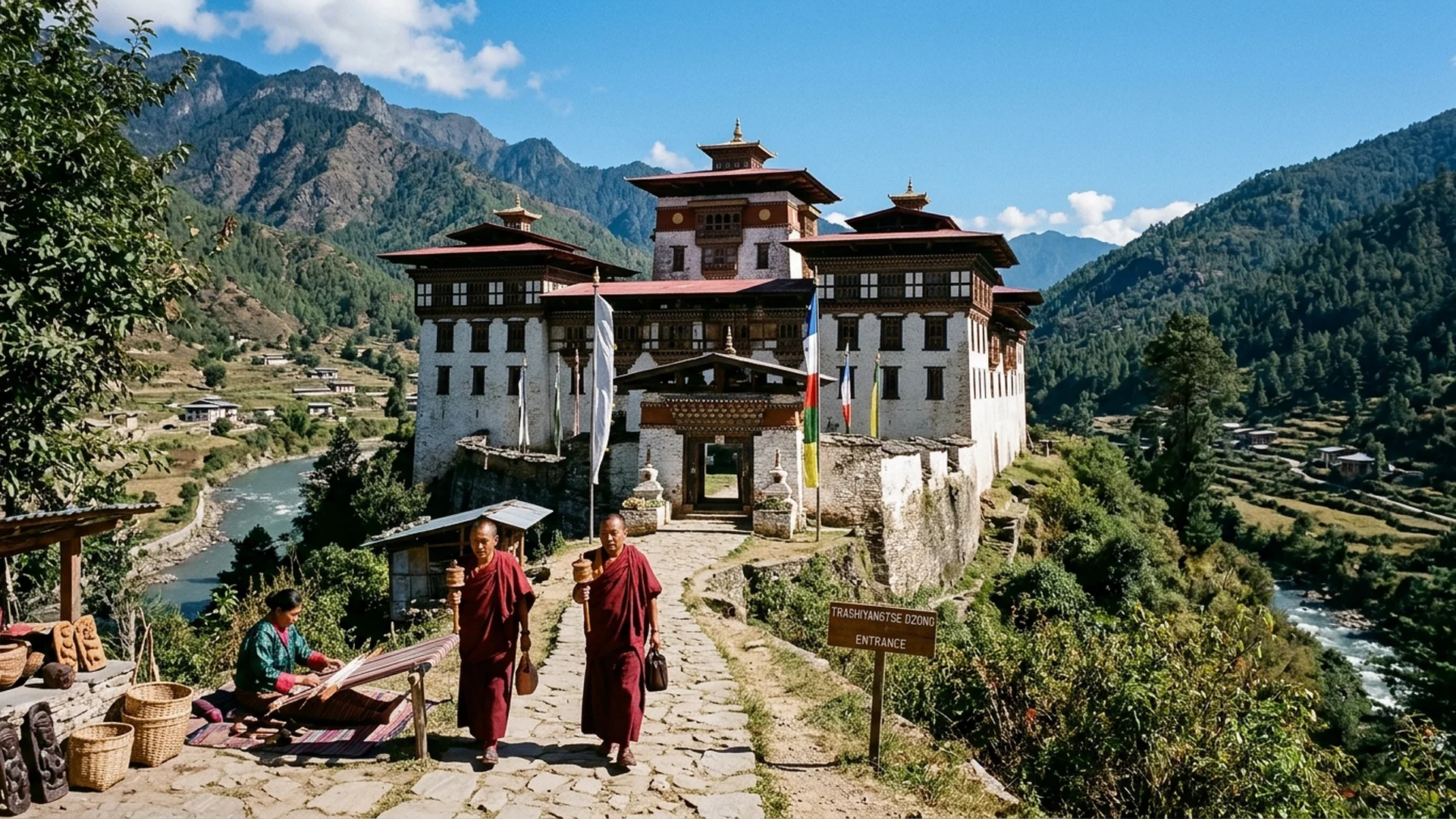
As the morning mist slowly lifts over the remote valleys of eastern Bhutan, low, resonant chants echo against thick rammed-earth walls and vibrant, hand-carved timber frameworks. Here stands Trashiyangtse Dzong, an ancient fortress sentinel keeping watch over the passage of time. To cross the threshold into this secluded region is to step away from well-trodden itineraries and enter a realm where profound silence, deep-rooted faith, and traditional craftsmanship remain entirely undisturbed.
Set against a rugged and dramatic Himalayan landscape, Trashiyangtse Dzong—traditionally known as the fortress of auspicious fortune—is much more than a seat of administration or a sacred sanctuary. It serves as a living chronicle connecting modern travelers to ancient spiritual legacies. From its ninth-century foundations to intricate woodcarvings rarely witnessed in the modern world, this eastern sanctuary embodies the soul of the Thunder Dragon Kingdom.
Roots of Faith: From Ancient Outpost to Fortress of Auspicious Fortune
The narrative of Trashiyangtse Dzong reaches back to the ninth century, an era when Vajrayana Buddhism was first taking root in the Himalayan valleys of Bhutan. Long before the current structures rose, the site sheltered an ancient outpost known as Dongdi Dzong. Centuries later, the revered tertön (spiritual treasure revealer) Pema Lingpa—an ancestor of the present royal dynasty—played a pivotal role in restoring the site and laying down its profound spiritual foundations. It was subsequently consecrated as Trashiyangtse, signifying a realm where abundance, fortune, and prosperity ripple across the surrounding valley.
Parallel Architecture: The Contemplative Old Dzong and the Living New Dzong
The architectural layout of Trashiyangtse features a unique duality, with two distinct eras of fortresses situated within proximity of one another. The Old Dzong, perched higher along the hillside, offers an atmosphere of profound stillness, ideal for deep contemplation and absorbing the quiet echoes of the past. Meanwhile, the New Dzong accommodates contemporary regional administration and ongoing monastic rites. Both sites exemplify classical Bhutanese construction, entirely crafted without the use of a single iron nail, featuring master woodwork adorned with traditional motifs of auspicious flora and fauna.
The Wonder of Chuchizhey and the Cradle of Mastercraft
Within the innermost sanctum of the dzong rests its most sacred treasure: an eleven-headed statue of Avalokiteshvara, locally revered as ‘Chuchizhey.’ The serene countenance and compassionate gaze of this deity evoke an immediate sense of inner peace. Beyond its spiritual walls, the Trashiyangtse valley is recognized as a vital pillar of Zorig Chusum (the thirteen traditional arts of Bhutan). It is particularly renowned for the creation of ‘Dapa,’ hand-turned wooden bowls carved from specialized burls by master craftspeople whose techniques have passed unbroken through generations, reflecting an intimate harmony with the surrounding forested mountains.