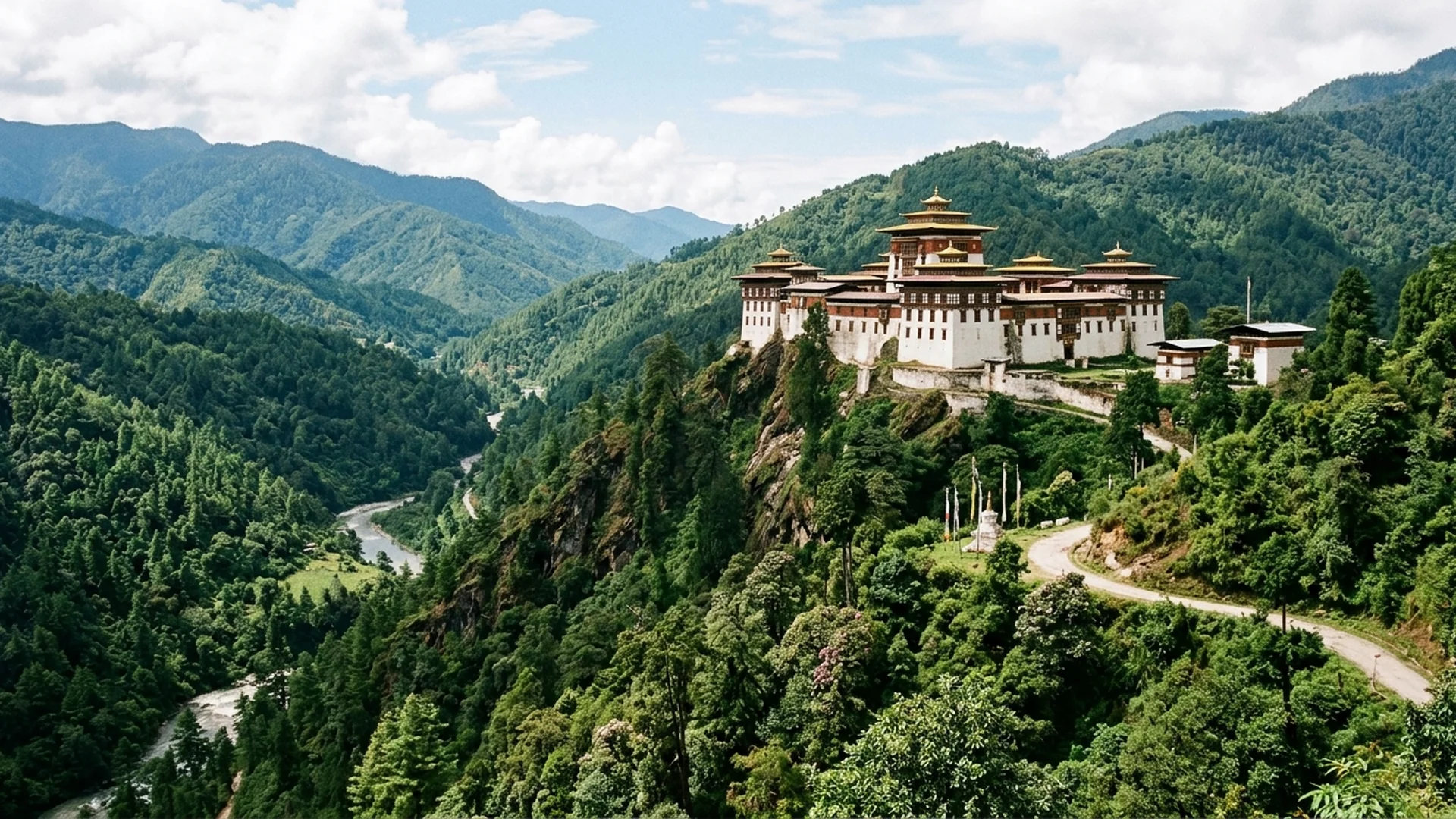
As the morning mist slowly lifts from the precipitous ridge high above the Mangde Chhu river valley, the stark white walls and deep crimson window frames of Zhemgang Dzong emerge like a heavenly palace suspended in the sky. This ancient fortress is far more than a historic monastic stronghold or former administrative hub; it is the beating spiritual heart of the Kheng region in eastern Bhutan, where the unbridled purity of nature and ancient traditions remain wonderfully intact. Journeying to Zhemgang Dzong is akin to stepping through a portal into another dimension of the Dragon Kingdom—one where the mountain winds whisper tales of ancient saints and the boundless wilderness below redefines the very meaning of profound, slow-paced exploration far beyond conventional tourist paths.
Roots of Faith: From Secluded Hermitage to Protector of the Realm
The narrative of Zhemgang Dzong unfurls in the twelfth century when the accomplished master Lama Zhang Dorje Drakpa of the Drukpa Kagyu lineage traversed these steep heights seeking utter solitude, establishing a modest meditation retreat upon this dramatic ridge. The profound stillness and sacred energy of the surrounding primeval forest transformed the site into a powerhouse of spiritual attainment. Later, in 1655, the fortress was substantially expanded and consolidated by Chogyal Minjur Tenpa, the formidable governor serving under the visionary unifier of the nation, Shabdrung Ngawang Namgyal. Commissioned to unite the eastern territories under central governance, it was christened Khenrig Namsung, signifying the alliance of the three ancestral Kheng clans. The dzong was masterfully engineered to contour the unforgiving cliffside topography, simultaneously securing strategic military defense while operating as an architectural bridge connecting the mortal realm with celestial Buddhist sanctuaries.
Architecture and Spirituality in the Kheng Valley
The structural design of Zhemgang Dzong exemplifies the ingenious engineering and aesthetic mastery of Bhutan’s traditional master builders. Perched precariously on a razor-thin ridge cascading down toward the rushing waters of the Mangde Chhu, the complex features thick stone and rammed-earth walls juxtaposed with pine timberwork, whitewashed plaster, and signature ochre-red bands denoting sacred structures. Within its hallowed interior lie six sacred lhakhangs (temples), housing venerated statues of ancient deities, enlightened masters, and exquisite wall murals depicting foundational Buddhist narratives and regional legends. A delicate fragrance of herbal incense and yak-butter lamps burning upon sacred altars permeates the air, cultivating an atmosphere of deep introspection. This quiet serenity is occasionally punctuated only by the low, resonant chanting of resident monks echoing softly through timeworn wooden corridors.
Gateway to a Living Heritage Forest: A Biodiversity Haven
Beyond its profound historical significance, Zhemgang is intimately linked to the Royal Manas National Park and one of the most ecologically rich biological corridors in the Eastern Himalayas. The virgin forests enveloping the fortress teem with rare flora and elusive fauna, earning the surrounding terrain global acclaim as a premier destination for bird watching. Home to over five hundred recorded avian species, including the striking Rufous-necked Hornbill, vibrant barbets, and myriad sunbirds, the region is a naturalists’ sanctuary. Standing upon the open verandas of Zhemgang Dzong and gazing out across an uninterrupted ocean of emerald-green canopy offers a visceral encounter with untouched nature entirely distinct from Bhutan’s more frequently visited western valleys.