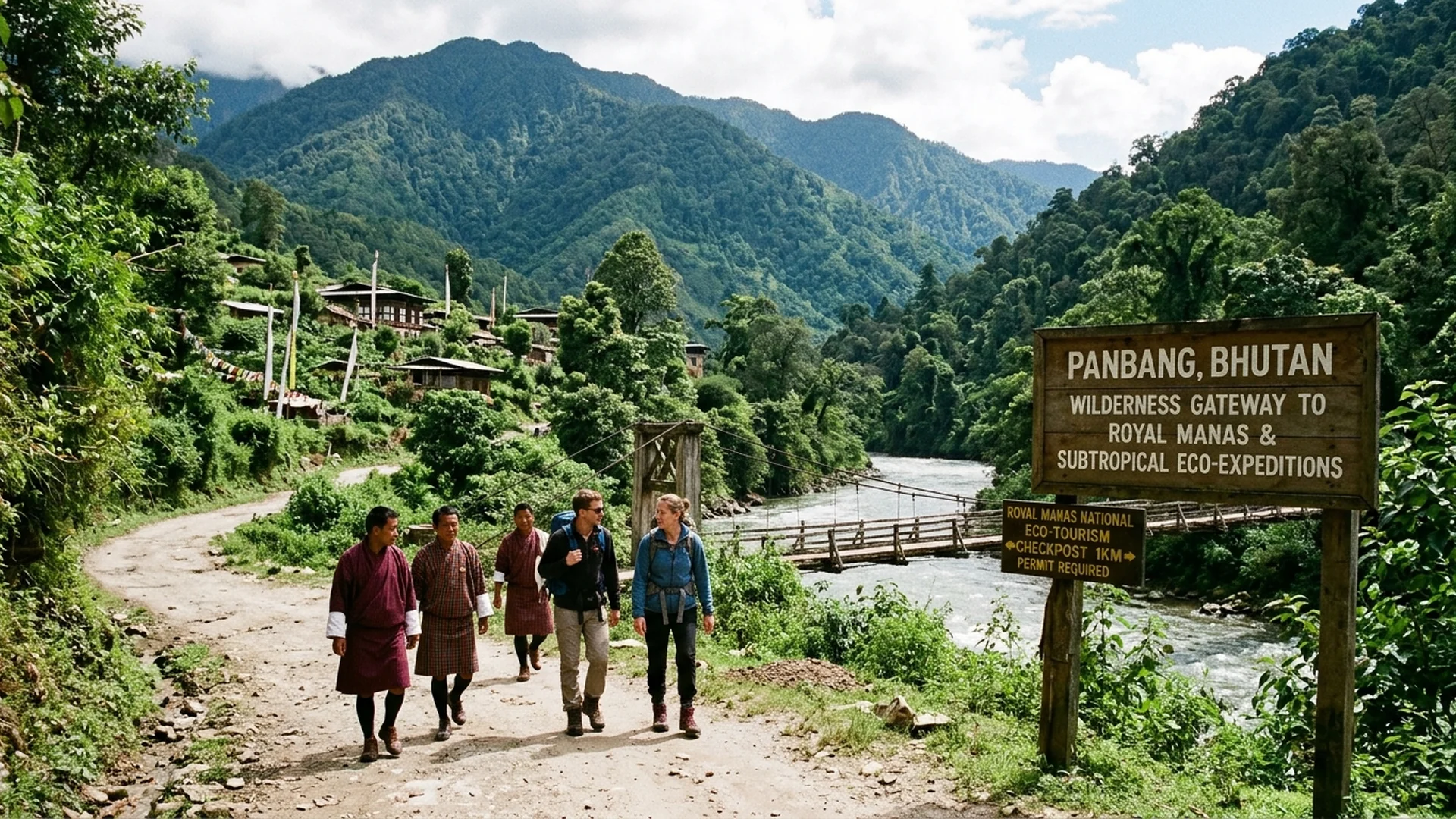
When conjuring the image of Bhutan, the mind instinctively drifts toward snow-draped Himalayan crests, ancient fortress-monasteries clinging precipitously to sheer granite cliffs, and prayer flags fluttering in brittle mountain winds. Yet, if one descends southward into the undulating subtropical folds of Zhemgang, a different Bhutan unfurls—one whispered by the rush of mighty rivers and the low, resonant calls of an untamed wilderness. Panbang lingers here at the country’s southern threshold, a hidden emerald jewel untouched by the rapid footfalls of standard tourism.
This is not a traditional pilgrimage route, but rather a frontier of high-end ecological adventure that completely reframes the Gross National Happiness realm. Panbang invites the discerning traveler, weary of conventional itineraries, to step into one of the world’s most biologically intact subtropical rainforest ecosystems. Here, the deep breath of the primeval forest harmonizes with the living heritage of the ancient Khengpa people, birthing a journey unlike any other on earth.
Gateway to Royal Manas National Park: The Green Heart of the Southern Himalayas
Royal Manas National Park, for which Panbang acts as the grand antechamber, is Bhutan’s oldest national park and celebrated as one of Asia’s most biologically diverse sanctuaries. This unbroken sweep of pristine jungle contiguous with India’s Manas National Park allows endangered wildlife to roam freely across a vast transnational ecosystem.
The atmosphere within Panbang is saturated with the rich, fertile scent of damp earth and river mist, offering a sensory world worlds apart from the alpine north. Before the traveler’s eyes lies an ocean of emerald canopy, where towering old-growth trees draped in vibrant mosses and delicate forest ferns speak to an undisturbed ecological equilibrium. Here, the profound silence is punctuated only by the resonant wings of the Rufous-necked Hornbill soaring across sapphire skies and the rustling canopy above, where troops of Golden Langurs—rare primates boasting shimmering golden pelts against deep green leaves—reign as the unmistakable sovereigns of the forest.
The Celestial Rivers: Mangde Chhu Rafting and the Legend of the Golden Mahseer
The lifeblood coursing through Panbang is its formidable river system, where the rushing waters of the Mangde Chhu and Drangme Chhu converge to form the majestic Manas River. These powerful waterways are not merely geographical features; they are the ancient veins that sustain all living things in the valley. Navigating these currents via traditional river craft or bamboo raft unveils a perspective of Bhutan’s wilderness that is both exhilarating and deeply humbling.
Flanking the riverbanks are sheer precipices and dense tangles of foliage where fortunate travelers might occasionally glimpse wild elephants, Bengal tigers, or sambar deer coming down to drink. Furthermore, for the conservation-minded angler, Panbang represents a legendary destination in the pursuit of the elusive Golden Mahseer—the golden river trout of the Himalayas—managed under strict catch-and-release protocols to safeguard the fragile aquatic balance of these pristine watersheds.
The Khengpa Legacy: Spirit and Wisdom of an Ancient Indigenous Tribe
Beneath the ecological splendor lies a rich cultural dimension: Panbang is the ancestral domain of the Khengpa, the indigenous people of Zhemgang whose lives have remained interwoven with the forest for centuries. A pilgrimage to communities such as Bjoka offers a deeply enriching cross-cultural encounter, as this remote village serves as the heartbeat of ancient hand-coiled pottery—a living heritage passed down through generations without the aid of a potter’s wheel.
The ethos of the Khengpa people is vividly expressed through intricate bamboo weaving, sustainable agroforestry, and time-honored customs. Welcoming travelers with warm hospitality, steaming cups of local butter tea, and captivating folklore surrounding mountain deities and forest spirits, they impart a profound realization: true contentment in Bhutan is not measured by material accumulation, but by living in reverent harmony with the natural world.