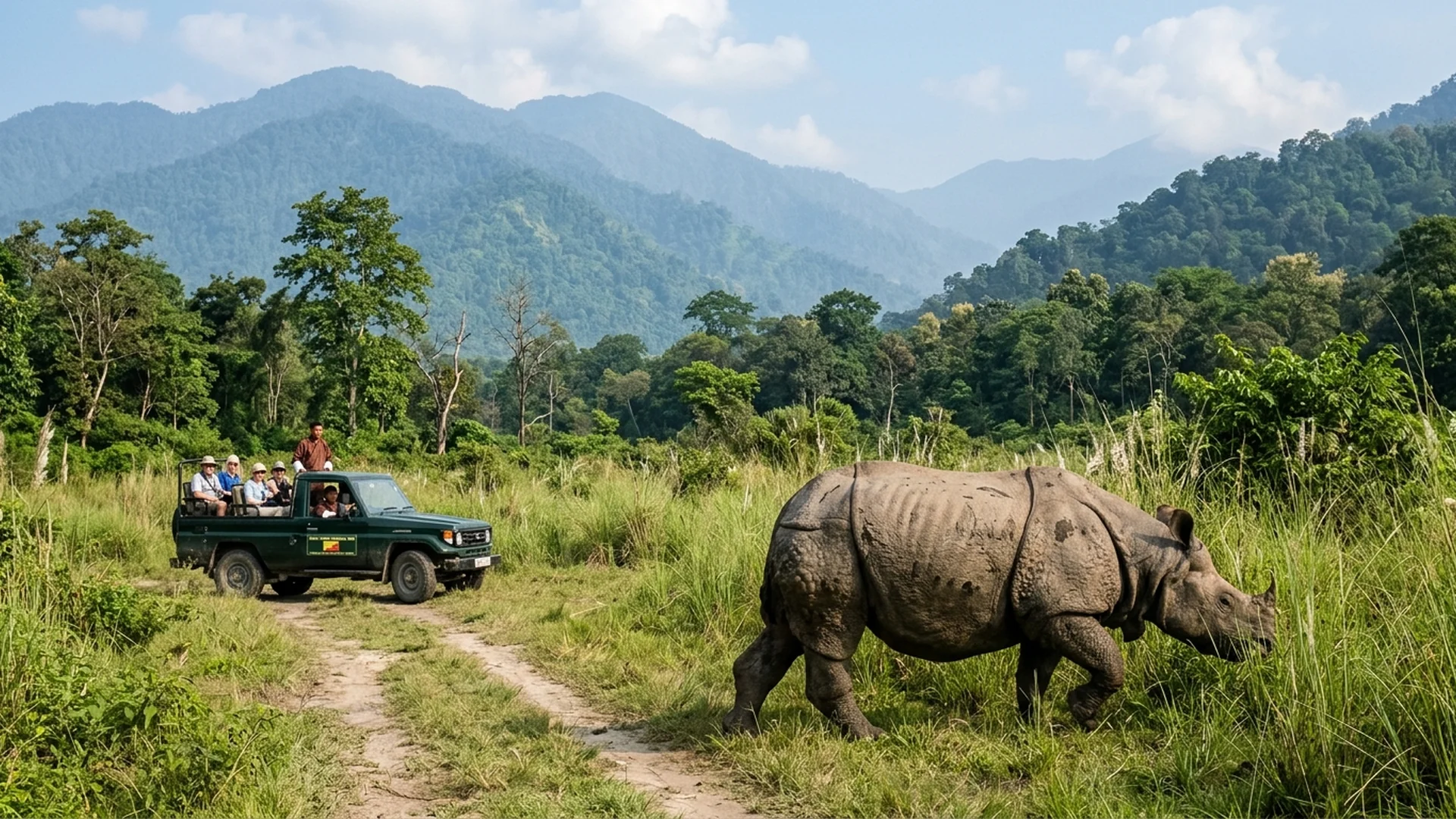
When the Kingdom of Bhutan is invoked, the mind invariably conjures pristine snow-capped summits, the contemplative serenity of cliffside monasteries, and monumental dzong architecture. Yet far to the south, where sweeping subtropical rainforests blanket the rolling foothills of the Himalayas, an entirely different realm hides in plain sight—a sanctuary resounding with the territorial calls of Bengal tigers, the rhythmic wingbeats of giant hornbills, and an emerald exuberance often celebrated as the ‘Serengeti of Bhutan.’
Royal Manas National Park is not merely the country’s oldest protected reserve; it forms the beating ecological heart of the Manas river basin, seamlessly contiguous with India’s Manas National Park to create a UNESCO World Heritage expanse. To journey here is to step beyond conventional alpine itineraries and cross into a pristine biological frontier where the rhythms of the natural world remain entirely untouched by the frantic pace of modern modernity.
A Frontier of Diverse Ecosystems: The Green Heart of the Southern Himalayas
Spanning the southern expanse of Bhutan, Royal Manas presents a topography radically distinct from the dramatic alpine heights of the north. Here, dense semi-tropical rainforests, sweeping deciduous woodlands, and sprawling lowland grasslands are nourished by the roaring, glacier-fed currents of the Manas River—a principal tributary of the Brahmaputra. This steep gradient in elevation creates a remarkably intricate and fertile ecosystem, serving as a sanctuary for hundreds of flora and fauna species found nowhere else within the kingdom.
An Autonomous Realm of Golden Langurs and Apex Predators
The crowning allure of Royal Manas lies in its thriving populations of elusive wildlife, most notably the golden langur, a rare primate adorned in luminous, shimmering fur that serves as the emblem of these ancient forests. The park is also a vital stronghold for Bengal tigers, Asian elephants, wild water buffalo, and gaurs. Explorers frequently encounter leopards and dholes along the forest trails, while the canopy above comes alive with multiple hornbill species, forest kingfishers, and over 365 cataloged bird species, rendering the park an extraordinary haven for ornithologists.
The Aesthetics of Exploration: Safaris by Land and River
Engaging with the majesty of Royal Manas offers a refined duality: the pulse-quickening thrill of discovery paired with the profound stillness of high-end wilderness immersion. Early morning jeep safaris threading through veils of river mist or silent bamboo raft excursions drifting along the glassy curves of the Manas River invite discerning travelers to observe riparian wildlife without disturbing the delicate ecological balance. Evening gatherings at secluded eco-lodges, surrounded by the symphony of the nocturnal forest, define the ultimate expression of travel that reconnects the human spirit with the wild earth.