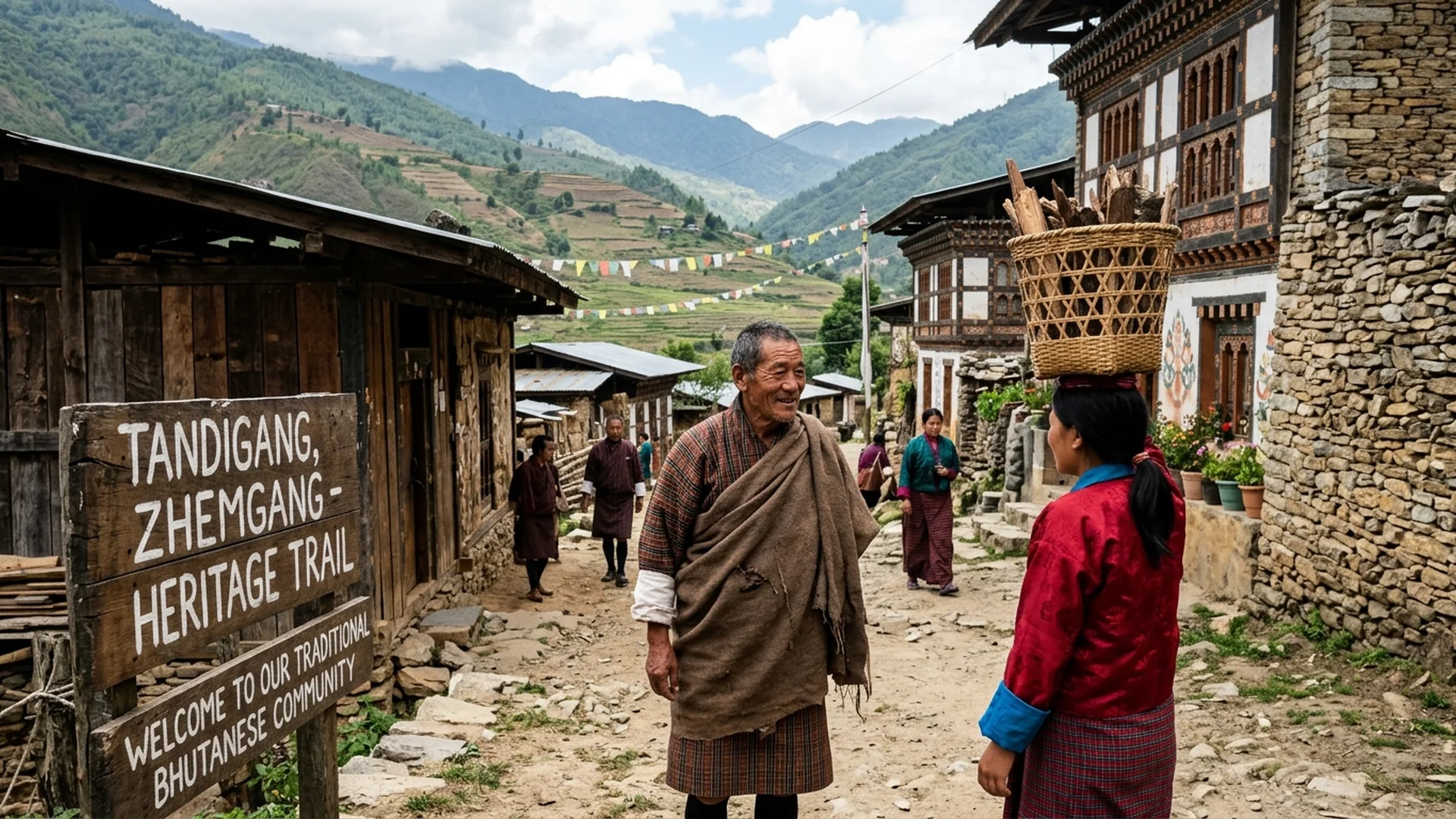
Stepping across the mist-shrouded mountain passes that weave through the luxuriant, subtropical rainforests of south-central Bhutan, one encounters a thick fog that seems determined to guard the ancient secrets of the valley. This is Tandigang, a reclusive heritage village nestled within the Zhemgang district—a realm where time unfurls at a gentler cadence, inviting the soul to commune with a profound stillness impossible to find in the hurried modern world.
Amidst a shifting global tourism landscape, the Kingdom of Bhutan steadfastly preserves its immaculate natural and cultural integrity through its guiding philosophy of Gross National Happiness (GNH). For Tandigang, this philosophy manifests not merely as a map coordinate, but as the beating heart of an ancestral heritage passed down through ancient forests, pristine rivers, and the warm, welcoming smiles of the Kheng people. Descended from the original guardians of these deep woods, arriving in this secluded sanctuary is akin to turning the page of a living history book, where every footfall honors a sustainable, symbiotic relationship with the earth.
The Heart of Zhemgang: Sacred Lands of the Kheng and Untamed Biodiversity
Zhemgang is frequently celebrated as Bhutan’s uncut jewel, and Tandigang serves as the luminous core of that raw, unadorned beauty. This region falls under the profound cultural and ancestral influence of the Kheng people, an indigenous community possessing a distinct dialect, unique customs, and social traditions quite distinct from those of western Bhutan. The Kheng are renowned for their intimate kinship with the forest, serving as traditional custodians of herbal pharmacopeia, sustainable foraging practices, and agrarian rhythms that honor natural cycles.
The topography of Tandigang is characterized by a warm, subtropical and humid climate—a striking contrast to the snowy, alpine heights commonly associated with Bhutan. Here, the landscape thrives with dense flora, rare avian species, and dense woodlands that shelter endangered wildlife. Strolling along the natural pathways of Tandigang unfolds like paging through an expansive natural history text, where the wind whispering through high canopy leaves and the gentle murmur of rushing streams compose a grand symphony for the contemplative traveler.
Architecture and Daily Life: The Art of Simple, Graceful Living
Traditional dwellings in Tandigang embody vernacular ingenuity, demonstrating how architecture adapts seamlessly to the environment. Low-stilted timber structures and rammed-earth homes blended with local wood are engineered precisely to withstand warmth and heavy seasonal rains. Within the village, daily life proceeds with unhurried simplicity yet profound refinement. Local artisans continue to preserve the intricate art of indigenous backstrap loom weaving, creating geometric patterns unique to the Kheng identity—a painstaking craft requiring months of labor to imbue each textile with cultural meaning and spiritual intention.
The true brilliance of this enclave lies within its art of hospitality. Bhutanese families in Tandigang welcome guests with unfeigned warmth. Sharing a communal bowl of steaming butter tea (suja) or tasting organic farm-to-table delicacies harvested moments earlier from adjacent homesteads dissolves cultural barriers, melting them into a profound realization of shared humanity.
Philosophy of Sustainability: Where Eco-Tourism Meets Genuine Well-Being
In an era characterized by relentless acceleration, Tandigang stands as a timeless reminder of the vital necessity of balance. Bhutan adheres strictly to its tourism policy of ‘High Value, Low Impact,’ and Tandigang represents this ethos realized in its purest form. Traveling here is never about consuming a destination; rather, it is about participating with humility and learning with reverence.
By safeguarding its forests, arts, and ancestral traditions without commercial artificiality, Tandigang maintains an unblemished authenticity. Travelers who choose to walk softly upon these paths discover that sustainable fulfillment arises not from limitless material luxury, but from living simply within the breath of nature and among people of luminous integrity.