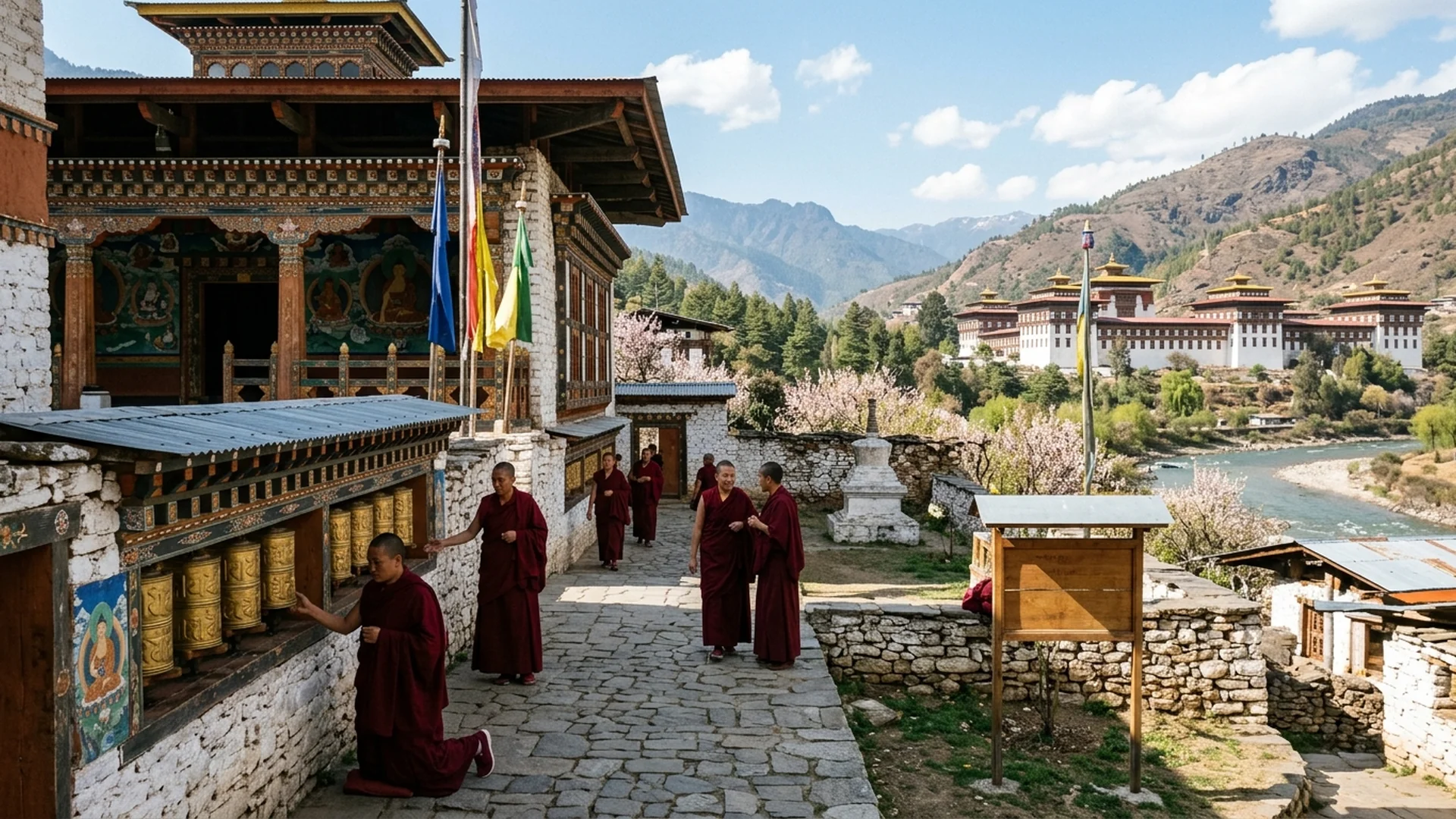
As the restless hum of the modern world gradually fades along the winding hillside tracks rising above the capital of Thimphu, travelers are met with an extraordinary stillness at Zilukha Nunnery, more formally known as Thangtong Dewachen Nunnery. This sacred enclave is far more than a conventional religious landmark; it is a hidden sanctuary quietly anchored by the devotional rhythm and contemplative discipline of more than seventy resident nuns.
Crossing the threshold of this tranquil terrace invites a departure from conventional tourism, inviting the discerning heart to experience the profound depth of female spiritual empowerment. Against a backdrop of traditional Bhutanese architecture fragrant with juniper incense and softened by the gentle resonance of evening prayers, Zilukha offers an unmatched aesthetic reward: an expansive, unobstructed panorama framing the regal expanse of Tashichho Dzong and the emerald depths of the valley below.
Roots of Faith: The Legacy of the Iron-Chain Bridge Master
Founded in 1976 by Drubthob Rikey Jadrel—revered as the 16th incarnation of Thangtong Gyalpo (1361–1385), the legendary polymath and engineer who spanned Himalayan gorges with iron-chain suspension bridges—Zilukha Nunnery represents a monumental dedication to spiritual architecture. The master’s vision extended far beyond physical infrastructure into the cultivation of steadfast inner domains.
The hilltop placement above Thimphu mirrors the ancient Himalayan philosophy of purposeful retreat from worldly noise into meditative clarity. Within the sanctuary, sacred images of Thangtong Gyalpo and intricate iconography honor the unbroken lineage of Tibetan Buddhism. Every square meter of the monastery radiates the patience, endurance, and quiet equilibrium accumulated over half a century.
Female Empowerment: Behind the Serene Smiles of Bhutanese Nuns
Historically, advanced philosophical scholarship within Himalayan monasteries was primarily accessible to male monastics. Zilukha Nunnery stands as a vital milestone in contemporary Bhutanese society, carving out an esteemed sanctuary where women engage deeply with classical sacred texts, advanced meditation, and the intricate arts of ritual performance.
The daily routine for the resident nuns begins at dawn with communal chanting and meditation, balanced thoughtfully with the meticulous maintenance of the sanctuary grounds. For the cultural traveler, the nuns’ progressive outlook is deeply inspiring; alongside traditional studies, the curriculum embraces modern subjects such as English, administration, and critical philosophy, equipping the community to bridge ancient wisdom with the demands of the modern world.
Panoramic Terraces: Where the Splendor of Tashichho Dzong Meets the Thimphu Sky
Beyond its profound spiritual weight, Zilukha is celebrated by photographers and travelers as one of the finest vantage points in the Thimphu Valley. From the open stone courtyard outside the main sanctuary, the gaze sweeps down across the majestic, tiered courtyards of Tashichho Dzong—the formidable fortress housing the nation’s administrative and monastic headquarters.
In the late afternoon, when slanted golden light catches the copper-gilt roofs and whitewashed fortress walls against a shifting backdrop of deep green ridges, the scene transforms into a living masterwork. The quietude of the courtyard, punctuated only by mountain breezes and the rhythmic rustle of prayer flags, elevates this fleeting moment into an unforgettable aesthetic encounter.