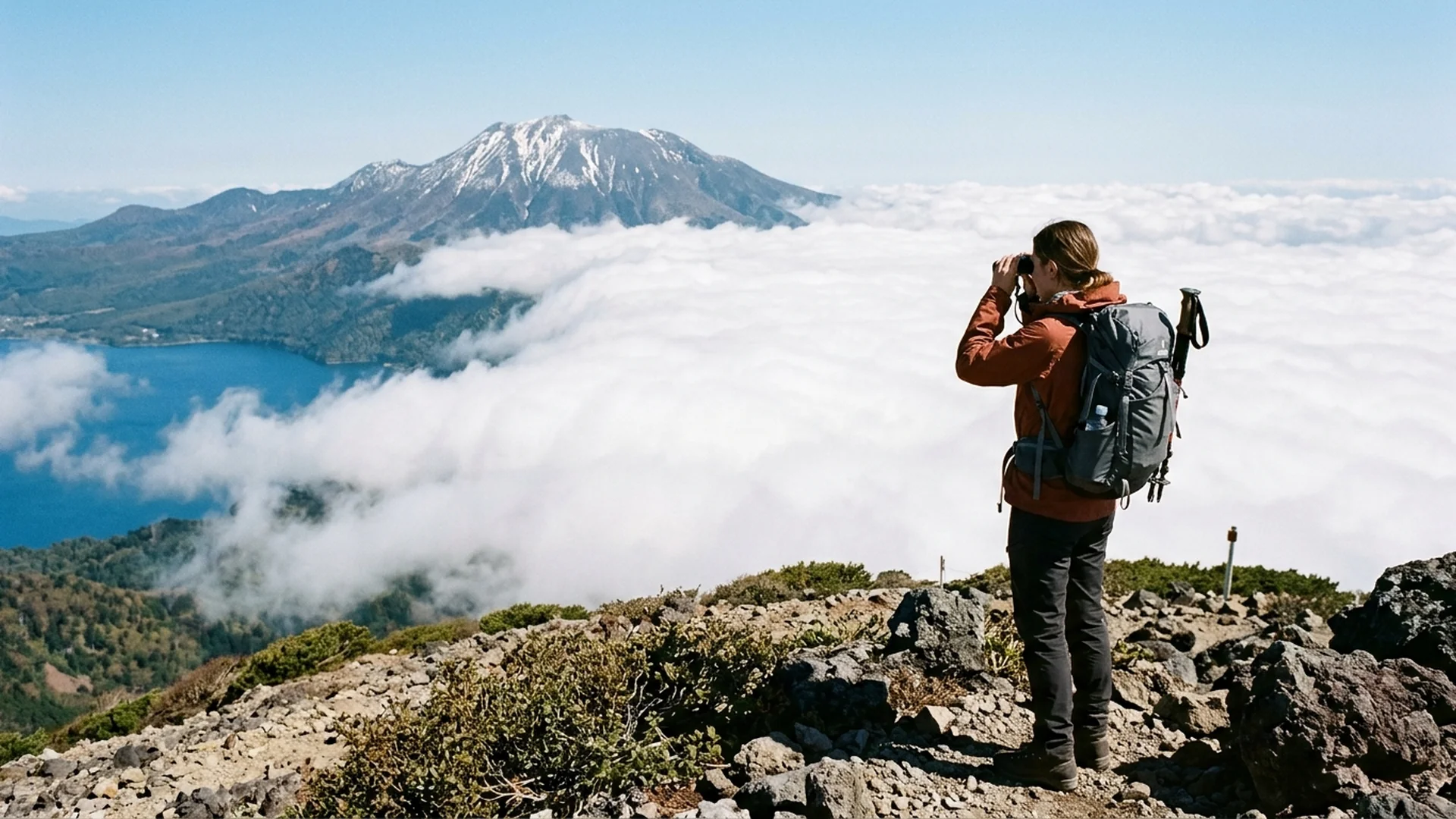
As the morning mists gently recede, revealing the sweeping horizons of Akita Prefecture, Mount Komagatake emerges like an ethereal island suspended above a sea of clouds. Standing proudly at approximately 1,637 meters above sea level, this venerable peak commands the landscape, beckoning discerning travelers in search of quietude and the unadorned, yet exquisitely detailed, beauty of the northern wilderness.
Journeying to this summit transcends mere physical ascent; it is an unhurried passage through time and a fragile yet resilient ecosystem. From dense subterranean forests, the trail scales upward into expansive alpine clearings and ancient volcanic calderas. During the warmer months, these plateaus transform into a tapestry of vivid wildflowers—earning the region its reputation as an Eden of the Rising Sun—while far below, the cobalt-blue waters of Lake Tazawa shimmer like polished lapis lazuli. The resulting composition is a masterclass in natural artistry, where earth, sky, and water converge in silent harmony.
An Eden Above the Clouds: The Alpine Flora and Calderas of Komagatake
Mount Komagatake comprises several distinct subsidiary peaks, with Omodake reigning as its highest point. The geographical character here is entirely singular, shaped by centuries of volcanic activity. The moment one steps beyond the timberline and onto the high plateau, an expansive, unobstructed vista opens before the eyes. In high summer, the dark volcanic soil becomes an exquisite canvas painted with delicate alpine flora—most notably the Komakusa, poetically revered as the ‘Queen of Alpine Plants’ for its soft mauve-pink blossoms, alongside resilient mountain heather thriving against brisk mountain gales.
This elevated tableland is affectionately dubbed ‘Moomin Valley’ by locals and seasoned wanderers alike, owing to its gentle rolling meadows and the crystal-clear streams meandering through the grasses, conjuring the gentle atmosphere of a Scandinavian storybook. Here, the profound silence—interrupted only by the whispering alpine winds—offers a rare sanctuary for spiritual contemplation, far removed from the clamor of the contemporary world.
The Akita Panorama: Where Lake Tazawa Meets the Horizon
No pilgrimage to Komagatake is complete without lingering at the primary overlooks to absorb the breathtaking descent toward Lake Tazawa. Plunging to a staggering depth of 423 meters, Japan’s deepest lake possesses a cobalt intensity reminiscent of a precious gem cradled within the rugged contours of the valley floor. From the lofty vantage point of the summit ridge, the graceful curve of the shoreline creates a dramatic contrast against the layered ridges of the Shirakami mountains.
On crisp, clear days, sunlight dances upon the deep waters, mirroring low-slung drifting clouds that feel astonishingly close to touch. This all-encompassing 360-degree panorama serves as both a breathtaking visual reward for every upward step and a profound reminder of the majestic scale of northern Honshu’s wilderness.
A Heritage of Rest: The Timeless Embrace of Nyuto Onsen
The Komagatake expedition finds its ultimate expression at the mountain’s forested base, where the legendary enclave of Nyuto Onsen-kyo hides amidst ancient primeval beech woods. Historic ryokans here, such as the storied Tsurunoyu, have faithfully preserved their rustic Edo-period architecture and unhurried hospitality through the centuries.
To submerge oneself within the mineral-rich, milky-white waters of these woodland hot springs—surrounded by curling mists and the gentle rustle of leaves after a day upon the alpine ridges—is to experience restorative wellness at its absolute zenith. It represents the quintessential Japanese aesthetic: an effortless synthesis of rustic simplicity and refined devotion to nature.