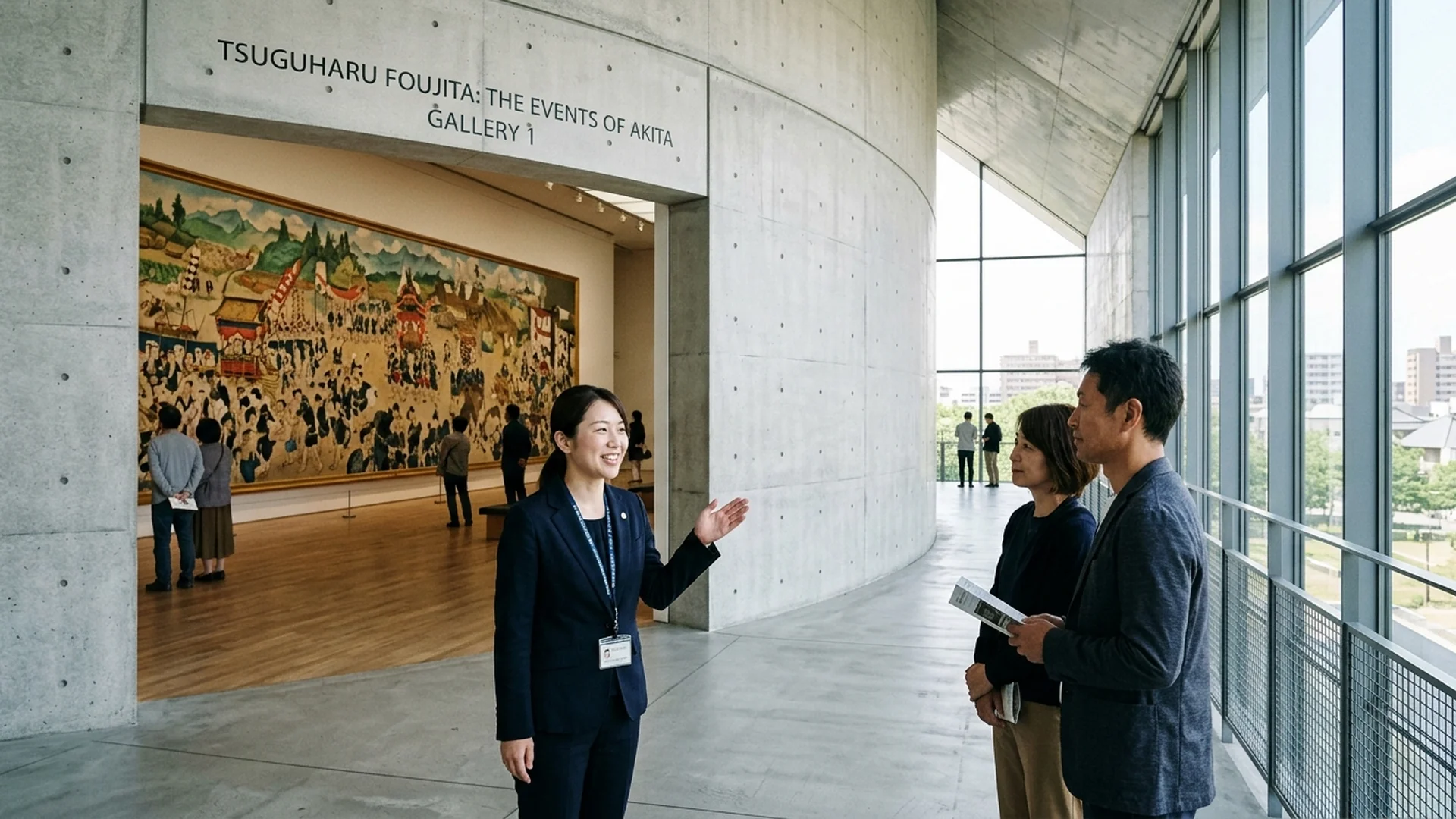
When the sharp, unyielding lines of architectural concrete meet a monumental canvas capturing the spirit of the Tohoku watersheds, the space transcends mere exhibition. It becomes an architectural laboratory of light and shadow, inviting the traveler to recalibrate the very rhythm of their journey. Standing majestically by the old moat of Senshu Park in Akita Prefecture, the Akita Museum of Art bridges ancient regional heritage with contemporary global aesthetic sensibilities.
Conceived by Pritzker Prize-winning architect Tadao Ando, the building transforms raw matter into profound spatial emptiness amidst the serene northern landscape. Approaching the museum feels akin to architectural meditation. From the first step through the light-controlled threshold, the external world’s clamor is filtered into the gentle whisper of wind and water, while the interior unfolds as a masterclass in hidden beauty waiting to be absorbed by a discerning eye.
A Dialogue Between Concrete and Light: The Architecture of Tadao Ando
Tadao Ando is internationally revered for his mastery of architectural concrete, reflecting Zen philosophy, uncompromising minimalism, and the intrinsic truth of materials. For the Akita Museum of Art, Ando conceived a three-story structure that plays deliberately with triangular and rectangular geometries. At the heart of this design lies the Water Patio—a reflecting pool positioned at the front of the building that acts as an immense mirror, drawing the changing skies and greenery of Senshu Park directly into the interior. As the sun traverses the sky, the elongated shadows of concrete beams and columns shift throughout the day, cultivating a profound aesthetic of stillness far removed from the turbulence of the modern world.
The Floating Spiral Staircase: Gravity Defied Through Structural Poetry
If architecture is the body, the free-standing spiral staircase within the museum is its beating heart of elegance. Ando designed this helical ascent without central columns or lower structural support, rendering the transition to the second floor an experience of airborne weightlessness. This sweeping curve offers visitors shifting perspectives of the interior volume with every step. Ascending this architectural sculpture serves as a physical ritual, slowing the breath and quieting the mind in preparation for the masterpieces waiting above.
The Epic of Akita: Tsuguharu Foujita’s 20.5-Meter Mural
The crown jewel of the collection is housed within a dedicated gallery showcasing the work of Tsuguharu Foujita (Léonard Foujita), the legendary Japanese-born painter who conquered the avant-garde circles of Montparnasse in 1930s Paris. Created in 1937, his monumental mural ‘Events of Akita’ (行事の秋田)—measuring over 20.5 meters long and 3.65 meters high—celebrates the seasonal rhythms, deep-rooted traditions, and intimate relationship with nature held by the people of Akita. Featuring his signature milky-white skin tones and an exquisite synthesis of Western fine art technique and Eastern lyricism, the mural pulses with vibrant life, making history feel as though it is unfolding in real time before the viewer.