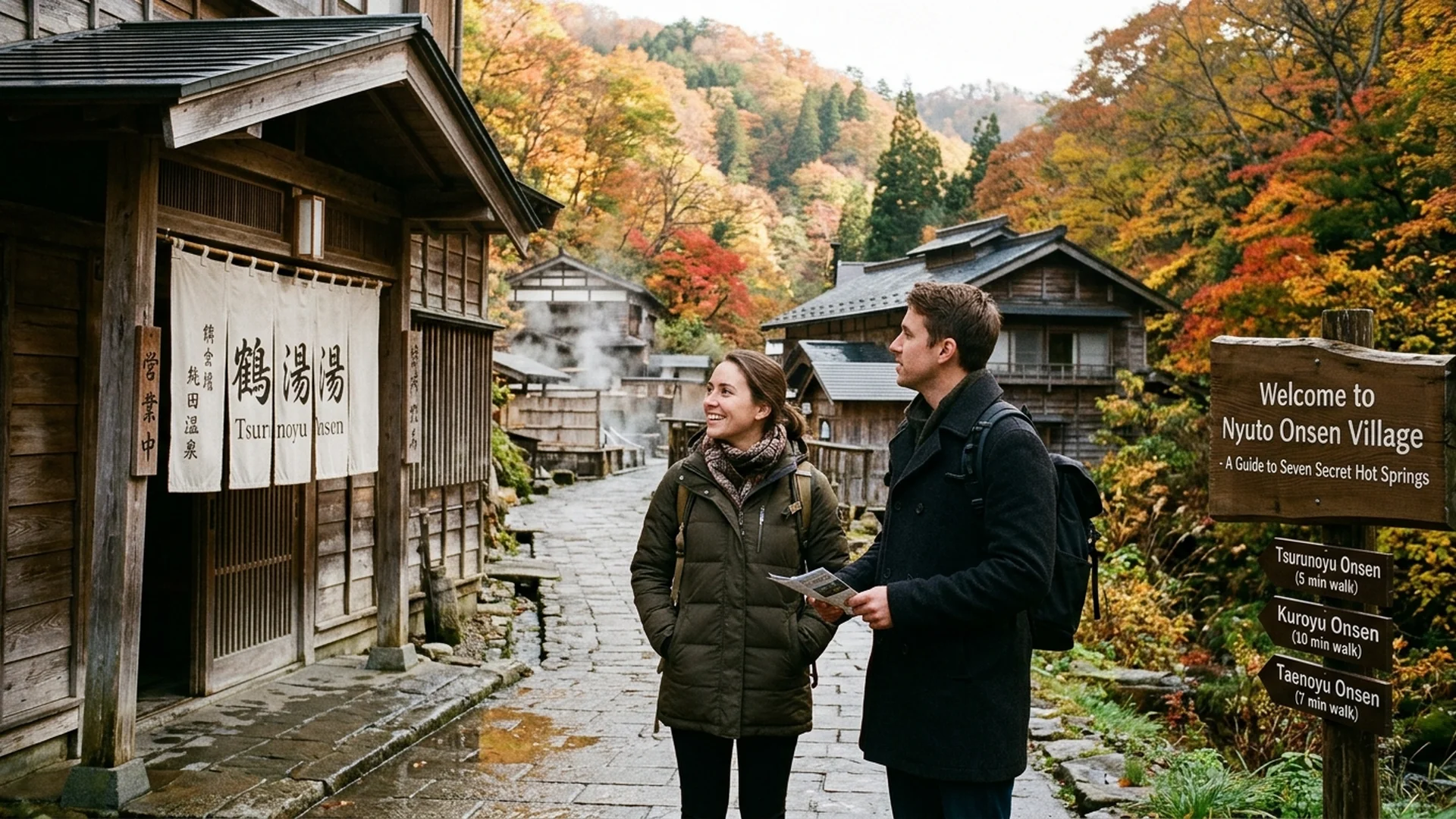
As delicate wisps of mist linger among ancient primeval forests of Mount Nyuto, the gentle murmur of mountain streams and plumes of pure thermal steam signal a transcendent journey through time. Tucked away in the snow-kissed northern reaches of Akita Prefecture, Nyuto Onsen Village rests in quiet seclusion within the embrace of Towada-Hachimantai National Park. This sanctuary is far more than a mere retreat for tired muscles; it functions as a living archive of traditional Japanese thermal culture, where centuries-old ryokans welcome seekers of serenity with authentic, unadulterated hospitality.
Crossing into Nyuto Onsen is akin to slipping past the boundaries of the modern world into an unhurried realm of pure sensory appreciation. The rich scent of weathered cedar, the drifting woodsmoke of hearths known as irori, and the vast expanses of beech forests shifting color with the turning seasons combine to create an idyllic dreamscape for discerning travelers who revere understated yet profound elegance. The true luxury of this hidden valley lies not in streamlined modernity, but in its raw, elemental beauty and the miraculous mineral springs welling up from the heart of the volcanic earth—each possessing its own distinct character and therapeutic hue.
Legacy of the Ages: The Legend of Seven Ryokan and Edo-Period Charm
The beating heart of Nyuto Onsen’s legendary allure is its collection of seven independent ryokans: Tsurunoyu, Taenoyu, Ganbaizaemon, Kuroyu, Ogama, Magoroku, and Kyukamura Nyuto-Onsenkyo. Each establishment carries a deep lineage and exclusive stewardship over distinct thermal water sources.
Tsurunoyu Onsen remains the most venerable jewel of the valley, welcoming travelers since the Edo period when it served as a private sanctuary for the Satake samurai lords of the Kubota domain. The stark black timber buildings known as the Honjin quarters and the milky-white thermal waters veiled by lush foliage create an unforgettable tableau of timeless elegance. Meanwhile, Taenoyu weaves refined contemporary touches into traditional aesthetics, offering riverside rotenburo baths accompanied by the soothing music of cascading waterfalls. Deeper in the valley, Kuroyu Onsen—open exclusively from spring through autumn—delivers a raw, powerful encounter with subterranean steam and untamed wilderness.
The Science of Mineral Waters: Chemical Secrets and Therapeutic Virtues
The enchantment of Nyuto Onsen extends far beyond its picturesque surroundings, drawing its true power from the subterranean depths. The valley’s thermal waters display remarkable chemical diversity; despite the short distances between inns, their mineral compositions vary profoundly. Certain springs feature acidic, sulfurous waters renowned for detoxification and softening the skin to silk-like perfection, while others blend iron and sodium carbonate, prized for soothing joint aches and relieving deep physical fatigue.
Lowering oneself into an open-air rotenburo while crisp winter air brushes the water’s surface offers an incomparable sensory contrast. The interplay between the scalding embrace of mineral water and the invigorating chill of pristine mountain air stimulates circulation and guides the consciousness into profound stillness.
The Art of Slow Travel: The Yumeguri Pass and Contemplative Living
For overnight guests within the valley, the Yumeguri Pass serves as a master key for exploring thermal baths beyond one’s lodging. This pass not only grants convenient access to the dedicated Yumeguri-go shuttle circulating among the seven ryokans, but also gently invites travelers to explore quiet forest footpaths, breathing in the pure mountain air with every deliberate step.
Evening inside a traditional ryokan defines contemplative luxury. The amber glow of paper lanterns reflecting upon pristine snow or emerald canopies, the subtle fragrance of woven tatami mats, and multi-course kaiseki dining—or rustic Sansai Ryori featuring wild mountain vegetables grilled alongside Akita beef over hoba leaves—seamlessly merge landscape and culture into a singular, harmonious masterpiece.