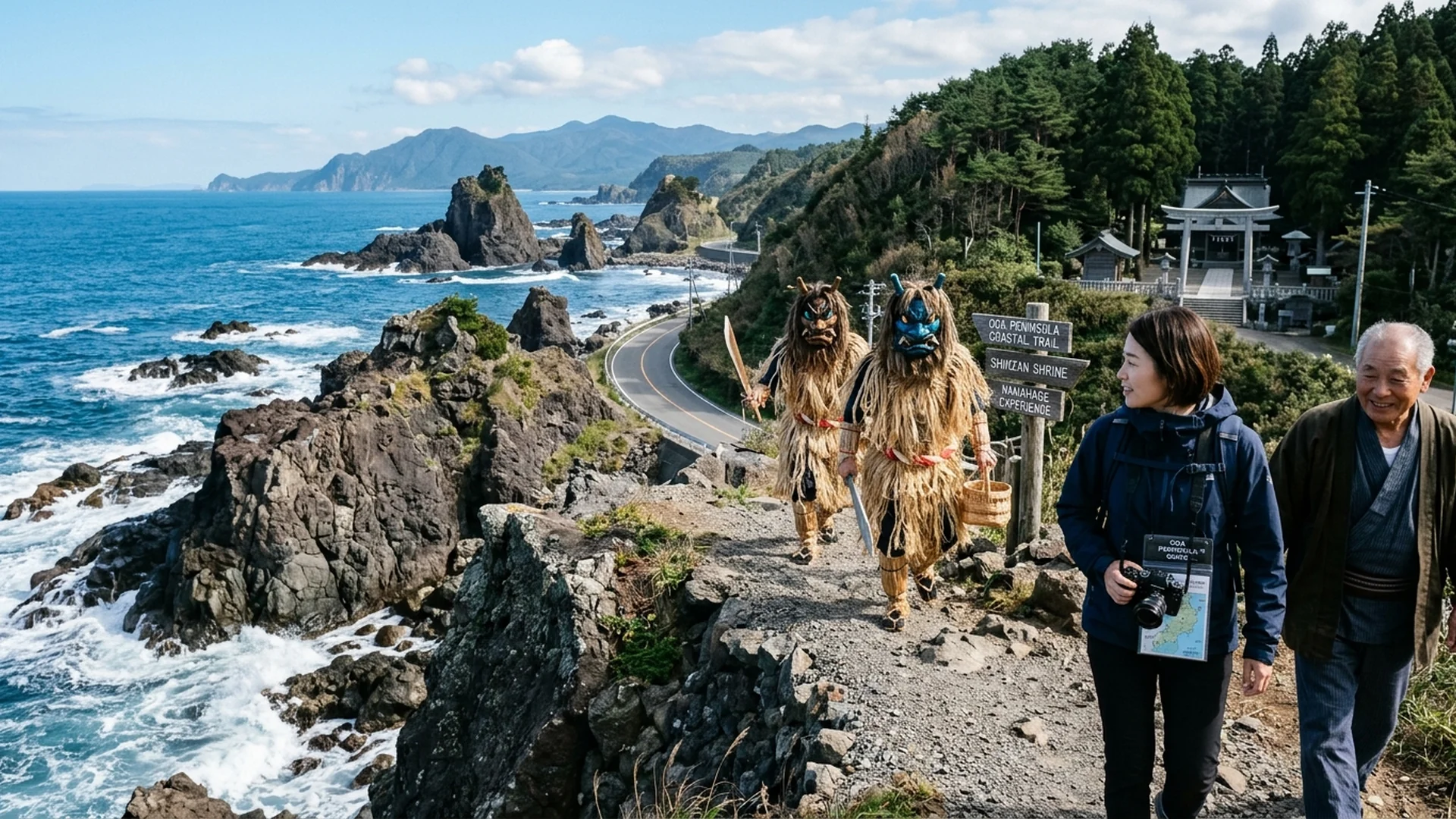
When the crisp winter winds of the Tohoku region whisper across the indigo expanse of the Sea of Japan, the Oga Peninsula—shaped like an ancient battle axe extending from western Akita—begins to glow with the quiet majesty of a sacred realm. Here, raw, untamed wilderness and centuries of profound spiritual belief converge in a timeless embrace. This is far more than a conventional travel destination; it is a spiritual sanctuary where the resonant roars of the Namahage echo through primeval forests and morning mists, running parallel to sculpted coastlines shaped with artistic precision by wind and tide.
Stepping onto the Oga Peninsula is akin to crossing the threshold into another dimension. It is a realm where invaluable folk traditions and unseen landscapes warmly envelop the discerning traveler seeking depth and meaning far beyond ordinary leisure. Through legends of mountain deities and boundless, pristine waters, Oga preserves a rare, uncompromised purity.
The Path of Mountain Deities: Decoding Oga’s Namahage Legend
When speaking of the Oga Peninsula, the first image that etches itself into the traveler’s soul is undoubtedly the legend of the Namahage—formidable, mask-wearing figures clad in straw garments, recognized as a UNESCO Intangible Cultural Heritage. While their fierce initial appearance might strike a momentary chord of awe, the Namahage are far from malevolent demons. Instead, they are revered as emissaries of the mountain deities, descending upon village hearths on New Year’s Eve to banish malevolent spirits, chastise idleness, and bless households with abundant harvests.
An intimate comprehension of these deep spiritual roots awaits at the Namahage Museum and the Oga Shinzan Folklore Museum, nestled amidst the hushed, atmospheric woods near Shinzan Shrine. Within, hundreds of hand-carved wooden masks, each unique to its village of origin, reflect the profound devotion and artistry of local craftsmen. Witnessing a simulation of the sacred ritual inside a traditional thatched-roof farmhouse (Magariya)—accompanied by echoing heavy footsteps and roaring cries against the flickering hearth fire—allows the visitor to profoundly grasp the symbiotic bond uniting humanity, nature, and the divine.
Sculpted by Tides: Coastal Dramas and Natural Masterpieces
Moving from the quiet forests to the jagged coastline, the Oga Peninsula reveals the dramatic, painterly beauty of the Sea of Japan. Millennia of relentless winds and crashing waves have carved the volcanic rock into astonishing natural sculptures. Among the most arresting highlights is Godzilla Rock, a volcanic outcrop whose profile uncannily mimics a prehistoric monster opening its jaws in a silent roar. As the setting sun dips toward the horizon, casting its silhouette against a canvas of burning gold and amber, the scene transforms into one of the most powerful and captivating vistas in the entire Tohoku region.
Further north at the peninsula’s northernmost tip stands Cape Nyudozaki, distinguished by its iconic black-and-white striped lighthouse. Standing proudly against sweeping sea breezes, it offers an uninterrupted 360-degree panorama of the curvature of the earth where the sea meets the sky in a seamless line—a tranquil vantage point capable of washing away the fatigue of the modern world.
Summit Panoramas and the Warm Embrace of Oga Onsen
No expedition across the Oga Peninsula is truly complete without ascending the majestic slopes of Mt. Kanpu, an extinct volcano blanketed in velvety, rolling green grasslands. At its summit, a revolving observation tower affords sweeping, unobstructed vistas encompassing Lake Hachirogata, the Sea of Japan, and distant layered mountain ranges. The undulating pastures swaying in the breeze impart an incomparable sense of freedom and serenity.
As evening descends, retreating to the mineral-rich waters of the historic Oga Onsen district serves as the ultimate reward for the traveler. These thermal waters envelop the body in restorative warmth amidst crisp, pristine air, perfectly paired with the legendary local culinary tradition of Ishiyaki Ryori. Fresh seafood is cooked instantly in wooden buckets by plunging superheated volcanic rocks into the broth, sending up a vibrant hiss and savory aroma—a living culinary heritage that encapsulates the authentic spirit of Oga.