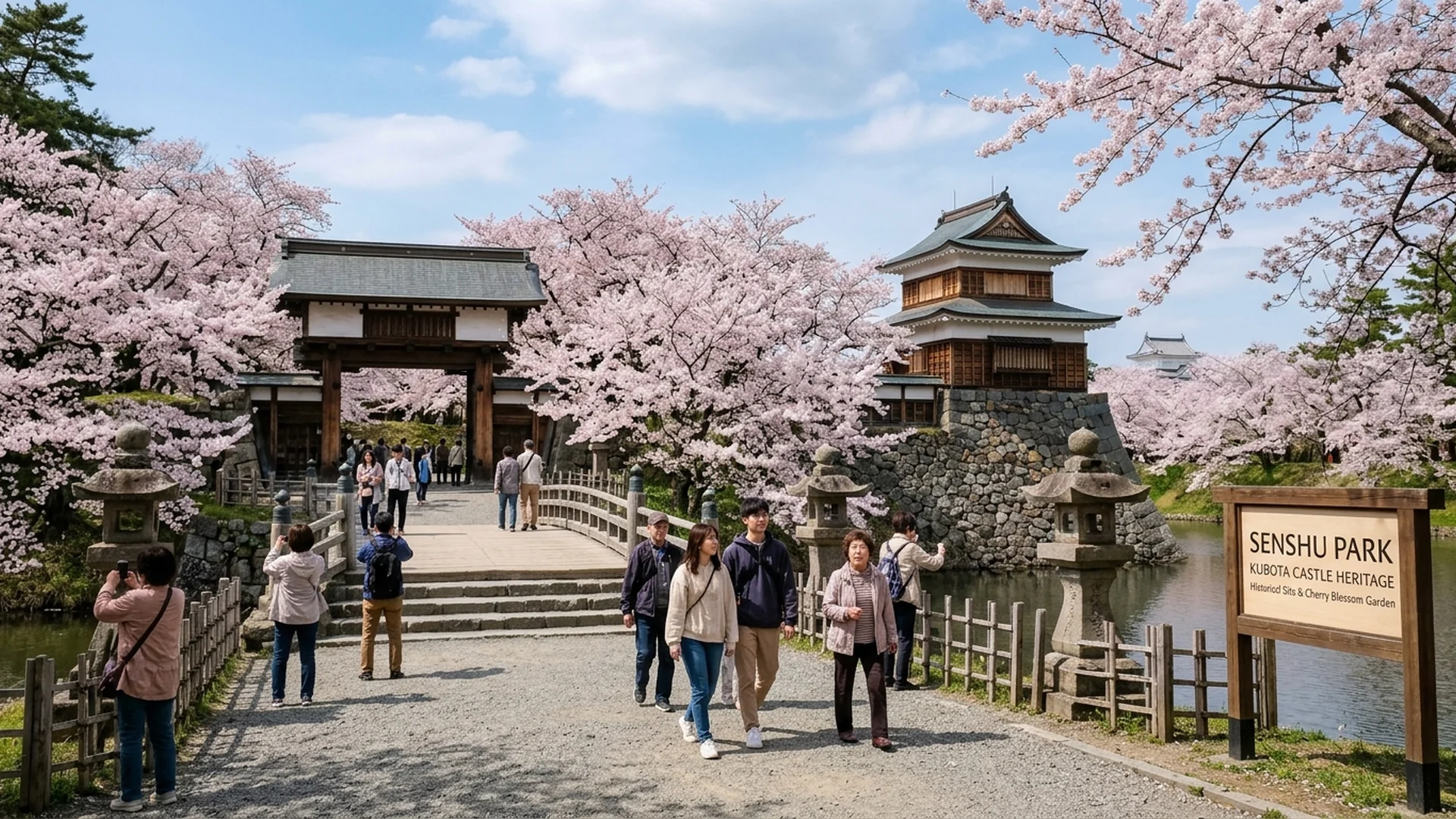
As your footsteps leave behind the bustling rhythm of modern Akita and cross into the canopy of ancient woodlands, the atmosphere shifts as though time itself has been quietly rewound to the Edo period. Senshu Park—once the formidable strategic stronghold of Kubota Castle—is far more than a conventional municipal green space. It stands as the spiritual heart and revered historical chronicle of the Satake clan, who ruled the sprawling Dewa Province.
Perched upon an elevated earthen plateau embraced by deep moats and resilient stone ramparts, the whispers of samurai history still linger among meticulously restored architectural remnants. Here, profound tranquility is punctuated by the shifting seasons: a pristine snow of falling cherry blossoms catching the spring sunlight, or the quiet rustle of lotus pads skimming the ancient moats. To journey through Senshu Park is to open a portal into another dimension of the Tohoku region—one where nature, heritage, and local artistry intertwine with rare, captivating grace.
The Satake Legacy: The Architectural Enigma of Kubota Castle
Kubota Castle stands apart from the quintessential Japanese fortress typology. Opting out of constructing a towering central keep (Tenshu) due to delicate political maneuvers and the desire to avoid friction with the reigning Tokugawa Shogunate, the Satake clan engineered their defense around the natural topography. They leveraged steep hillsides, profound water moats, thick earthen walls, and numerous timber defensive turrets (Yagura) instead. Though only skeletal stone foundations remain of the inner sanctum, the faithfully reconstructed Otemon Gate and Osumi-yagura turret eloquently narrate past grandeur. Strolling along the rising paths beneath towering pines and venerable maples imparts the distinct sensation of walking in the exact footsteps of the samurai guardians who once watched over the domain.
Seasonal Metamorphoses: From Sakura Carpets to Ancient Lotus Ponds
The aesthetic character of Senshu Park transforms dramatically with the turning of the wheel of nature. When spring awakens the earth, the grounds dissolve into a pastel dreamscape dominated by Somei Yoshino and Yamazakura cherry trees, drawing travelers to witness a landscape ranked among the nation’s premier blossom viewing sites. As summer takes hold, the castle moats become a canvas of deep green pads and striking pink lotus blossoms that contrast sharply against the weathered dark stone. By autumn, the canopy ignites in brilliant shades of amber and crimson, ensuring that every return visit offers an entirely fresh visual and emotional resonance.
The Spirit of Tohoku: Shrines and Intangible Cultural Arts
Beyond its military legacy, the sanctuary of Senshu Park harbors deep spiritual gravity through the revered Hirano Shrine and Hachiman Hachimangu Shrine, which have served as the emotional anchors of Akita for centuries. Vermilion torii gates and classical timber structures define an atmosphere of profound stillness. Furthermore, the park rests adjacent to the historic Matsushita tea house, where discerning guests may partake in the refined arts of the Akita Maiko—the celebrated geisha of Japan’s northern realms—while savoring artisanal green tea within immaculate traditional architecture.