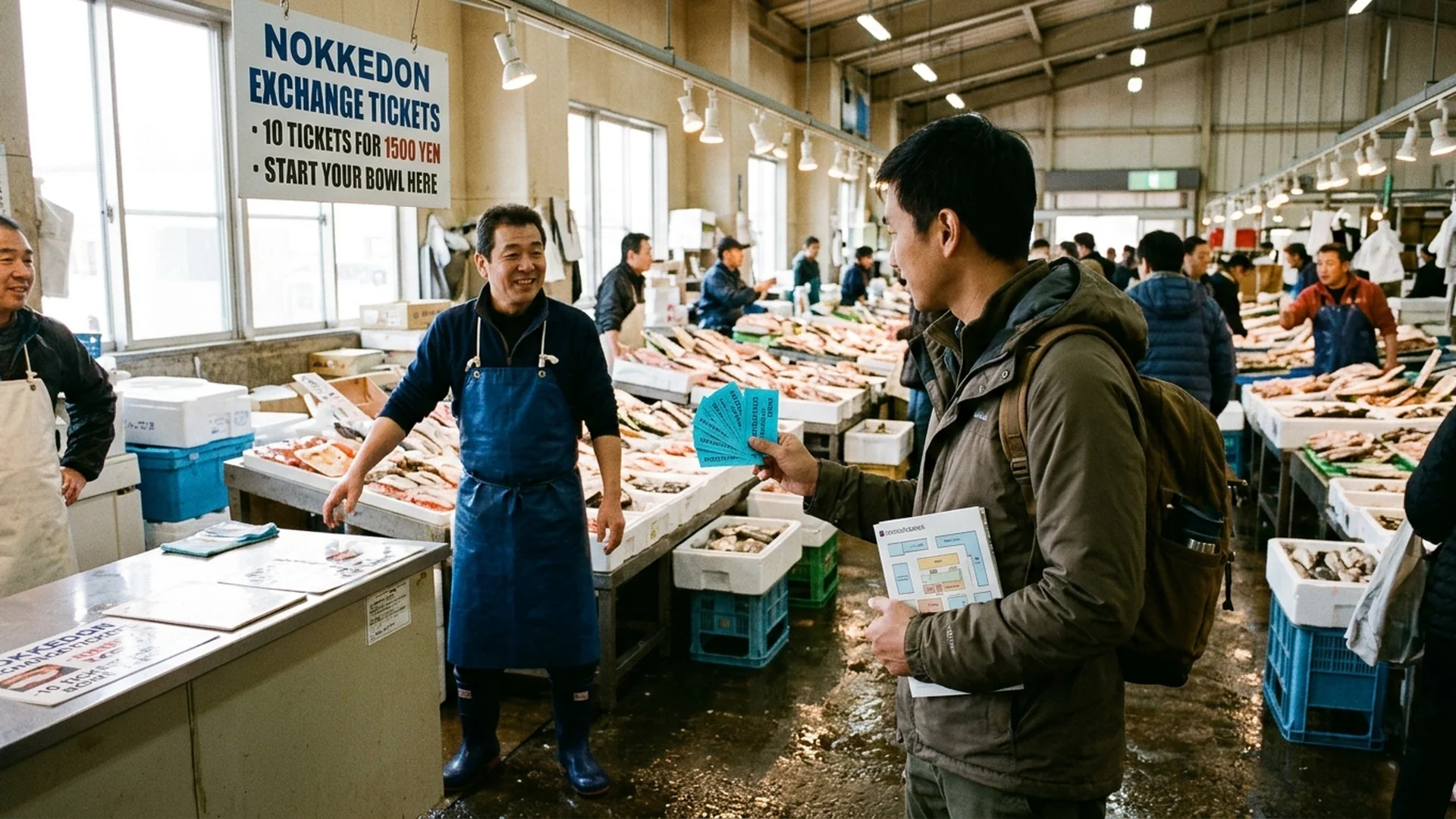
When winter winds sweep across the pristine waters of the Tsugaru Strait, the vibrant pulse of Aomori does not awaken in formal dining rooms. Instead, it stirs to life behind the weathered wooden doors of the Furukawa Fish Market, known locally as the Aomori Gyosai Center. This is far more than a conventional wholesale fish market; it is an intimate culinary stage where travelers curate their own personalized donburi, an interactive tradition affectionately celebrated as ‘Nokke-don’.
Stepping across the threshold is akin to holding a passport to absolute gastronomic autonomy. Abandon any preconceived notions of rigid, pre-plated seafood bowls. Here, you assume the role of an architect of flavor—from exchanging your currency for paper coupon strips and securing a steaming bed of freshly harvested rice, to personally hand-selecting glistening slices of Hon-maguro and translucent Mutsu Bay scallops. Every movement is accompanied by the rhythmic hum of local commerce and the welcoming smiles of generational vendors.
Architecture of Flavor: Decoding the Coupon System and the Art of Nokkedon
The beating heart of the Nokkedon phenomenon rests upon a delightfully tactile exchange system. Derived from the verb nokkeru, meaning ‘to place upon,’ the ritual commences at the central reception desk, where visitors acquire a booklet of vouchers.
Your first stop is any stall bearing a vibrant orange banner. Handing over a single coupon yields a warm bowl of pristine white rice. From there, you wander freely among twenty to twenty-five independent purveyors. Each station displays meticulously portioned seafood priced clearly in coupons—typically costing between one and three vouchers per exquisite cut. You might pair buttery salmon roe with rich sea urchin or contrast delicate white-fish sashimi with flame-seared delicacies, treating your porcelain bowl as a living canvas.
Jewels of the Tsugaru Strait: Selecting Unrivaled Regional Produce
The geographic fortune of the Tsugaru Peninsula elevates Aomori into one of Japan’s most revered epicurean sanctuaries. Mutsu Bay scallops serve as a shining emblem of this maritime wealth, celebrated for their crisp, resilient texture and a natural sweetness that deepens when paired with warm rice.
Equally coveted is the local Hon-maguro, or Pacific bluefin tuna. Whether you lean toward the lean, mineral-rich red meat of the akami or the decadent marbling of otoro that melts effortlessly upon the palate, the quality rivals the finest Michelin-starred establishments at a fraction of the expectation. Freshly grated wasabi and artisanal soy sauce, stationed at communal dining areas throughout the market, provide the final harmonious chord.
Geographical Clarity: Distinguishing Aomori’s Fish Markets
For the discerning traveler approaching Aomori for the first time, a vital geographic distinction must be made between the Furukawa Fish Market (Aomori Gyosai Center)—the historic birthplace of Nokkedon—and the Agla Fresh Market, a modern municipal building situated several blocks away.
While both venues celebrate the immense bounty of the northern seas, only the Furukawa Fish Market hosts the interactive D.I.Y. coupon experience. Confirming your destination ahead of time ensures an authentic immersion into the convivial, unhurried hospitality of Tsugaru’s trading community.