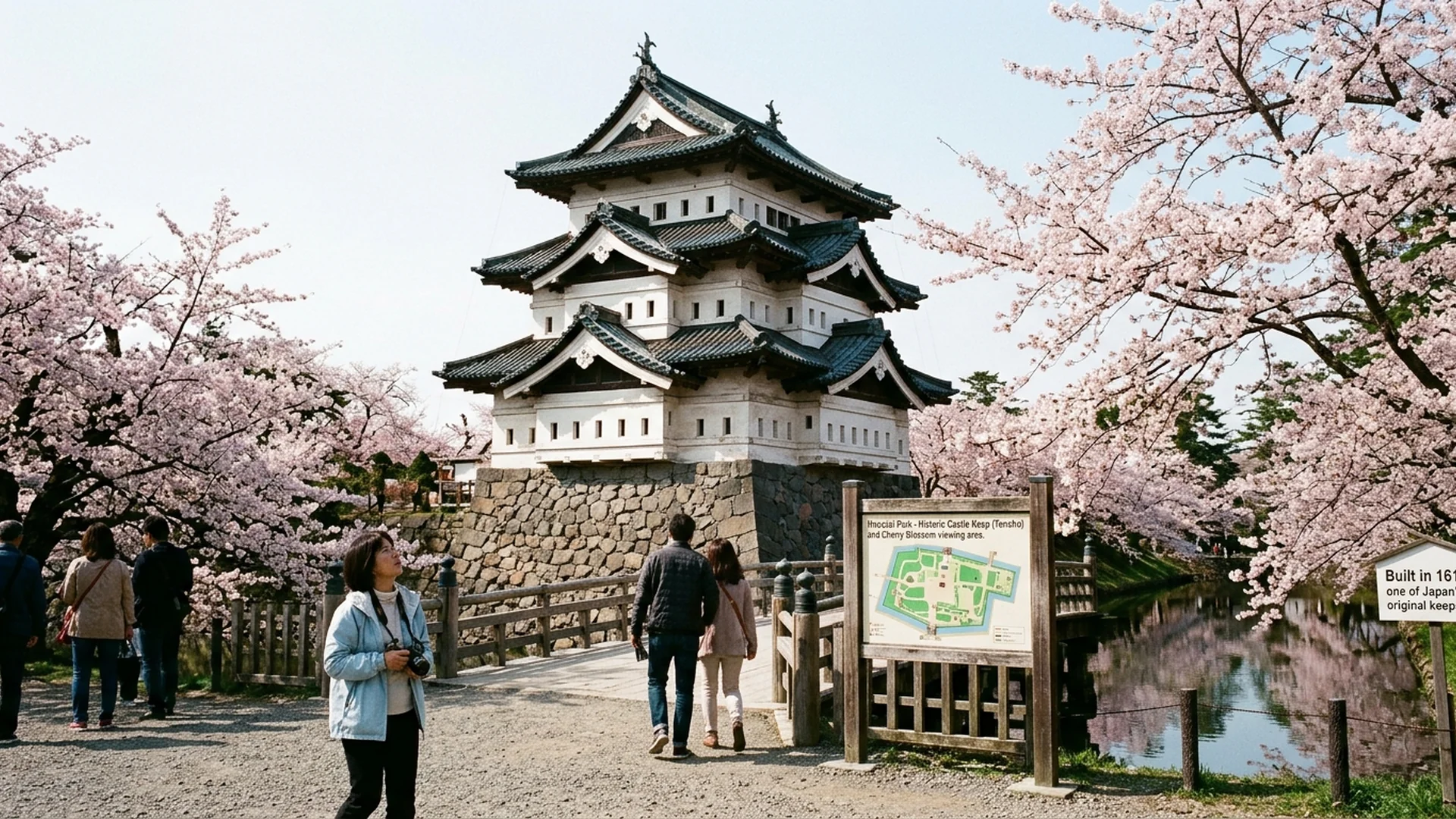
When morning mist drifts softly across the surface of the ancient moat in Tsugaru, the silhouette of the traditional white timber fortress against the snow-draped peaks of Mount Iwaki evokes an unbroken dialogue with the past. Hirosaki Castle is far more than a waypoint on an Aomori itinerary; it is a breathing page of history, standing resolutely against northern winters and the shifting tides of centuries. In this northernmost frontier of Honshu, classical samurai architecture dissolves seamlessly into the cyclical rhythms of nature, creating an aesthetic masterpiece that every discerning traveler must witness at least once in a lifetime.
Among the hundreds of castles scattered across the Japanese archipelago, only twelve retain their original keeps—structures that miraculously escaped fires, warfare, and demolition during eras of modernization. Hirosaki Castle stands proudly among this rarefied echelon. To walk across its creaking, centuries-old tatami mats beneath the sturdy Hiba cypress beams is a profound intellectual experience, connecting the modern wanderer directly to the legendary Tsugaru clan while immersing the senses in landscapes that transform the moat-side forests into living art.
Architectural Roots and Historical Legacy: The Value of an Original Keep
The chronicle of Hirosaki Castle began in the early Edo period when the visionary daimyo Tsugaru Tamenobu unified the Tsugaru domain, laying the foundation for the fortress in 1603, with completion achieved in 1611. Although the original central keep stood a towering five stories high, a catastrophic lightning strike in 1627 reduced it to ashes. It was not until 1810 that a subsequent lord erected a compact three-story fortification upon the ancient stone base—the very structure that stands today, having miraculously evaded the ravages of World War II.
The brilliance of Hirosaki’s architecture lies in its austere yet formidable design, rooted in tactical agility and maximum defense. Curved stone ramparts, three defensive corner turrets, and iron-plated gateway wings whisper tales of vigilance from a feudal past. Furthermore, in recent decades, local preservationists executed a remarkable feat of structural engineering: lifting and shifting the entire castle keep backward to restore its settling stone foundations. This meticulous endeavor exemplifies an unyielding commitment to authentic cultural preservation.
The Rhythm of Nature: From Petal Carpets to Winter Whispers
While its history commands respect, what etches Hirosaki Castle into the global imagination is Hirosaki Park, an expansive estate widely celebrated as one of Asia’s premier sakura viewing destinations. Over 2,600 cherry trees spanning more than fifty varieties burst into synchronized bloom each April and May.
As the ephemeral blossom season draws to a close, a breathtaking natural spectacle known as Hana-ikada unfolds. Millions of fallen cherry petals drift onto the inner moat, carried by gentle currents until they knit together into a dense, shimmering pink river of blossoms—a poignant visual poetry echoing the Zen philosophy of impermanence.
Yet the castle’s splendor is not confined to spring. By October and November, thousands of maple and ginkgo trees ignite in hues of crimson and gold, casting a warm glow over the ancient fortification. When winter descends, pristine snow blankets the dark tiled roofs and surrounding gardens, providing an enchanting backdrop for the annual Hirosaki Castle Snow Lantern Festival, where illuminated miniature snow sculptures glow softly against the quiet polar night.
Insider Perspectives and Contemplative Vantage Points for Discerning Travelers
To truly comprehend Hirosaki Castle beyond the standard tourist gaze requires intention and timing. Rather than following the midday crowds along the primary avenues, early morning offers the purest light, illuminating the timber keep and Mount Iwaki without interruption.
Professional photographers revere the Sugyobashi Bridge as a master vantage point, where ancient pine greenery meets the mirror-like reflections of the castle tower. Additionally, a late-afternoon stroll along the western moat reveals the fortress standing shoulder-to-shoulder with the distant mountain range, resembling a classical ink-wash landscape painting brought to life.