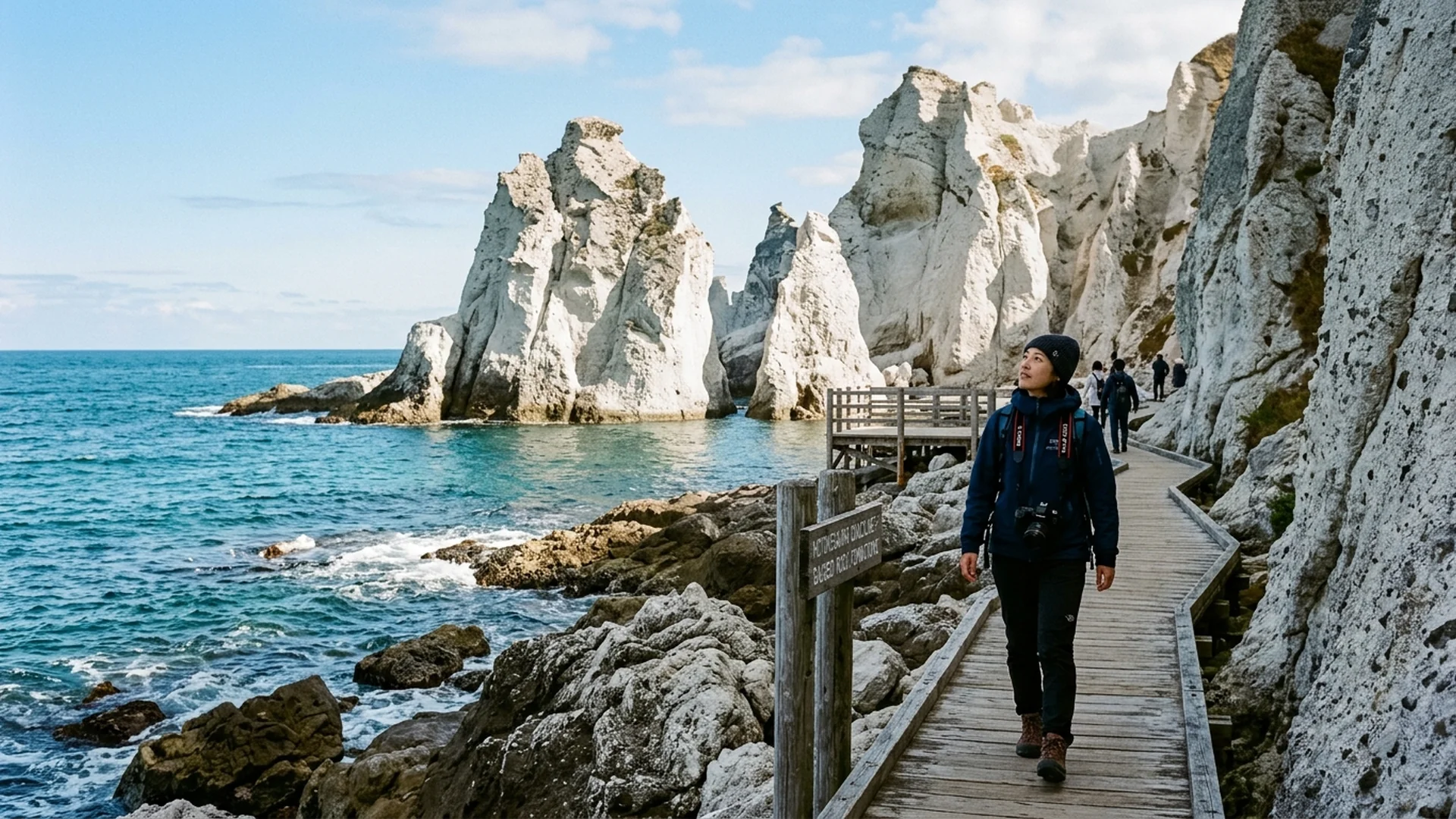
When the relentless swells of the Tsugaru Strait meet sheer, blindingly white tuff cliffs sculpted by fifteen million years of wind and tide, the resulting vista feels less like geography and more like an act of divine architecture. Known as Hotokegaura, this dramatic stretch along the Shimokita Peninsula in Aomori Prefecture is frequently whispered of as a pure Buddhist paradise manifested upon the earthly plane—a sanctuary where profound silence, elemental mystery, and geological grandeur merge into absolute stillness.
Spanning over two kilometers of coastline, these soaring rock formations bear nomenclature steeped in ancient devotion and local reverence. Individual monolithic towers evoke revered deities, sacred buddhas, and celestial guardians, as though nature herself carved an open-air cathedral amidst emerald-hued, crystalline waters. It stands as an immutable invitation for discerning travelers seeking refuge from the relentless pace of modernity to commune with a landscape suspended beyond ordinary time.
Geology and Sacred Lore: When Nature Carves a Cathedral in Stone
The genesis of Hotokegaura traces back tens of millions of years through submarine volcanic upheavals and successive strata of ash accumulation. Subsequent tectonic shifts and the unceasing erosion dealt by the Tsugaru Strait gradually chipped away at the stubborn stone, leaving behind immaculate white precipices that contrast sharply with the deep emerald sea. The appellation ‘Hotokegaura’ translates literally to the ‘Buddha’s Bay,’ reflecting the awe experienced by generations of local fishermen who perceived in these contours the serene visages of sacred figures. This inspired a deep-rooted spiritual conviction that the enclave serves as a dwelling place for divinities and departed souls alike, imbuing the atmosphere with a contemplative quietude rarely found in conventional destinations.
Two Pathways to a Hidden Jewel: Maritime Voyage Versus Forested Descent
Encountering the majesty of Hotokegaura offers entirely contrasting experiences depending on the chosen approach. The maritime route—via sightseeing vessels departing from Sai Port or Ushitaki Port—presents sweeping panoramic vistas. Gliding across the water allows travelers to absorb the continuous sweep of brilliant white cliffs framed by the vast horizon, complemented by local maritime guides recounting the lore of individual stone pillars.
Conversely, the land-based approach caters to those seeking tactile intimacy with the terrain. A drive to the cliffside parking area precedes a descent of roughly 700 meters along wooden stairways and winding stone steps weaving through a lush temperate forest. While the descent is invigorating, the return climb demands deliberate physical effort. The reward, however, is standing directly upon the shoreline shingle, enveloped by the mist of gentle waves and the dizzying scale of towering white rock faces rising overhead.
The Shimokita Peninsula: A Northern Frontier of Cultural Discovery
An expedition to Hotokegaura finds its ultimate context when woven into a broader exploration of the Shimokita Peninsula—the axe-shaped northernmost headland of Honshu. Beyond its spectacular coastline, this remote frontier acts as a profound crucible of spiritual heritage. Among its treasures is Mount Osorezan, a sacred volcanic caldera widely regarded as a spiritual threshold between the living world and the afterlife. Its terrain of muted yellow sulfur deposits and cobalt lakes, ringed by dark pine forests, offers a hauntingly serene counterpoint. Pairing the pristine, sculptural beauty of Hotokegaura with the metaphysical resonance of Osorezan yields an encounter with Japan that is intellectually enriching and deeply resonant.