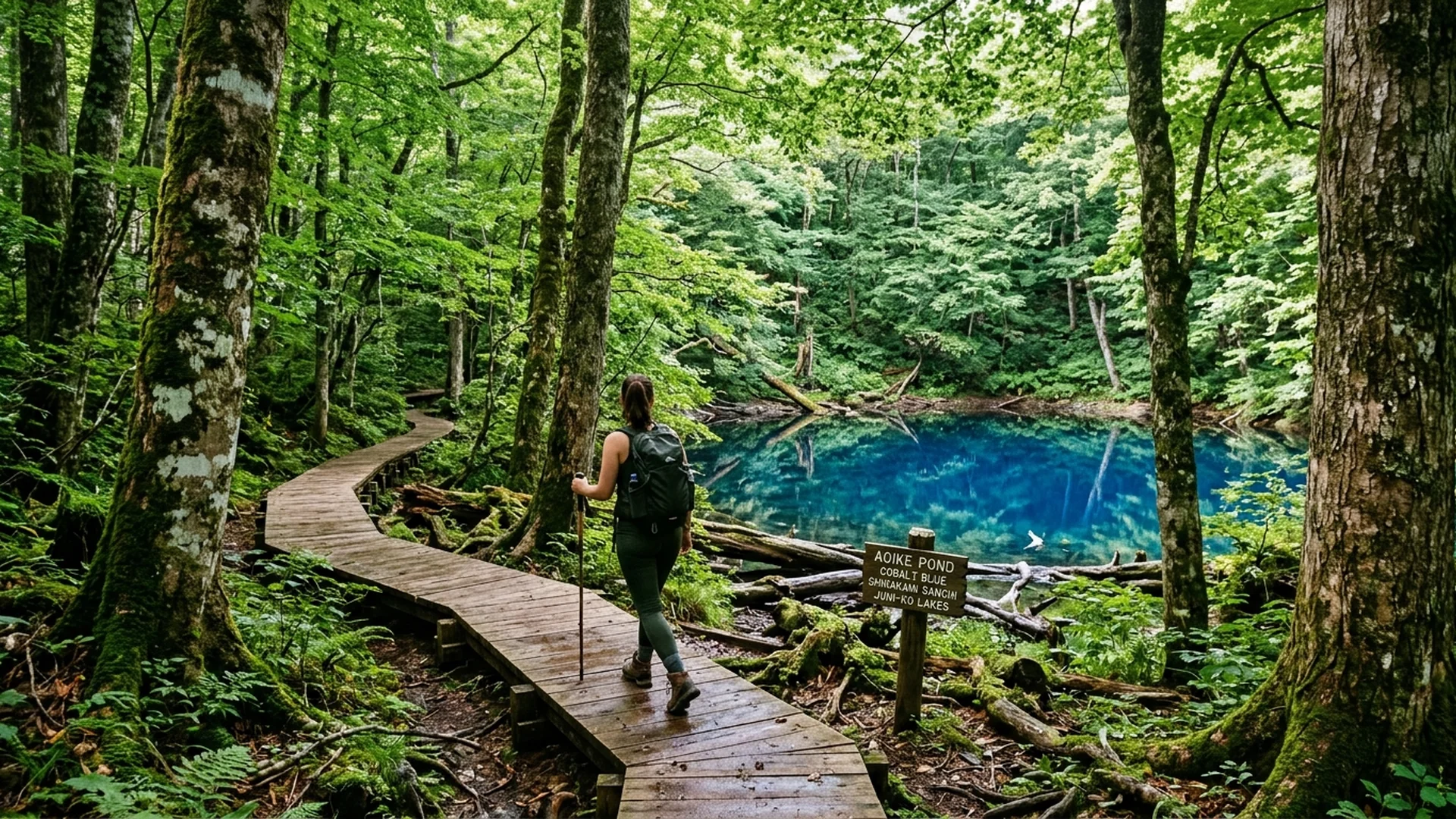
Amidst the tranquil embrace of the Shirakami Sanchi mountains—a UNESCO World Natural Heritage pristine beech forest—lies a hidden sanctuary far removed from the clamor of the modern world. This is Lake Juniko, the famed ‘Twelve Lakes,’ which were forged not merely by the gradual hand of time, but by a powerful Edo-period earthquake that dramatically sculpted the landscape into over thirty crystalline basin pools.
Stepping onto the woodland trails, your senses are immediately greeted by the scent of damp earth, fallen foliage, and the cool, restorative crispness of a deep-rooted temperate forest. Yet, the true marvel that beckons travelers seeking unblemished beauty is the intense, glass-clear cobalt brilliance of Aoike, a small pond that mirrors ancient canopy and sky with the striking clarity of an oil painting. This is an invitation to decode Aomori’s priceless natural heritage through an unhurried, deeply contemplative lens.
The Cobalt Mystery of Aoike: When Water Becomes a Mirror of the Soul
Among all the water bodies scattered across Juniko, Aoike—the Blue Pond—stands as the undisputed visual and spiritual focal point. The moment morning sunlight filters through the high beech boughs to strike the surface, the water glows with an astonishing, saturated cobalt hue, as though liquefied rare gemstones rested upon the floor. The astonishing clarity permits a clear view of centuries-old submerged logs resting in the depths, bestowing an otherworldly solemnity upon the entire clearing. Naturalists and photographers continually study this phenomenon, attributing the shade to the interplay of light refraction, dissolved minerals, and decaying organic debris under the cold forest canopy. Above all, however, this radiance feels like an unadorned gift crafted purely by nature’s patient hand.
The Ancient Beech Trail: Meditation and Movement Within a UNESCO Sanctuary
The most rewarding way to explore Lake Juniko is on foot along the nature-study trails, which require roughly forty-five to ninety minutes to traverse. The journey offers little physical exertion of steep inclines, presenting instead a subtler challenge: the art of mindful sensory reception. Towering Japanese beech trees, many exceeding two centuries in age, blanket the forest with smooth grey bark and sweeping crowns that filter sunlight into soft golden motes. Every footstep upon the resilient, leaf-carpeted earth provides a gentle cadence that slows the rush of modern existence. Beyond Aoike, mindful wanderers encounter Wakitsubo Pond, whose purity allows for a refreshing sip, alongside other hidden tarns defined by their own distinct micro-ecosystems.
A Cinematic Window: Traveling Aboard the Resort Shirakami
The voyage toward Lake Juniko forms an integral chapter of the entire experience, commencing the moment you board the Resort Shirakami. This premier sightseeing train tracks the picturesque Sea of Japan coastline, engineered with oversized panoramic windows that frame dramatic contrasts between dark stone cliffs, expansive azure waters, and quiet fishing hamlets. At select points along the route, the train eases its pace so passengers may fully absorb the dramatic coastal vistas before arriving at Juniko Station, the portal into the forested highlands of Shirakami.