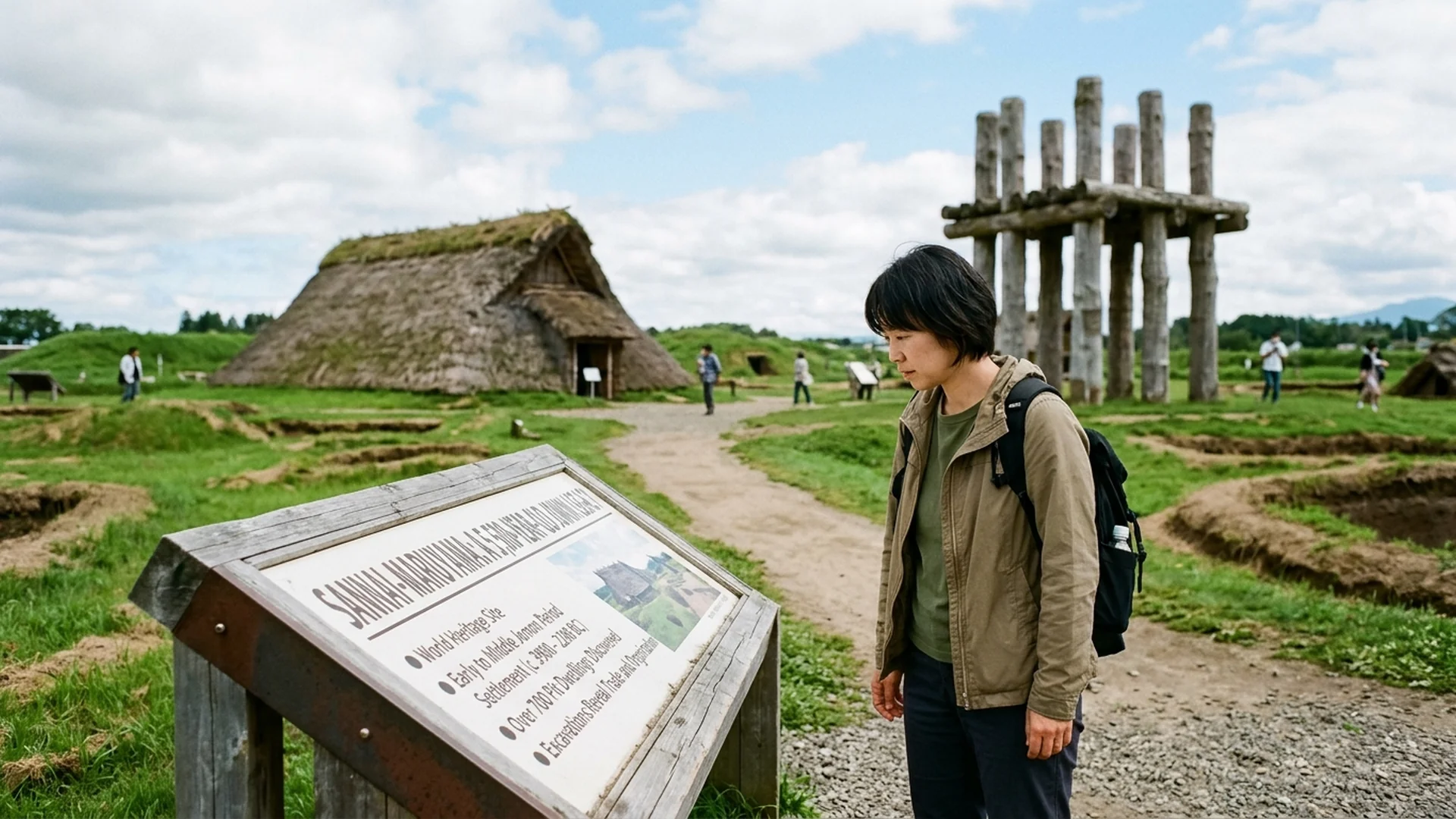
When the crisp northern wind sweeps through the quiet forests and rolling hills of Aomori Prefecture, one’s thoughts naturally turn toward pristine wilderness. Yet, beneath this tranquil landscape lies a profound chronicle of human history stretching back five and a half millennia. The Sannai-Maruyama Site is far more than a mere collection of prehistoric ruins; it is a masterwork of archaeological discovery that fundamentally reshaped our understanding of early Japanese and global civilization.
Here, the Jomon period reveals itself not as an era of aimless nomadic wandering, but as a sophisticated, sedentary society defined by urban planning, intricate architecture, and a deeply contemplative spiritual relationship with the natural world. Stepping onto these grounds is akin to opening a portal to an age when humanity lived in profound harmony with the earth. Towering wooden structures that defy the passage of time, warm subterranean dwellings, and iconic cord-marked pottery collectively whisper tales of a thriving community numbering in the thousands.
This editorial journey invites discerning global travelers to explore the inner depths of this UNESCO World Heritage treasure, unlocking the ancient roots of the Japanese aesthetic and spiritual consciousness.
Rewriting the Jomon Narrative: From Nomadic Tribes to Settled Civilization
Traditional historical accounts long characterized prehistoric Japanese society as a loose collection of nomadic hunter-gatherers. That dogma was overturned in the early 1990s during industrial construction work that unexpectedly unearthed the sprawling expanse of Sannai-Maruyama. Subsequent excavations revealed ceramic shards, polished stone tools, massive post holes, and extensive burial grounds, proving this was once a permanent, highly organized mega-settlement that flourished for over fifteen centuries, roughly between 3900 and 2900 BCE. The inhabitants possessed an advanced grasp of resource management and ecological stewardship. Rather than merely enduring the harsh northern winters, they cultivated an artistic and philosophical way of life, expressed through exquisite cord-marked pottery—the very hallmark of the Jomon period, derived from the Japanese word for rope-patterned.
Architectural Enigmas: The Six-Pillar Monument and Colossal Pit Dwellings
Walking deeper into the archaeological zone, one’s gaze is instantly captured by six colossal timber pillars supporting a soaring fifteen-meter-tall structure, meticulously reconstructed above the original excavation site. Each column, exceeding a meter in diameter, was anchored using sophisticated ancient engineering techniques. Archaeologists and architectural historians continue to debate the true purpose of this towering edifice: was it an astronomical observatory, a sacred ritual sanctuary, or a towering communal totem? Beyond this monumental landmark lie more than five hundred pit dwellings, alongside a massive longhouse stretching thirty-two meters—believed to have served as a communal assembly hall. These structures bear silent witness to the astonishing capacity for collaborative enterprise possessed by our ancient forebears.
The Jomon Jiyukan Museum: A Sensory Threshold to Antiquity
An exploration of Sannai-Maruyama remains incomplete without visiting the Jomon Jiyukan, a subterranean welcome center and museum whose turf-covered roof blends seamlessly into the surrounding topography. Inside, over 1,700 registered Important Cultural Properties are displayed, ranging from elegantly contoured vessels and enigmatic dogu clay figurines to intricate ornaments crafted from jade and animal bone. Guests are invited to handle replica stone tools and garments, while glass-walled conservation laboratories offer a rare glimpse into meticulous artifact preservation. In the culinary pavilion, seasonal menus draw inspiration from authentic Jomon staples such as chestnuts, acorns, and wild game, offering an intellectual and sensory feast for the discerning traveler.