The winter winds sweeping across the deep indigo expanse of Aomori Bay today carry a profound stillness, belying the frenetic energy of an era when these waters served as a vital arterial lifeline for millions. Yet moored quietly near the sweeping arch of the Aomori Bay Bridge rests an iron colossus. Far more than a mere static monument, the Seikan Ferry Memorial Ship Hakkodamaru is a colossal time capsule, poised to transport the discerning traveler back to the golden age of naval engineering and trans-strait travel.
Long before the subterranean excavation of the Seikan Tunnel linked Honshu to Hokkaido, this remarkable vessel stood as a masterclass in marine transport. Beyond carrying passengers and motor vehicles, the Hakkodamaru performed an astonishing feat of logistics: swallowing entire railway trains into its cavernous underbelly to brave the treacherous, storm-tossed currents of the Tsugaru Strait.
Stepping aboard the Hakkodamaru is not merely an exhibition walkthrough; it is a trans-dimensional voyage into the late Shōwa era. Here, the lingering echoes of roaring steam whistles, heavy riveted steel, and the unyielding labor of maritime pioneers resonate softly through every rust-kissed corridor.
Legacy of the Tsugaru Strait: The Floating Iron Bridge Before the Subsea Tunnel
Before the Japanese National Railways united Honshu and Hokkaido through the engineering triumph of the Seikan Tunnel, the notoriously tempestuous Tsugaru Strait presented a formidable barrier to transit. Journeys between Aomori and Hakodate relied entirely on the Seikan Ferry—an armada of colossal passenger and cargo vessels functioning as a floating bridge for decades.
The Hakkodamaru stands as one of the most revered and longest-serving vessels of this fleet, undertaking continuous operations from 1964 until its honorable retirement in 1988 upon the opening of the rail tunnel. Its significance extends far beyond shipping statistics; it is a testament to relentless human determination against the elements. Amid fierce winter blizzards and towering swells, the ferry unfailingly delivered warmth, mail, agricultural produce, and human hope across the treacherous waters.
Engineering Wonders Within the Hull: When Entire Trains Sailed
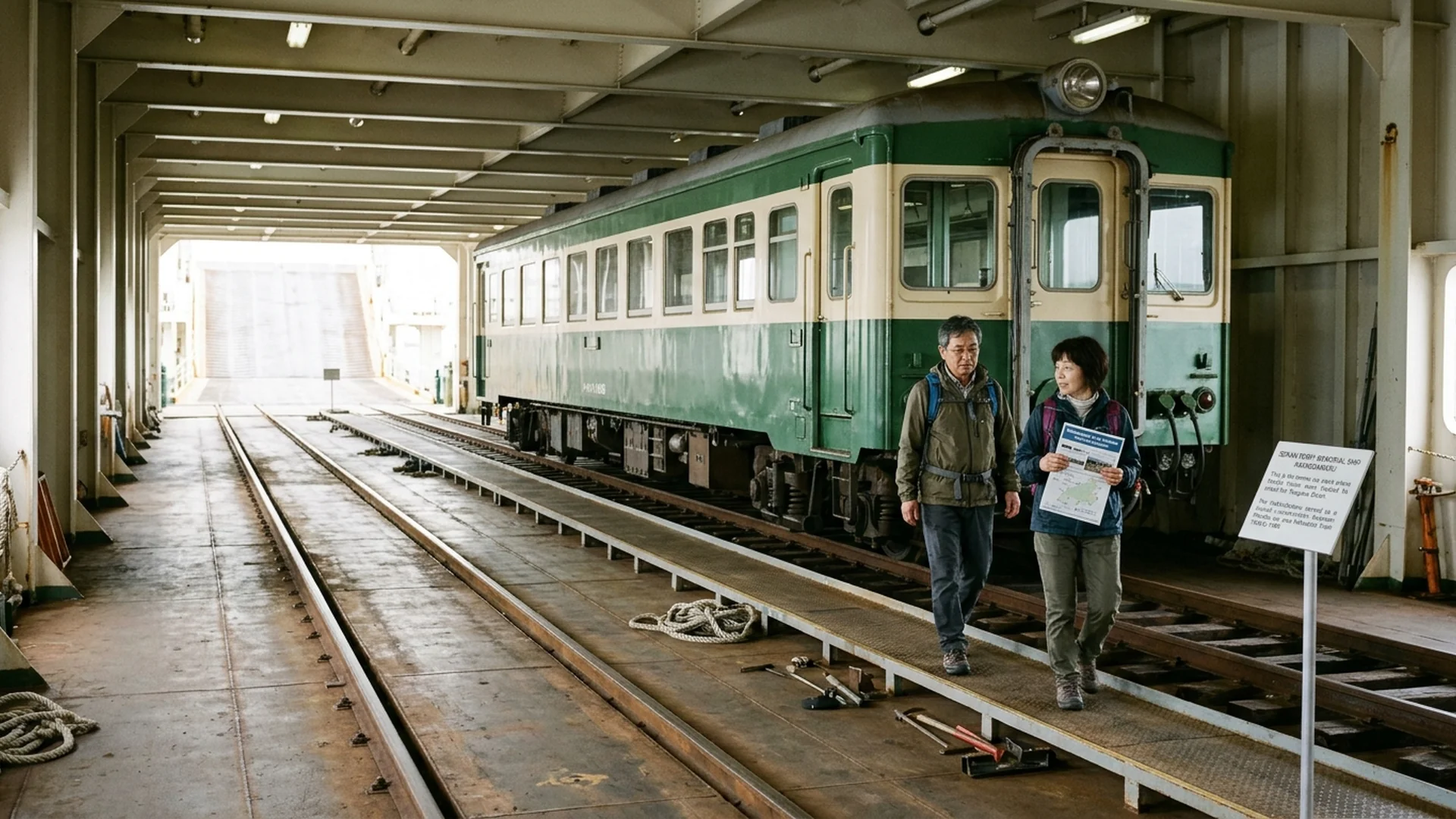
The most breathtaking revelation aboard the Hakkodamaru is the Vehicle Deck, situated deep within the lower tier and meticulously engineered to accommodate entire train sets upon internal railway tracks. This railway car ferry design required masterclass naval architecture and precise center-of-gravity calculations to ensure absolute stability while carrying immense loads through open-sea swells.
Within this lower deck, vintage diesel locomotives and passenger carriages rest silently upon their tracks, appearing as though poised for departure at any moment. The olfactory notes of oxidized iron and heavy overhead structural beams evoke the raw industrial grit of the mid-20th century. Meanwhile, the upper deck has been transfigured into an open promenade hosting automotive displays and panoramic vantage points overlooking the serene Aomori Bay.
Exploring the Shōwa Spirit: From the Navigation Bridge to Titanic Engines
Navigating the interior of the Hakkodamaru unfolds like turning the pages of a meticulously preserved historical diary. The journey begins on the uppermost deck within the Navigation Bridge, where binnacles, brass engine order telegraphs, and original steering wheels remain untouched, as though the officers have merely stepped away for a brief moment.
Descend into the vessel’s cavernous core to discover the colossal engine room, a cathedral of steam piping, pressure gauges, and eight-cylinder diesel engines that once thundered with synchronized power against the ocean waves. Furthermore, the vessel houses the ‘Aomori Railway Halk’ exhibition space, meticulously recreating a nostalgic Shōwa-era station square complete with period storefronts, merchant stalls, and lifelike mannequins that evoke the poignant longing for a bygone cinematic era of Japanese travel.