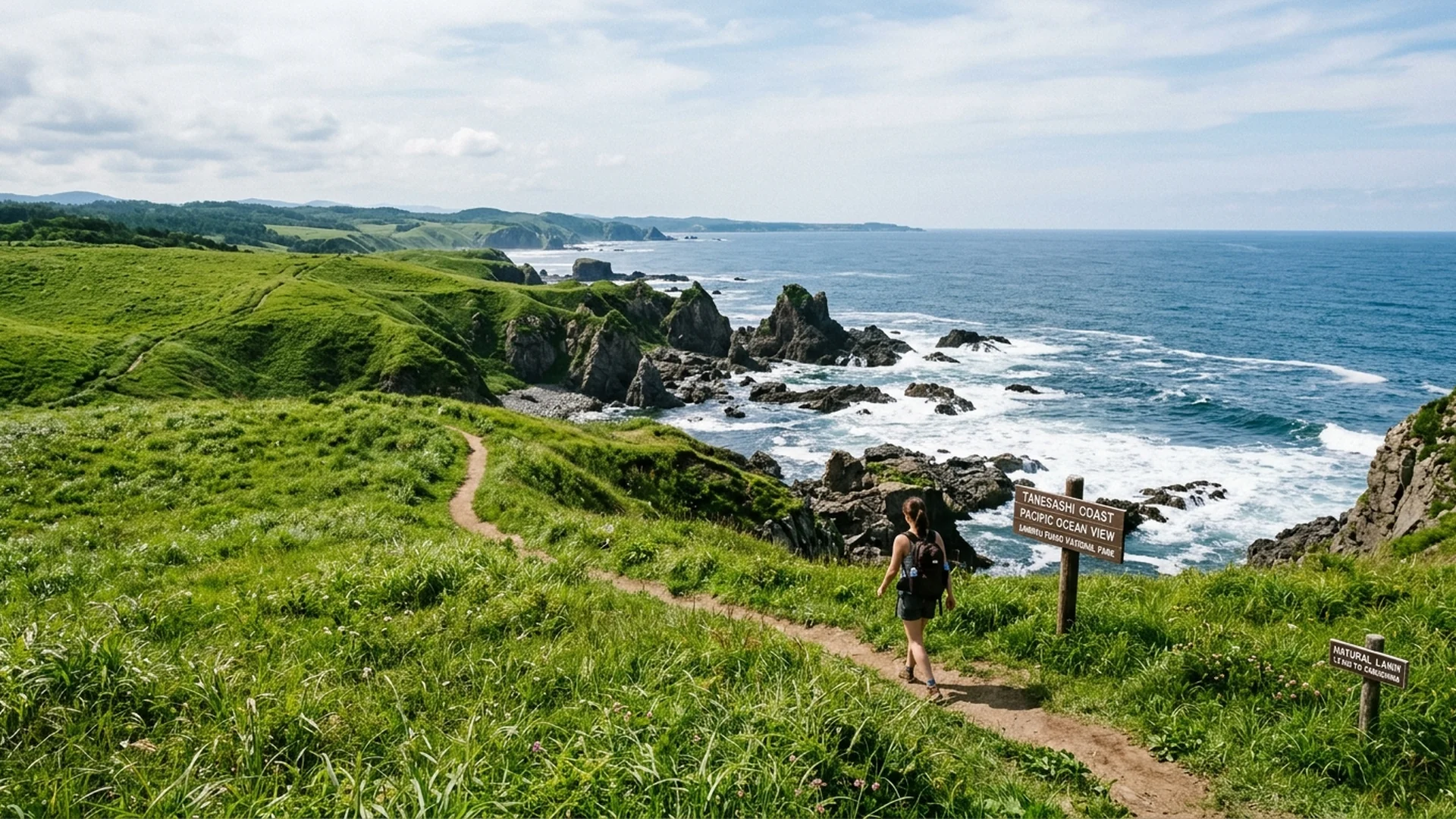
When whispered thoughts of Japan’s Tohoku region arise, they often conjure fleeting visions of autumn maples or hushed blankets of pristine snow. Yet, venturing toward the dramatic eastern coastline of Aomori Prefecture, nestled within the sweeping boundaries of Sanriku Fukkō National Park, reveals an entirely different dimension of raw, untouched serenity. The Tanesashi Coast serves as a living masterwork of natural artistry, where lush, velvet-green lawns stretch uninterrupted right to the edge of weathered rock cliffs and the deep indigo surges of the Pacific Ocean.
Arrival here is an intentional quiet luxury—a deliberate withdrawal from the clamor of the modern world into a realm governed by the gentle percussion of distant tides, the crisp fragrance of sea salt, and golden sunlight warming sweeping meadows. Tanesashi transcends mere picturesque landscapes, whispering an ancient spirit of resilience and an intimate, unbroken communion between humanity and the northern sea.
The Symphony of Velvet Lawns and Singing Sands
The initial marvel of the Tanesashi shoreline is the legendary Tanesashi Natural Lawn—an extraordinary expanse of verdant turf that grows directly against sandy shores and rugged sea cliffs completely unassisted by human landscaping. This vibrant green carpet unfurls parallel to the vast Pacific, inviting weary travelers to recline upon its resilient softness while listening to the rhythmic percussion of waves acting as a profound acoustic therapy.
Just beyond lies Osuka Beach, an immaculate two-kilometer stretch of white quartz sand famously designated as a ‘singing beach’ (nakisuna). Due to the exceptional purity of the fine grains, footsteps evoke a musical, melodic crunch beneath walking boots. This coastal sanctuary is equally celebrated as a natural breeding habitat for black-tailed gulls and stands as one of Japan’s finest vantage points for witnessing dawn breaking in shimmering golden cascades across the water.
Echoes in Time: Ancient Pine Forests and the Sanctuary of Kabushima
Framing this coastal grandeur stands Yodo-no-Matsubara, a storied pine forest that has steadfastly weathered fierce ocean gales for centuries. The gnarled, deep-green silhouettes of these ancient evergreens trace jagged rock lines, creating natural framing reminiscent of classical East Asian ink paintings brought vividly to life against the cerulean sea.
Further north rests Kabushima Island, now gracefully tethered to the mainland by a pedestrian bridge. Dominated by Kabushima Shrine—a spiritual anchor where local fishermen pray for safe voyages and abundant catches—the island transforms each spring into an extraordinary wildlife haven. Tens of thousands of migratory black-tailed gulls claim the slopes for nesting, lending an energetic, vibrant pulse to the surrounding ecosystem.
Gastronomic Heritage: The Culinary Aesthetics of Tohoku
No contemplative sojourn along the Tanesashi Coast is truly complete without experiencing the regional cuisine born from the convergence of warm and cold ocean currents. Hachinohe’s culinary masterpiece is ‘Ichigoni’, an ethereal clear soup simmered meticulously with fresh abalone and tender sea urchin roe. When served, the delicate fragments of sea urchin suspended within the translucent broth evoke morning strawberries glistening with early dew—a revered local delicacy reflecting ancestral wisdom in preserving and elevating foundational flavors without artifice.