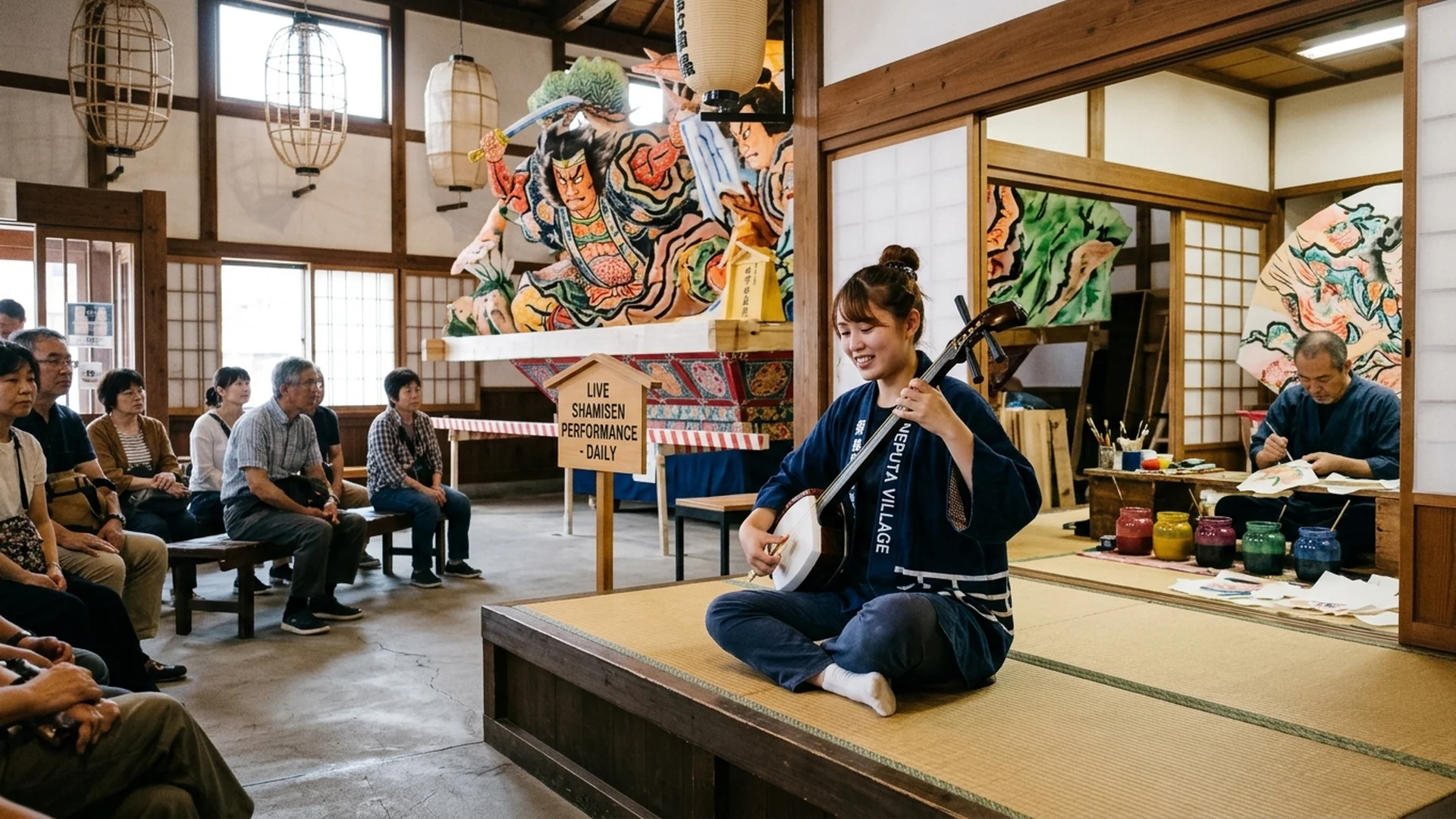
When the northern chill descends upon the deep silences of the Tohoku region, a singular sanctuary preserves the warm, beating pulse and restless spirit of midsummer all year round. Tsugaru-han Neputa Village in Hirosaki, Aomori Prefecture, transcends the ordinary definition of a cultural center. It operates as a living museum, cradling the breath, three centuries of history, and the exquisite ingenuity of the Tsugaru people within a single, cohesive realm.
Crossing the threshold into this domain feels like stepping across time through mountain mist, accompanied by the resonant thunder of taiko drums and the haunting yet commanding melodies of traditional folk lutes. This is a monumental archive chronicling northern resilience, the quiet brilliance of vernacular art, and the profound tether between humanity and high wilderness through uncompromised craftsmanship passed down unbroken through generations.
Monumental Floats and Three Centuries of Neputa Spirit
The beating heart drawing seekers of authentic aesthetics is the grand Neputa exhibition hall, standing tall with the stature of a three-story architectural marvel. These towering fan-shaped floats, known as o-neputa, are constructed from delicate bamboo frames wrapped in washi paper, meticulously hand-painted with vibrant pigments depicting legendary heroes and ancient Chinese epics. When internal lanterns cast a warm glow through the paper skin, the intricate internal architecture springs to vibrant life.
The annual Hirosaki Neputa Festival, held every August, serves not merely as a raucous procession to chase away sleepiness—or nemuri—during the agrarian growing season, but as an unbroken testament to community cohesion sustained by Tsugaru citizens for over three hundred years. Within this village, visitors stand mere inches from these colossal structures, breathing in the scent of aged beeswax and parchment while imagining the echoing nighttime cries of ‘Yaeya-yaeya’ reverberating through ancient castle-town streets during the midsummer processions.
The Earth-Shaking Resonance of Tsugaru Shamisen
Beyond the arresting visual grandeur of towering lanterns, another unforgettable sensory immersion lies in the soundscape of the Tsugaru Shamisen, a rustic three-stringed lute born from these very snow-swept plains. Distinguished by its breakneck tempos, heavy percussive strikes, and aggressive plucking techniques evocative of sudden rain drumming on autumn leaves or gales howling through pine canopies, this music commands complete attention.
The village’s dedicated acoustic hall hosts live performances by seasoned virtuosos who channel generations of regional hardship and triumph through their fingertips and plectrums. The notes, echoing sharply through traditional timber chambers, convey profound isolation, unyielding courage, and the poignant beauty of northern survival. Listeners often find themselves entirely transfixed by the raw, unpolished vitality embedded within every single note.
Aesthetics of Borrowed Scenery: Yoki-en and Mount Iwaki
Venturing deeper into the domain reveals Yoki-en, a classical Japanese landscape garden meticulously designed according to the Oishi Bugaku-ryu school. The garden employs the masterful technique of shakkei, or ‘borrowed scenery,’ seamlessly integrating the distant majesty of Mount Iwaki—revered locally as the ‘Fuji of Tsugaru’—as a permanent, natural backdrop.
The snow-crowned summit contrasting with emerald forestry, mirror-clear ponds reflecting shifting cloudscapes, and archaic stone arched bridges collectively restore psychological equilibrium to the wanderer. Here, time noticeably decelerates, inviting the inner consciousness to converse directly with absolute silence and the unadorned purity of the surrounding wilderness.
The Tsugaru Craft Legacy: From Kogin Thread to Lacquerware
The Tsugaru region is much more than a seasonal festival ground; it is a fertile cradle of elite craftsmanship reflecting northern patience. In the village’s atelier spaces, travelers observe and participate in rigorous artisanal processes, including Tsugaru-nuri lacquerware, which demands a painstaking cycle of color layering and polishing repeated over a dozen times to reveal intricate, organic bough-like patterns.
Visitors also encounter Tsugaru Kogin-zashi, a historic embroidery discipline born from historical austerity when agrarian women stitched white cotton thread onto coarse hemp fabrics to enhance warmth and durability, inadvertently creating mesmerizing geometric symmetries of high artistic merit. Additional opportunities invite guests to paint their own Kingyo Neputa, the charming, talismanic goldfish lantern unique to the region.