When moving beyond the conventional perception of Chiba Prefecture as merely an international gateway via Narita Airport or a realm of modern entertainment, discerning travelers often uncover a far quieter, spiritually resonant dimension. Perched atop Inohana Hill, Chiba Castle—historically known as Inohana Castle—stands as a stark white sentinel casting its reflection across the passage of time. This contemporary reconstructed keep is far more than a decorative civic landmark; it is the historic heartbeat that recounts the rise to prominence of a deeply influential samurai lineage.
Encircled by deciduous foliage that transforms in rich hues with the changing seasons, this elevation once served as a vital strategic stronghold. Today, it has evolved into a serene sanctuary fusing the disciplined elegance of the samurai sword, regional culture, and natural beauty into seamless harmony. Open the gateway to the past, touch the lingering threads of an ancient civilization that shaped the modern identity of Chiba, and immerse yourself in a panoramic vista connecting bygone eras with the present world.
Roots of the Chiba Clan: The Legend of Inohana Hill
The history of Chiba Castle is profoundly intertwined with the Chiba clan, a formidable warrior house wielding significant influence from the Heian through the Sengoku periods. The narrative begins in the twelfth century when the samurai Chiba Tsunemasa selected strategically advantageous Inohana Hill, overlooking Tokyo Bay, as the foundation for his expanding domain. This lineage played an indispensable role fighting alongside Minamoto no Yoritomo, the founder of the Kamakura shogunate. Although the current fortress structure was meticulously reconstructed in 1967 to house a regional museum, its architectural framework and commanding topography preserve the dignified atmosphere of Japan’s legendary warriors amidst the tranquil parklands enveloping the grounds.
Treasures Within the Chiba City Museum of Local History
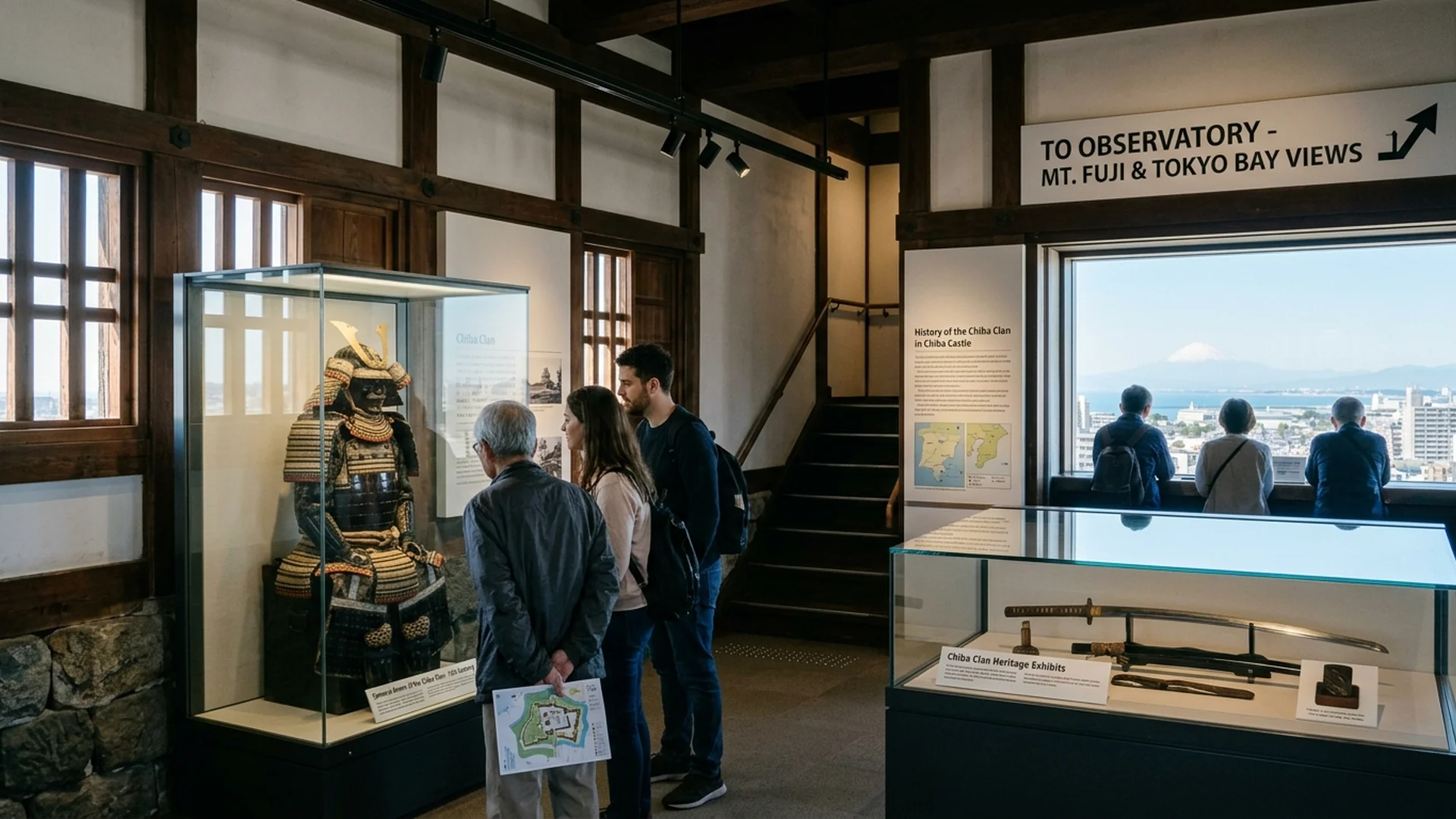
Stepping inside the five-story structure of the Chiba City Museum of Local History invites visitors to traverse time through an invaluable collection of exhibits. Each floor articulates a distinct narrative, ranging from ancient utilitarian implements and regional history to daily life and dedicated samurai armory chambers. The paramount highlights include venerable suits of samurai armor, intricately adorned kabuto helmets, and finely forged katana blades reflecting the peerless craftsmanship of historical swordsmiths. Furthermore, the uppermost observation level is thoughtfully engineered as a panoramic gallery, offering an expansive 360-degree vista encompassing the breadth of Chiba City. When atmospheric conditions align favorably, travelers may discern the unmistakable silhouette of Mount Fuji standing in majestic contrast against the distant horizon.
A Secret Cherry Blossom Haven and Seasonal Splendor
Beyond its profound historical significance, Chiba Castle is celebrated as one of the finest and most intimate cherry blossom viewing destinations in the prefecture. Throughout spring, spanning late March to early April, hundreds of sakura trees surrounding the keep burst into delicate pastel blossoms that offset the pristine white walls, creating scenes reminiscent of classical scrolls. After nightfall, traditional illuminations known as yozakura enhance the romantic, contemplative atmosphere. Within the wider Inohana Park grounds, visitors also encounter the historic Ochanomizu well—an ancient water source legendarily used to draw tea for high-ranking samurai commanders.