When the relentless hum of Tokyo begins to weigh heavily upon the senses, a brief journey of barely an hour and a half southward into the Boso Peninsula of Chiba Prefecture transports the traveler across the threshold of time. Here lies the Yoro Valley, a sanctuary where nature has woven a rich tapestry of vibrant autumn color, defying the earlier seasons of northern Kanto and holding its breathtaking peak from late November through early December.
This is far more than a mere destination for leaf-peeping; it is a landscape where time slows its cadence. The gentle murmur of crystal streams cutting through ancient strata, the crisp crunch of fallen leaves beneath footsteps, and the rising plume of mineral-rich thermal waters from primordial springs converge to create an unhurried, luxury wellness experience that discerning travelers continuously seek.
The Crimson Gem: Southern Kanto’s Most Poetic Autumn Tapestry
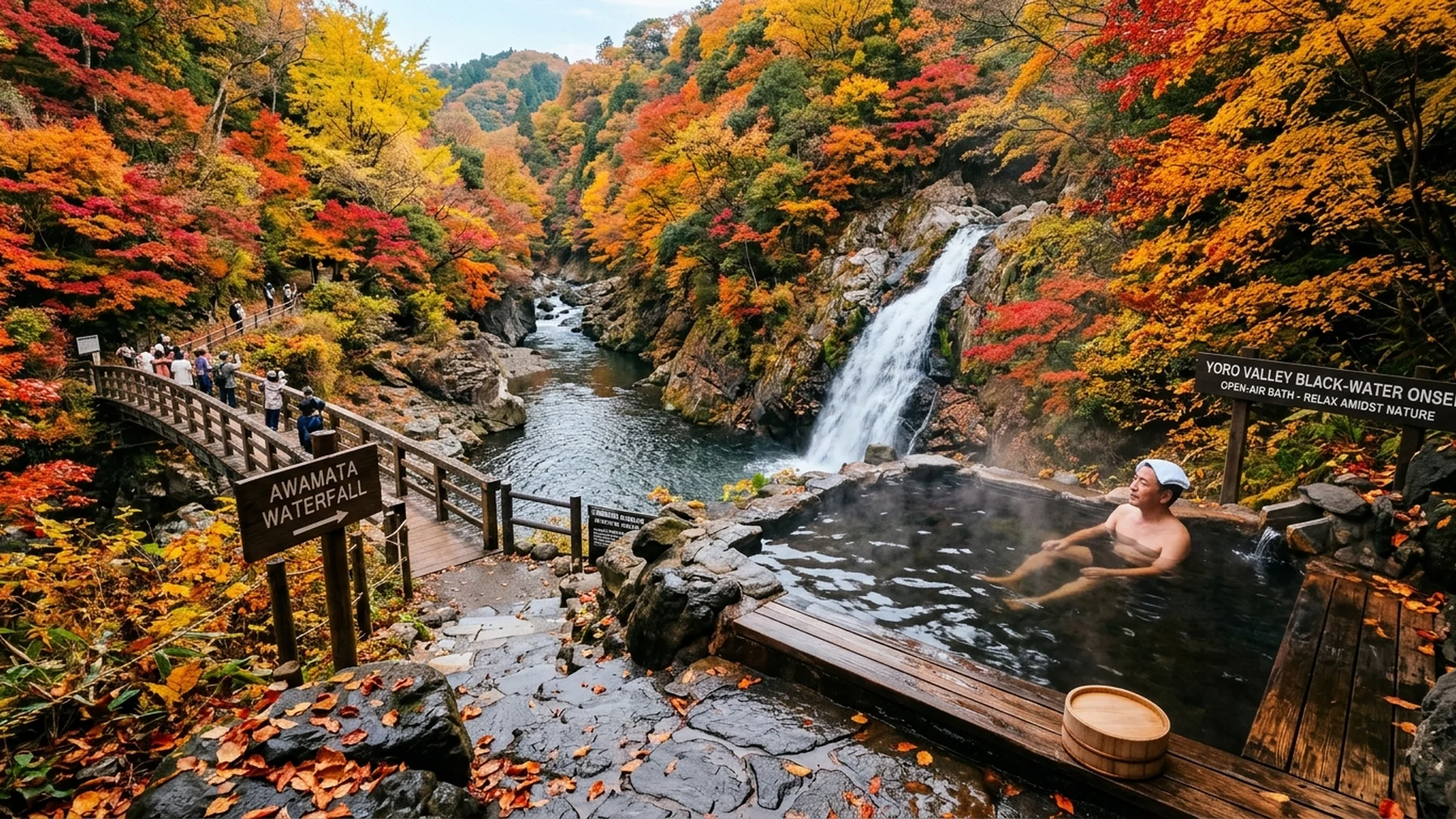
The true magic of the Yoro Valley in autumn lies in the astonishing intensity of its palette, which transitions effortlessly from the gilded gold of ancient beeches and warm ambers to the vivid vermilion of Japanese maples and lacquer trees reflecting upon the pristine surface of the Yoro River. The Yoro Valley hiking trails are thoughtfully integrated into the surrounding topography, inviting travelers to immerse themselves fully in the crisp, pristine air. Particularly enchanting are the Koboshi Suspension Bridge and Awamata Falls—a magnificent hundred-meter stepped cascade where dark, weathered stone formations stand in striking contrast to the fiery canopy above, evoking the timeless grace of classical East Asian ink paintings.
The Alchemy of Healing: The Secrets of the Boso Peninsula’s Kuroyu Onsen
Beyond the transcendent visual vistas, the valley conceals a deeply treasured secret for wellness seekers: the legendary ‘black-water onsen’ known locally as Kuroyu. These thermal springs possess a deep amber-to-espresso hue, born from the prolonged absorption of organic humic acids derived from millions of years of compressed subterranean fossilized plant matter. Upon contact with the skin, these mineral-rich waters impart a remarkable silkiness, deeply hydrating while stimulating circulation and dissolving the remnants of modern fatigue. Soaking in an open-air bath surrounded by fluttering autumn leaves, accompanied solely by the soundtrack of rushing water, represents the absolute zenith of contemplative repose.
Suspended in Time: Journeying Through the Valley via Vintage Rail
No exploration of the Yoro Valley can be considered complete without experiencing the historic Kominato Railway. This vintage cream-and-crimson locomotive traces a nostalgic path through terraced rural fields, rustic valley settlements, and lush arboreal tunnels. Particularly during the autumn transition, when the single-track railway is embraced by a canopy of brilliant foliage near Ichihara or Satsumoto stations, the experience evokes a profound sense of stepping backward into an era of unhurried grace and enduring tranquility.