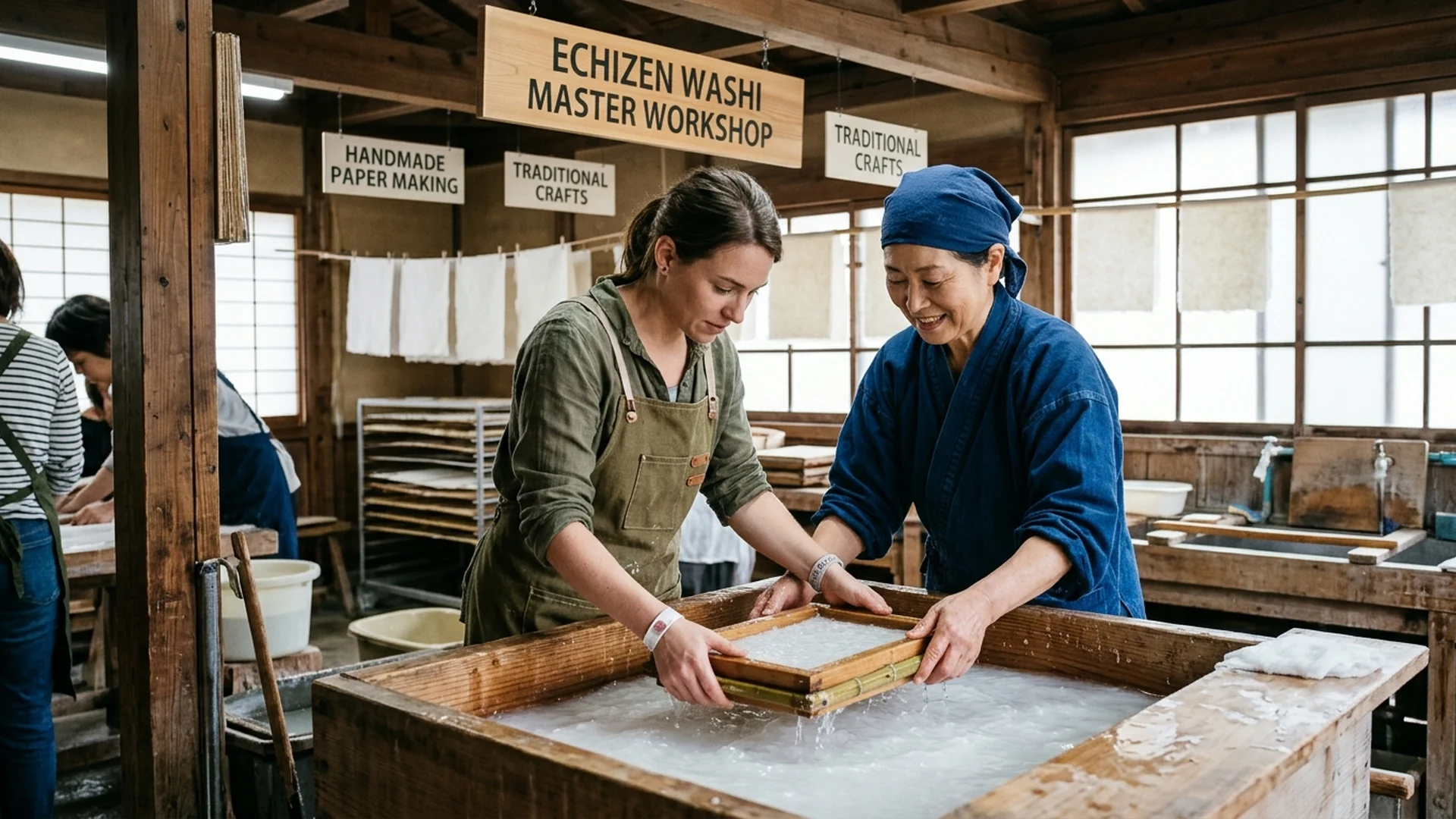
As crystal-clear waters meander through the verdant mountain valleys of Fukui Prefecture, they nourish more than just ancient forests. They are the lifeblood of a luminous, ivory tradition that has endured for over a millennium and a half. Arriving at Echizen Washi Village is never merely a cultural excursion; it is a profound retreat backward in time to the sacred roots of master craftsmanship, widely celebrated as one of the most venerable and treasured sources of washi paper in Japan.
Amidst lingering morning mists and the preservation-grade timber merchant houses of the Udatsu quarter, the gentle percussion of bamboo frames meeting pure water creates a timeless symphony. Here, every individual sheet of paper transcends its utilitarian purpose as a mere writing surface or wrapping medium. It becomes a living work of art, born from a delicate alchemy of pristine nature, glacial mountain streams, and unwavering human patience.
Legends of Water and the Paper Goddess: A 1,500-Year Ancestry
The chronicle of Echizen washi begins in antiquity. According to local lore, a celestial goddess descended into these forested ravines to instruct villagers in transforming natural botanical fibers into paper sheets of extraordinary thinness yet remarkable tensile strength. In profound gratitude, the community united to erect the Okamoto Otaki Shrine upon the forested slopes, dedicating their livelihoods to her benevolence. The enduring distinction of Echizen paper lies not merely in its antiquity, but in an uncompromising dedication to ancestral production standards. Artisans utilize pristine natural fibers such as kozo (paper mulberry), mitsumata, and gampi, blending them with mineral-rich mountain spring water. The resulting paper possesses legendary durability, resilience against the elements, and subtle textures that have made it indispensable for fine art, historical restoration, and archival preservation worldwide.
Architecture of Devotion: The Hidden Splendor of Okamoto Otaki Shrine
Ascending the moss-dappled stone stairway to Okamoto Otaki Shrine feels akin to stepping across the threshold of another realm entirely. The principal sanctuary building is designated as an Important Cultural Property of Japan, distinguished by intricate woodcarvings and masterclass multi-layered gable roofs that showcase the apex of historical carpentry. This sacred site serves as the spiritual heartland for the local papermaking community. Annual rituals are held here to express reverence to the natural world and the divine patroness who sustained the village through generations. Surrounded by towering centuries-old cedars, the tranquil ambiance invites quiet contemplation and a deep absorption of natural, grounding energy.
Contemporary Craft and the Master Art of ‘Kami-Suki’
Within the village, the Udatsu Paper Crafts Museum and the Papyrus House offer discerning travelers an intimate gateway into the precise discipline of ‘kami-suki’. Hand papermaking in the Echizen tradition demands absolute mental focus and precise kinetic intuition. The artisan must guide the bamboo screen (su) through a vat of suspended fibers with fluid grace, casting off surplus water in a single, deliberate motion so the fibers entwine uniformly. It is a profound synthesis of science and artistry requiring decades of mastery. Even for the transient visitor, crafting a personalized sheet of handmade washi—perhaps embedded with pressed mountain wildflowers or natural bark fragments—yields an irreplaceable, one-of-a-kind keepsake steeped in personal memory.