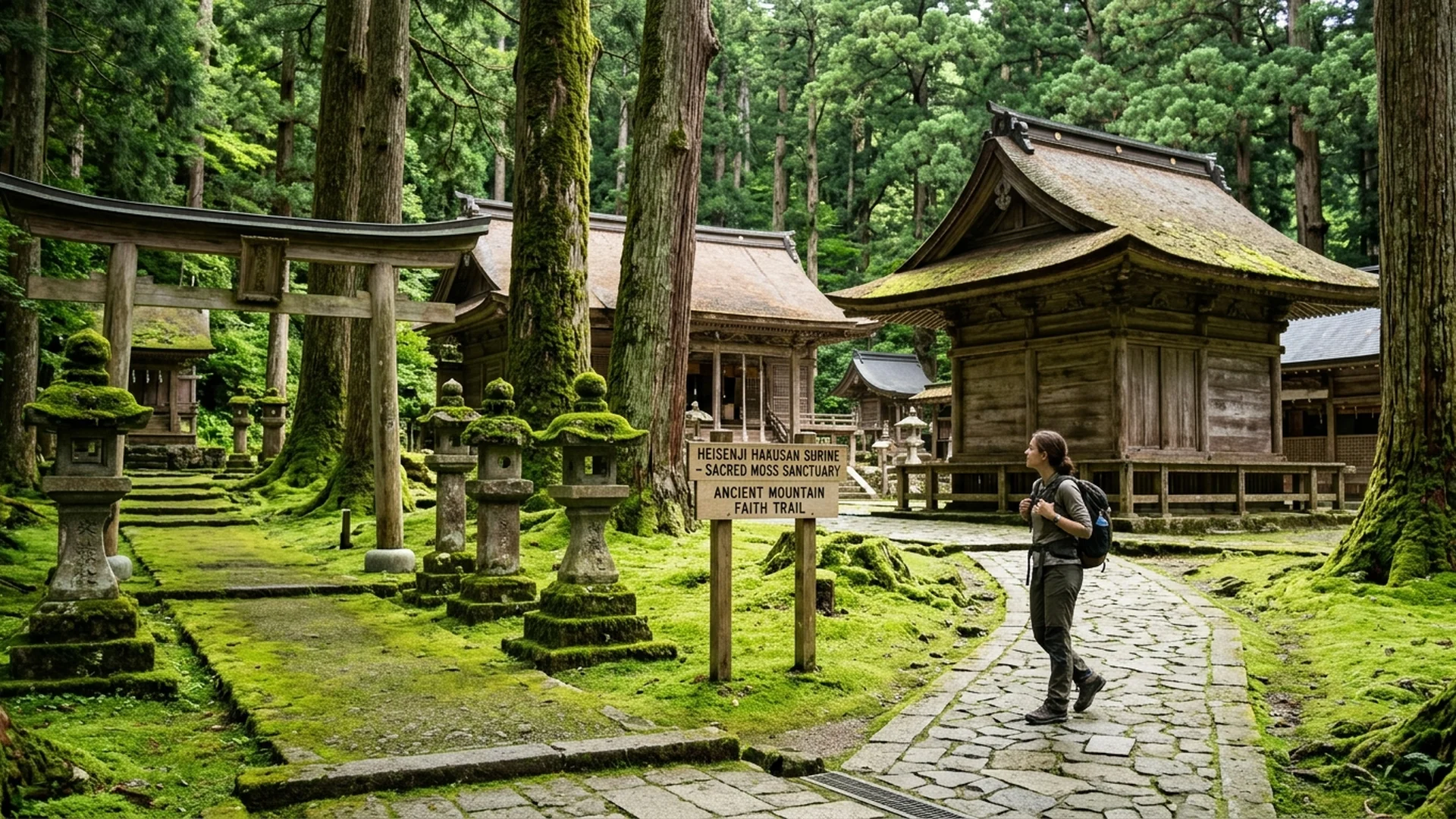
As the morning mist settles over the towering groves of ancient cedar trees in Katsuyama, Fukui Prefecture, footsteps naturally soften upon the damp, earthen paths. This tranquil realm seems determined to maintain a respectful distance from the restless cadence of the modern world. Welcome to Heisenji Hakusan Shrine, a sanctuary that transcends the traditional architectural boundaries of Japanese shrines to become a living cathedral immersed in nature.
The entire landscape is cloaked in a sprawling tapestry of vivid green moss, delicately hand-woven by time across historical ruins and stones that have silently witnessed over a millennium of devotion. Beneath this serene verdant beauty lies the profound history of a once-vast religious metropolis—a flourishing center of mountain asceticism along the sacred pilgrimage routes ascending Mount Hakusan, one of Japan’s three holiest peaks.
To wander these grounds is to step backward through the veils of time, tracing the ancient echoes of syncretic Shinto-Buddhist spirituality and absorbing the unhurried, restorative energy cultivated by centuries of quiet reverence.
From Monastic Metropolis to Mist-Shrouded Sanctuary
Founded in 717 AD by the revered ascetic master Taicho Daishi—who pioneered the sacred ascent of Mount Hakusan—Heisenji was never merely a modest rural shrine. In its medieval zenith, it operated as a sprawling religious city where thousands of monks and warrior-monks lived in quiet communion among hundreds of sub-temples and assembly halls. Fire and the tumultuous conflicts of the Sengoku period eventually consumed the physical structures, while the Meiji-era decree separating Shinto and Buddhism fundamentally reshaped its governance. Yet, despite the sweeping tides of history, the potent spiritual resonance of the ancient realm remains steadfastly anchored in every handful of emerald soil.
The Emerald Realm: Two Hundred Moss Species Beneath Ancient Cedars
Crossing the cedar-log torii gate feels akin to passing through a veil into another dimension. The canopy of towering Sugi trees filters the brilliant daylight into dappled, cathedral-like illumination. Beneath this arboreal shelter lies an uninterrupted sea of moss, comprising over two hundred distinct varieties thriving upon decaying roots, volcanic boulders, crumbling stone walls, and forgotten foundations. The radiant emerald tones contrast sharply against the dark, furrowed bark of ancient trunks, conjuring an atmosphere of profound stillness, mystery, and understated elegance that rivals the finest natural masterworks on earth.
Sanctuary Springs and Medieval Architecture
At the spiritual epicenter of the complex lies the Mitarashi-no-ike spring, a pristine natural basin fed by subterranean snowmelt descending from the heights of Mount Hakusan. According to local lore, this crystalline pool marked the miraculous appearance of the mountain deity. Its ice-cold, mineral-rich waters served as the essential purification station for medieval pilgrims preparing their bodies and minds for ascent. Nearby lie the evocative remnants of the Old Genseiin Garden, a medieval landscape design reflecting a refined aesthetic philosophy that seamlessly integrated stonework and water features into the primordial mountain wilderness.