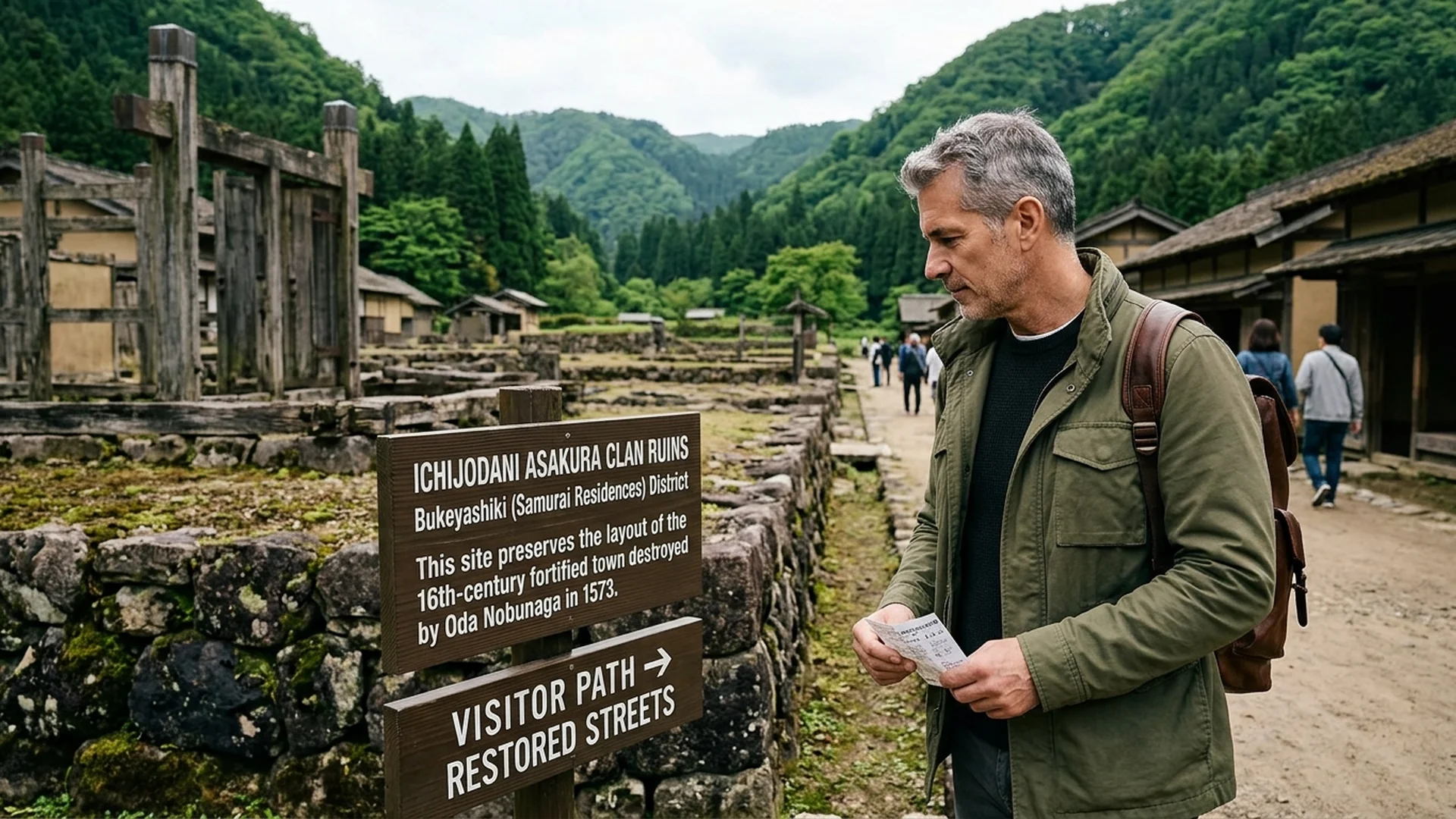
Amidst the tranquil, mist-shrouded valleys of Fukui Prefecture lies a feudal sanctuary frozen in time—often revered as the Pompeii of Asia. The Ichijodani Asakura Ruins are far more than mere archaeological foundations; they are a profound, living testament to the turbulent Sengoku period, an era when absolute power and lineage hung upon the edge of a katana. Here, the formidable Asakura clan once cultivated a magnificent metropolis nestled against a hidden gorge, only for it to be consumed by the ravages of war in 1573.
To walk the grounds of Ichijodani today is to turn the pages of a monumental chronicle long buried beneath centuries of undisturbed earth. Modern archaeological excavation has resurrected the city’s meticulous grid, ancient thoroughfares, contemplative stone gardens, and samurai residential quarters, breathing vitality back into the stones. Seamlessly bridged by the modern Hokuriku Shinkansen line, which welcomes global explorers to the majestic Hokuriku region with effortless speed, this destination offers an exquisite meditation on the balance between forward-looking progress and profound cultural preservation.
The Epic of Ichijodani: Glory, Devastation, and Resurrection
During the 16th century, Ichijodani stood as one of the Hokuriku region’s preeminent centers of politics, commerce, and high culture. Under the patronage of the influential Asakura clan, the city functioned as a miniature Kyoto, offering a secure haven for displaced scholars, poets, and master artisans fleeing the capital’s internecine conflicts. This golden age of opulence reached a tragic terminus when Oda Nobunaga, the visionary warlord who sought to unify war-torn Japan, unleashed a devastating assault that reduced the metropolis to ash in a matter of days. The searing intensity of those ancient flames effectively sealed Ichijodani’s historical chapter beneath the soil for over four centuries, until modern archaeology revealed a subterranean network of infrastructure standing in astonishingly orderly alignment.
Architecture and Landscape: Samurai Quarters and Zen Stone Gardens
Crossing the threshold into the excavation zone feels akin to stepping through a temporal portal. Wooden fences, cobbled stone pathways, and the foundational outlines of aristocratic estates are laid out with precision along the ancient city grid. A focal point that demands unbroken contemplation is the stark, black-lacquered Karamon Gate standing before Suisen-ji Temple—an original structure that miraculously withstood the historical inferno. Furthermore, the sprawling grounds of the Asakura family residences feature four distinct medieval estate gardens, widely celebrated as some of the oldest and most refined landscape designs in Japanese history. These grounds effortlessly harmonize native stones and the wild topography of the surrounding gorge through profound Zen philosophical principles.
A Contemporary Portal to Antiquity: The Asakura Family Site Museum
To fully contextualize the valley’s rich layers of history, the state-of-the-art Ichijodani Asakura Family Site Museum has been thoughtfully integrated into the natural landscape. Inside, more than 3,000 excavated artifacts are curated with exceptional refinement—ranging from everyday ceramics and imported porcelains to exquisite personal ornaments and military hardware. Sophisticated lighting design and immersive multimedia presentations allow discerning travelers to vividly reconstruct the aristocratic lifestyles of the era. Each exhibited fragment whispers tales of extraordinary craftsmanship, proving that refined aesthetic sensibilities flourished even amidst an age of relentless conflict.