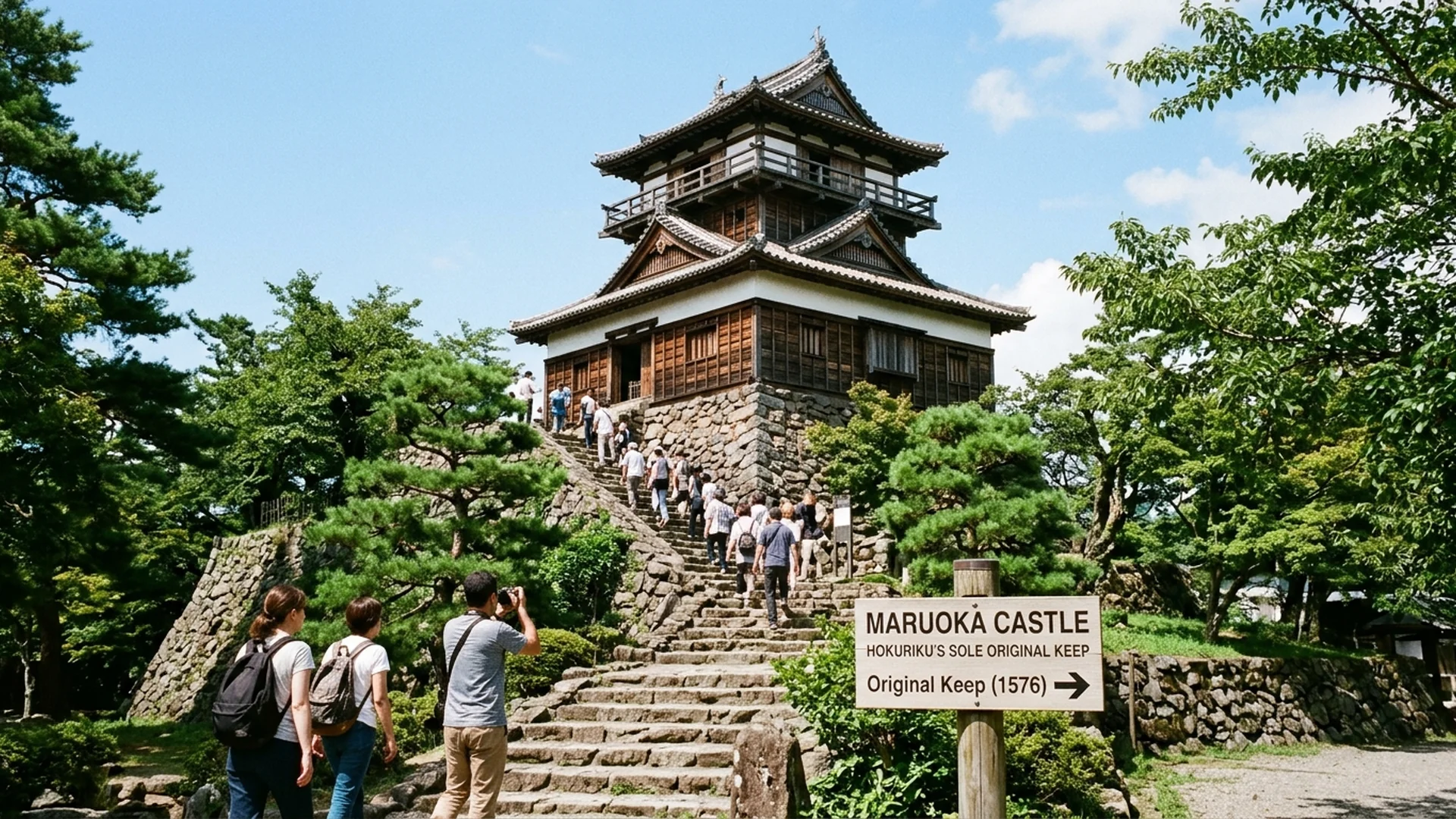
Across the sweeping expanse of the Hokuriku region, whispers of antiquity drift in on the dawn mists that cradle the skies of Fukui Prefecture. Here stands Maruoka Castle, poetically christened Kasumi-ga-jo—the Mist Fortress—a steadfast sentinel that has weathered the shifting tides of time for over four centuries. As one of only twelve surviving original keeps (Genson Juni Tenshu) in all of Japan, it preserves its pure wooden structure untouched by modern reconstruction, offering discerning travelers a rare portal into the past.
Stepping across the ancient stone ramparts of Maruoka is far more than a routine heritage visit; it is an unhurried pilgrimage back to the Sengoku period, an era of intense philosophical and military upheaval. Here, the austere elegance of samurai strategy merges seamlessly with the surrounding topography. This crown jewel of Fukui not only anchors regional history but also reveals an architectural singularity that commands the attention of anyone captivated by the deeper currents of Japanese culture.
Sengoku Roots and the Legend of the Mist Fortress
Maruoka Castle was established in 1576 by Shibata Katsutoyo, nephew of the formidable general Shibata Katsuie under the hegemony of Lord Oda Nobunaga. Amidst the volatile political climate of the civil war era, local folklore birthed the moniker ‘Mist Fortress.’ Legend holds that whenever hostile armies approached, a dense, supernatural fog would descend to envelop the citadel, completely veiling it from view. In truth, this phenomenon was a testament to brilliant geographic selection and an astute understanding of Hokuriku’s microclimate, utilizing nature itself as a defensive shield. Having survived the turbulent regime changes and the destructive castle demolition edicts of the Meiji era, the main tower (Tenshu) eventually attained designation as a Important Cultural Property of Japan.
Architectural Marvels: Shakudani Stone and a 65-Degree Ascent
From an architectural standpoint, Maruoka Castle displays an intimate harmony with the natural world. The roof of the keep is shingled with ‘Shakudani stone,’ a deep greenish-blue volcanic rock quarried exclusively within Fukui Prefecture. Beyond resisting the harsh winter elements and heavy accumulations of snow, these heavy tiles—weighing a staggering 120 tons in total—exert downward pressure that stabilizes the intricate wooden framework below without relying heavily on iron nails.
Upon stepping inside, visitors are immediately met with the formidable challenge of the interior staircase, pitching upward at an uncompromising 65 degrees. This makes it the steepest ascent among all surviving original keeps in Japan. Reaching the upper tier requires a measured, mindful climb, aided by thick hemp ropes provided for leverage. The interior is redolent with the scent of aged pine. At the summit, the panoramic view over the Fukui plains unfolds, framing the very strategic expanse once surveyed by samurai commanders.
Miraculous Restoration and the Legacy of the Fukui Earthquake
The chronicle of Maruoka Castle has not been without trial. On June 28, 1948, a massive seismic event known as the Fukui Earthquake struck the region with devastating force, causing the entire wooden tower of Maruoka Castle to collapse. The sight of the fallen timber structure dealt a profound emotional blow to the local community.
Yet, driven by a fierce devotion to their cultural heritage, the citizens of Maruoka mobilized a monumental restoration effort, determined to reassemble the original timbers with meticulous care. More than seventy percent of the original materials—including the Shakudani stone roof slabs and key wooden pillars that survived the rubble—were painstakingly reintegrated, breathing new life into the fortress by 1955. This miraculous resurrection stands as an enduring testament to the resilience of the local spirit in the face of natural disaster.