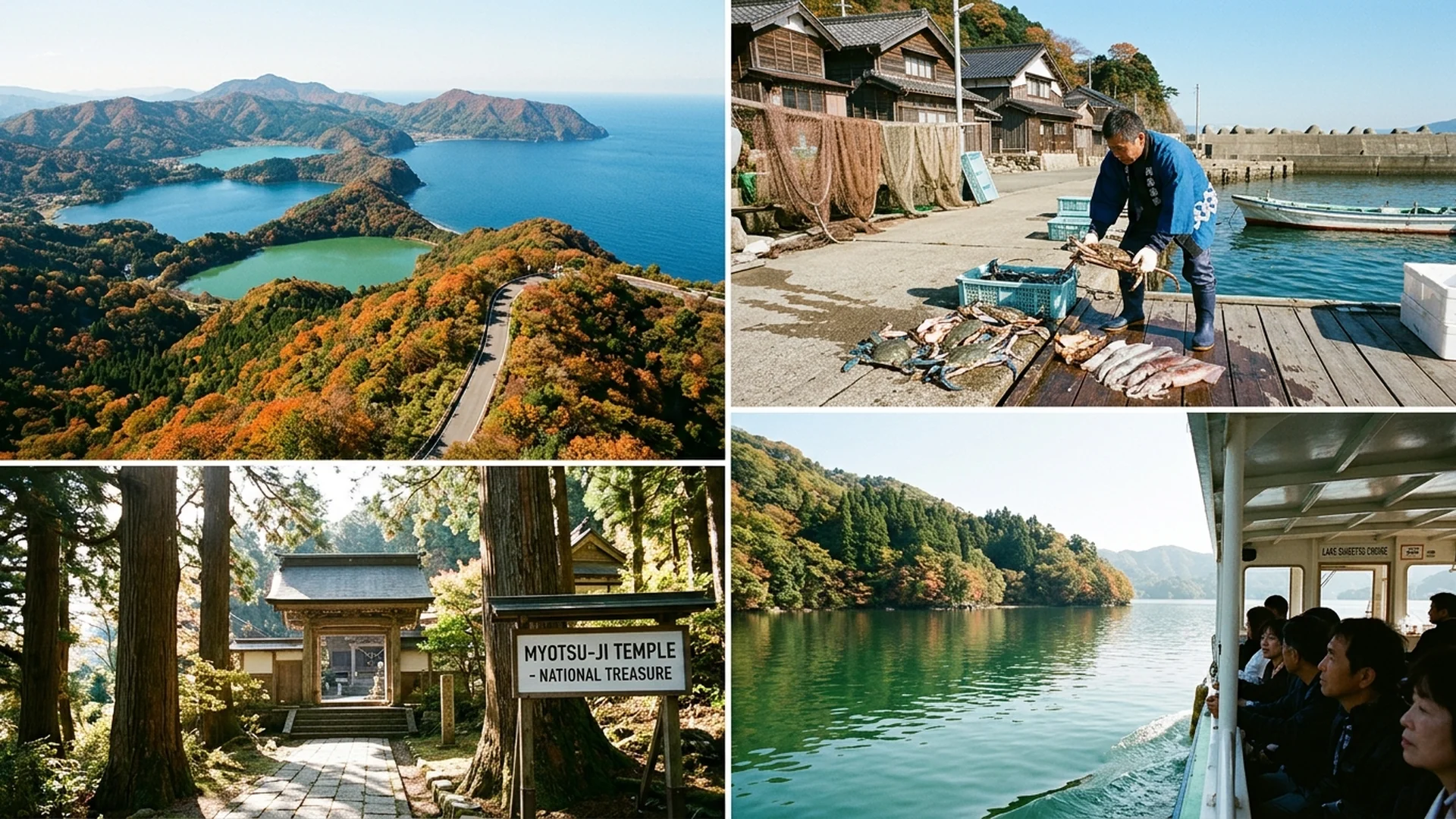
As modern travel increasingly shifts from frantic accumulation toward a deeper quest for meaning, regions long bypassed by mainstream itineraries begin to whisper with quiet power. On the southern peninsula of Fukui Prefecture, nature has composed a masterpiece of color and calm where the vast expanse of Wakasa Bay embraces the shore. Here lies the basin of the Mikata Five Lakes, a sanctuary where time and water have sculpted an untouched landscape destined to redefine the very essence of quiet retreat.
The fascination of Wakasa Bay and its five shimmering lakes extends far beyond mere picturesque charm; it is rooted in a complex ecology. Each of the five lakes possesses a distinct salinity, depth, and chemical composition, causing them to reflect sunlight in remarkable gradients of azure, emerald, and deep indigo, as if brushed by an artist’s hand. When beheld from the high vantage of the legendary Rainbow Line, this juxtaposition of the Sea of Japan’s briny depths with freshwater and brackish expanses reveals an ecological wonder rarely witnessed elsewhere in East Asia.
Decoding the Five-Color Secret and Ecological Symphony
Viewed from the shoreline, the Mikata Five Lakes might initially resemble ordinary bodies of water. Yet a fascinating reality lies hidden beneath their physical distinctions. Ranging from Lake Mikata, which is entirely freshwater, to Lake Suigetsu (brackish), Lake Kugushi, Lake Hiruga, and Lake Hyuga—the latter two connected directly to the Sea of Japan with high salinity—each lake harbors a singular ecosystem. Varying in depth from mere meters to several dozen, their waters refract sunlight differently each day, producing breathtaking contrasts of clear turquoise, translucent green, and midnight blue.
This aquatic diversity transcends mere aesthetics; it functions as a living classroom. These lakes have sustained local communities for generations, serving as vital habitats for rare aquatic species and standing as enduring testaments to nature’s adaptability along the rugged frontier where mountains meet the sea.
The Sky Terraces of the Rainbow Line and Panoramic Ridge
To fully comprehend the sweeping dimensions of Wakasa Bay and the five lakes, one must ascend the winding ridge of the scenic Rainbow Line drive, which culminates at the meticulously designed Rainbow Line Summit Park.
Here, five distinct sky terraces are thoughtfully positioned to capture different facets of the horizon: the endless blue of the Sea of Japan, the graceful curve of Wakasa Bay, and the glittering mirrors of the lakes far below. Pausing to unwind at the Foot Bath Terrace while crisp alpine breezes sweep across the expanse offers the definitive expression of mindful, unhurried travel.
Seventy Millenniums of Time at the Lake Suigetsu Varve Museum
Deep beneath the floor of Lake Suigetsu rests an ancient chronicle of the earth largely unknown to humanity until scientists unlocked its secrets: varves, or extraordinarily precise layers of sediment that have accumulated without interruption for more than 70,000 years. Comparable to the growth rings of an ancient tree, these strata record global climate fluctuations, natural disasters, and prehistoric volcanic eruptions with astonishing fidelity.
The Lake Suigetsu Varve Museum transcends conventional exhibition spaces, serving instead as a world-class scientific institution that illuminates the passage of deep time. Through displays featuring dozens of meters of genuine sediment cores, the museum provides the absolute chronological standard utilized by archaeologists worldwide to date ancient artifacts with pinpoint precision.
A Legacy of Taste: Where Wakasa Bay Meets the Saba Kaido
In bygone eras, Wakasa Bay functioned as Miketsu-kuni, the sacred imperial larder that supplied fresh provisions to the ancient capitals of Kyoto and Nara. Prized catches—most notably mackerel and Wakasa fugu—were transported inland along the historic network of mountain tracks known as the Saba Kaido, or Mackerel Road.
Culinary preservation techniques such as heshiko—fish cured meticulously in salt and rice bran—arose from the practical necessity of sustaining food supplies during arduous mountain journeys. Today, this tradition endures as a treasured culinary heritage, inviting discerning travelers to savor an authentic flavor profile born of the profound interplay between humanity, rugged peaks, and the sea.