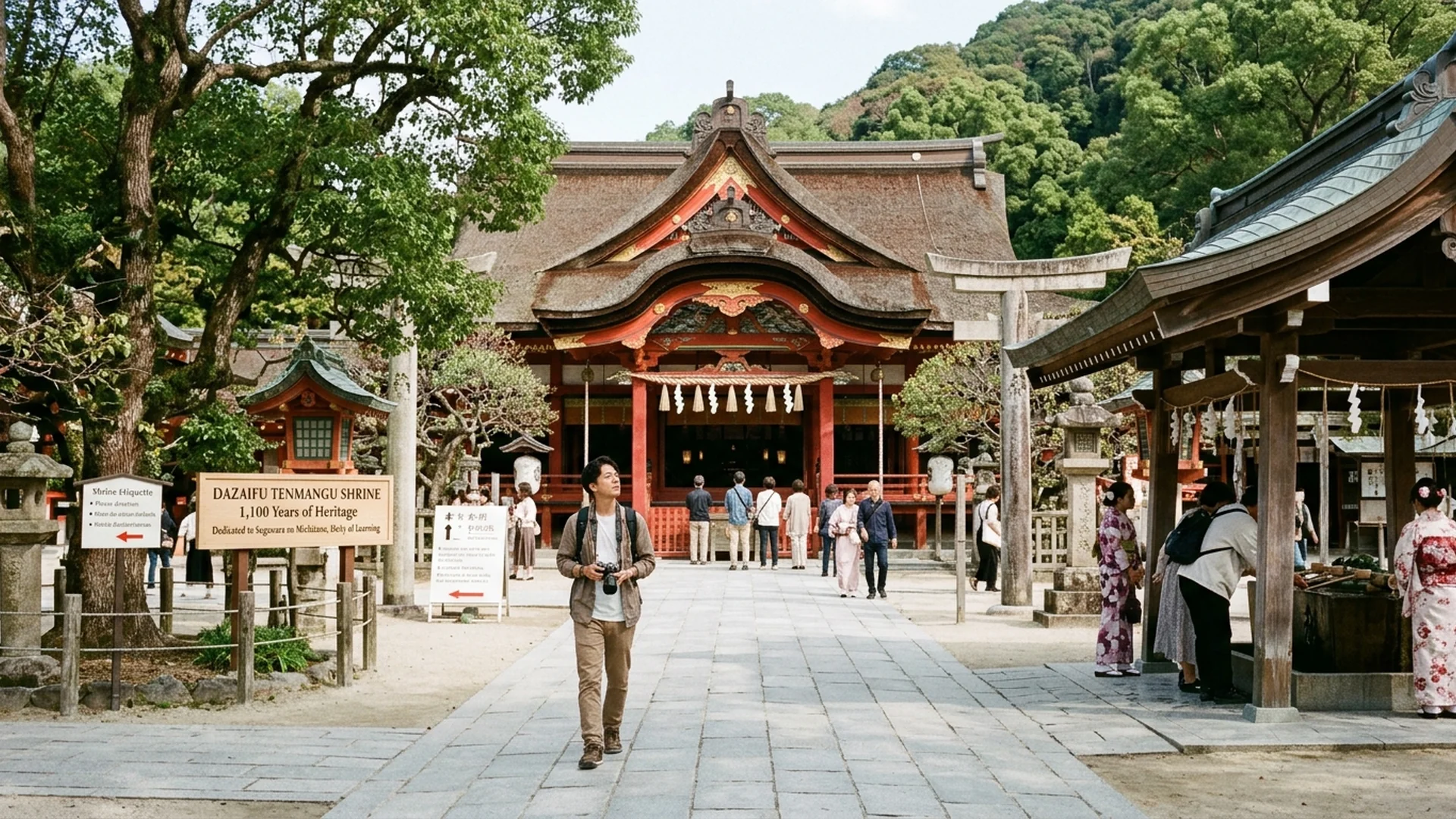
Crossing the first vermilion torii gate into the dense, ancient groves of Dazaifu Tenmangu, the clamor of the modern world dissolves into a quiet wind whispering through thousands of sacred trees. This is far more than a historical landmark in Fukuoka; it is a profound spiritual epicenter pulsing with over eleven centuries of devotion, art, and untamed nature.
Approaching Dazaifu Tenmangu with an unhurried, contemplative eye transforms a simple pilgrimage for academic blessings into an intimate encounter with the philosophy of time. Walking across the trio of sacred arched bridges bridges past, present, and future, while marveling at the seamless dialogue between ancient Shinto sanctity and avant-garde contemporary architecture. It stands as a living museum, continually narrating its enduring story upon a canvas of timeless faith.
The Philosophy of Time Across Three Bridges and the Legacy of the Scholar Deity
Before the hiragana-shaped Kokoro pond—meaning ‘heart’—stands the trio of Taikobashi arched bridges: a straight stone span representing the past, a flat wooden deck for the present, and a steeply curved stone bridge symbolizing the future. Walking these bridges according to ancient custom is not merely physical transit, but a meditative exercise in clearing away yesterday, anchoring oneself completely in today, and stepping toward tomorrow with a purified spirit.
Deep within the sanctuary rests the spirit of Sugawara no Michizane, a brilliant Heian-period scholar, poet, and statesman who was unjustly exiled to the remote reaches of Dazaifu. His profound sorrow and ultimate purity transformed into a sacred legend that draws millions seeking wisdom and scholastic success. Surrounding the sanctuary stand over 6,000 ‘Tobiume’ plum trees, whose ancient legend whispers that they flew here in steadfast loyalty to their master, blooming each spring ahead of all others across the land.
Timeless Architecture: From Momoyama Grandeur to Global Masterpieces
Another captivating dimension of Dazaifu Tenmangu is its harmonious synthesis of ornate Momoyama-style traditional carpentry—adorned with intricate, vibrantly painted wood carvings—and daring contemporary design. The bustling Sando approach leading to the sanctuary is elevated by the iconic Starbucks storefront designed by master architect Kengo Kuma. Utilizing over 2,000 interwoven lengths of natural cedar without a single nail, the structure brilliantly echoes the geometries of nature.
Furthermore, during the comprehensive restoration of the 400-year-old main honden sanctuary, a temporary hall featuring a cascading rooftop sky forest was crafted by leading architect Sou Fujimoto. This visionary intervention demonstrates a deeply respectful and poetic continuity, marrying ancient rites with modern structural innovation.
Flavors of Legend: Savoring Umegae Mochi and Local Atmosphere
No pilgrimage to Dazaifu is complete without tasting ‘Umegae Mochi,’ a thin-crusted, piping-hot rice cake filled with sweetened azuki bean paste and stamped with a plum blossom crest. The origins trace back to the days of Michizane’s exile, when an elderly local woman named Tomo wrapped rice and bean paste around a plum branch to nourish the fallen nobleman. The fragrant, crispy exterior yielding to a tender, sweet core is far more than a roadside delicacy; it is a tangible taste of empathy and enduring human connection across the centuries.
Strolling down the vibrant shopping lane while sipping green tea amid historic storefronts completes the cultural gastronomy of the journey. Every bite anchors the traveler more deeply into the enduring rhythm of life across Kyushu’s historic heartland.