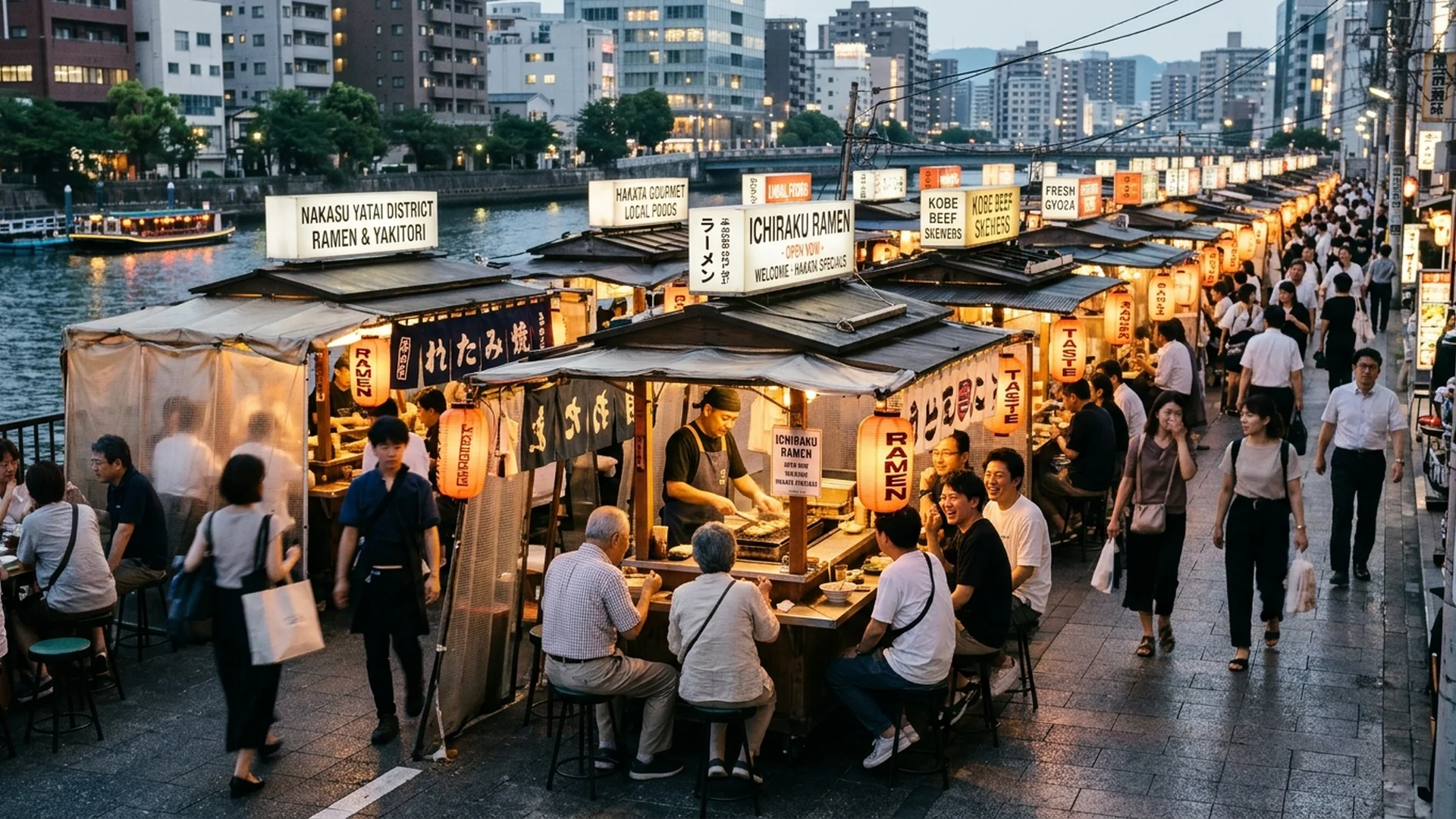
As dusk descends and neon shadows begin to dance across the serene expanse of the Naka River, the rhythmic clatter of wooden wheels and the rich, comforting aroma of simmered pork bone, shoyu, and garlic signal the awakening of the Nakasu Yatai District. This is far more than a mere collection of roadside food stalls; it is an intimate, open-air salon where travelers and locals of every background dissolve into one another beneath the sheltering white canvas of traditional Japanese street stalls, known as yatai.
This ambient warmth, suspended in the crisp evening air along the waterfront, reflects the deep-rooted cultural legacy of Fukuoka. Here, time-honored traditions continue to draw discerning voyagers close to the beating heart of Hakata. To perch shoulder-to-shoulder on a humble wooden stool, enveloped in animated chatter and the radiant hospitality of the master chef, is an art of nocturnal living simply unmatched by any fine-dining establishment in the world.
From Post-War Origins to Modern Canvas: The Living Breath of Hakata
The yatai culture of Fukuoka did not emerge by chance; it is anchored in a history stretching back to the Meiji era and blossoming vividly in the aftermath of the Second World War. Historically, hundreds of these mobile stalls lined the city streets before sweeping urban reorganizations streamlined them to preserve hygiene and scenic grace, leaving roughly a hundred master-operated stalls concentrated primarily in the Nakasu and Tenjin districts. The extraordinary nature of a yatai lies in its ingenious timber architecture, designed to be fully assembled and dismantled within hours—a true mobile structure housing the collective memories and living soul of generations. When you part the noren curtain and slip inside, seating yourself within arm’s reach of your neighbors, the barrier of strangerhood evaporates entirely, replaced by spirited, erudite conversation sparked over a shared meal.
A Masterclass in Flavor: From Hakata Ramen to the Art of Broth
No exploration of Fukuoka’s street gastronomy is complete without confronting the phenomenon of Hakata ramen. Distinguished by its milky, collagen-rich tonkotsu broth simmered relentlessly over hours until velvety and deeply complex, it is paired with firm, slender noodles and the delightful option for kaedama—a second serving of noodles ordered mid-meal. Beyond the noodles, Nakasu yatai have forged renown through a miniature universe of izakaya delicacies. Steaming oden yields daikon radish and boiled eggs saturated with savory dashi down to their core; binchotan-grilled yakitori releases an exquisite smoky perfume; and pan-seared Hakata gyoza arrive with golden, crispy skirts, designed to be paired with an ice-cold beverage that cuts cleanly through the richness.
The Art and Etiquette of Yatai Dining: An Insider’s Code
Approaching a yatai with grace requires an appreciation of its unwritten rules. Because physical space is remarkably intimate—typically accommodating only eight to ten guests at a time—fluid turnover and mindful spatial sharing are paramount. Once your meal concludes and the bill is settled, courtesy dictates prompt departure to allow the next waiting guests their moment at the counter. Furthermore, standard etiquette begins with ordering a beverage per person before exploring the culinary menu, and strictly prohibits bringing outside food or drink onto the premises. Observing these subtle protocols not only safeguards the delicate equilibrium of this communal micro-culture but also signals the deep cultural fluency expected of the modern traveler.