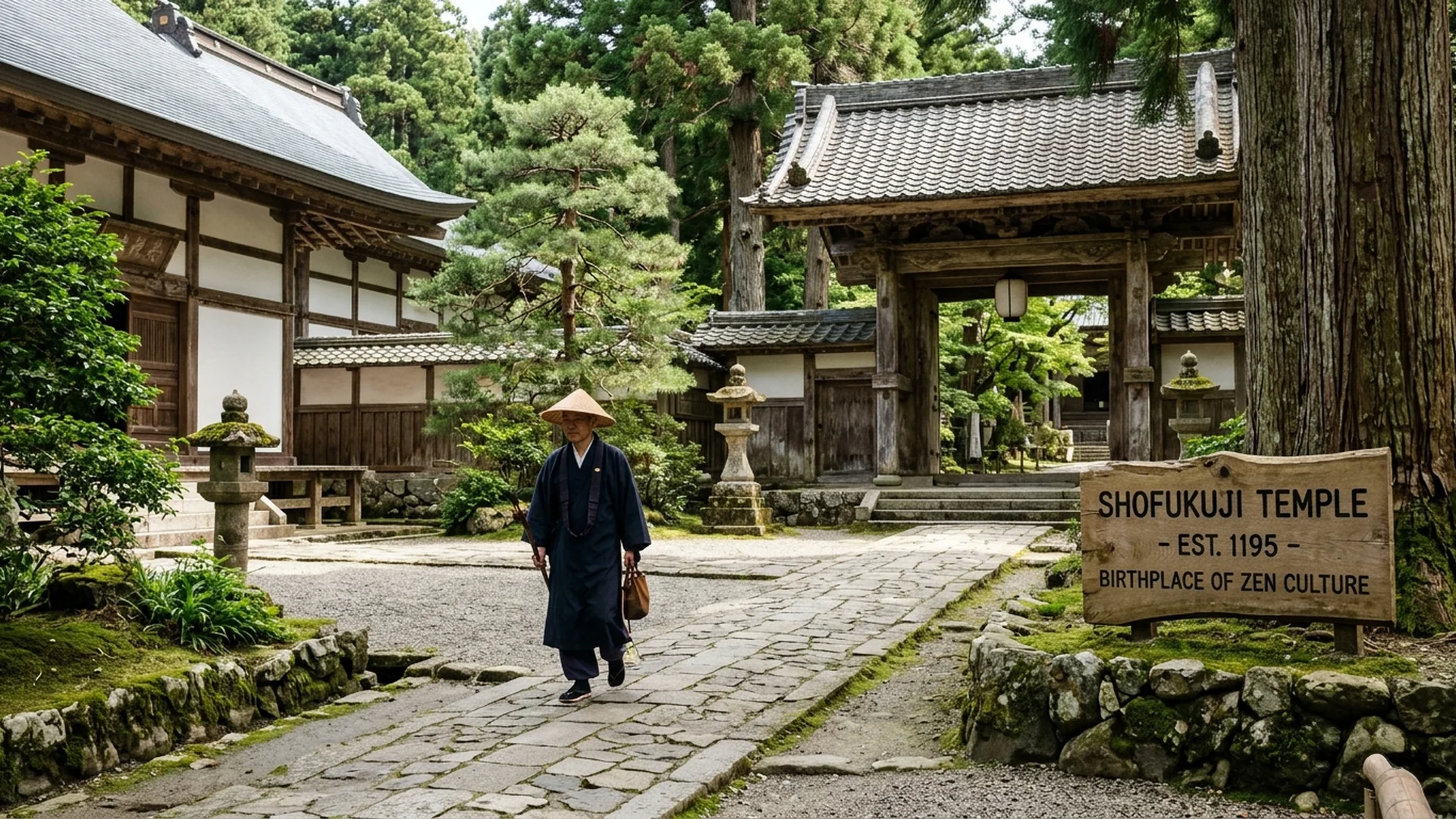
Amidst the vibrant commercial bustle and luminescent lights of Hakata in Fukuoka Prefecture, a sacred sanctuary exists where time appears to quietly stand still. The moment one steps past the weathered wooden fencing and ancient temple gates, the ambient roar of the outside world recedes, replaced entirely by the gentle rustle of wind sweeping through towering pine canopies and swaying bamboo groves. This is Shofukuji Temple, a domain of profound serenity that transcends the conventional definition of a religious site to stand as a monumental cradle in Japanese history—the nation’s very first Rinzai Zen Buddhist temple, founded in 1195.
Visiting Shofukuji is akin to opening a portal to the past, offering discerning travelers an intimate encounter with the spiritual roots that have quietly shaped Japanese aesthetics and philosophy for over eight centuries. This is the consecrated ground where the visionary monk Eisai, returning from his rigorous studies in Song Dynasty China, laid the foundational stones for disciplined Zen contemplation while simultaneously planting the seeds of an enduring green tea culture. For the global wanderer seeking intellectual depth and the unadorned elegance of wabi-sabi, Shofukuji is an invaluable pilgrimage to be approached with an open and reverent heart.
The Dawn of Zen on Japanese Soil: Eisai’s Footsteps and the Glory of Hakata
During the twilight of the Heian period and the dawn of the Kamakura era, amidst sweeping political and societal shifts, a visionary monk named Eisai journeyed across the sea to China. Upon returning to Japan in 1195 with the patronage of Shogun Minamoto no Yoritomo, he chose the bustling port city of Hakata—then Japan’s primary gateway to the Asian continent—as the site to establish Shofukuji as the nation’s premier Zen sanctuary.
The emergence of Shofukuji was far more than the construction of a mere house of worship; it ignited a profound intellectual renaissance. Zen philosophy, which emphasizes silent meditation, rigorous self-discipline, and direct awakening to inner truth, resonated deeply with the samurai elite and the nation’s rulers. At the height of its historical splendor, the temple complex commanded over thirty-eight sub-temples and residential quarters, serving as the throbbing spiritual and cultural heart of the entire Kyushu region.
Architecture of Emptiness: Decoding Aesthetics Through the Sanmon Gate and Sacred Halls
The architectural framework of Shofukuji strictly adheres to classical Zen design principles—uncompromising simplicity, freedom from superfluous ornamentation, and a breathtaking sense of spatial equilibrium. Upon entering the sacred precinct, visitors encounter a tranquil pond and a graceful stone bridge leading toward the magnificent Sanmon Gate. This venerated wooden gateway, reconstructed in later centuries, proudly bears an imperial plaque inscribed in the personal brushstrokes of Emperor Go-Toba, proclaiming the site as the premier Zen sanctuary in the realm.
Beyond the gate stands the Butsuden, or Buddha Hall, which enshrines an ancient wooden sculpture of the Buddha beneath a mesmerizing ceiling painting of a protective dragon. While the inner sanctums remain preserved primarily for the daily rituals of the resident monastics, viewing the structures from the tranquil pathways enveloped in lush greenery offers a potent infusion of restorative calm.
The Stream of Leaves: From Sovereign Elixir to the Foundations of Chanoyu
Beyond his tireless dissemination of Zen doctrine, Eisai fundamentally transformed Japanese gastronomy and culture by bringing tea seeds and the art of grinding green tea leaves back from China. He subsequently authored the seminal treatise Kissa Yojoki (Treatise on Drinking Tea for Health), championing the beverage as a medicinal elixir capable of invigorating both mind and body.
Initially, matcha was not consumed for leisurely recreation; rather, it was an indispensable tool for Zen monks striving to ward off fatigue during hours of silent seated meditation. By cultivating these early tea plants within the grounds of Shofukuji and upon nearby Mount Sefuri, the temple secured its proud legacy as the cradle of Japanese green tea culture—an agricultural and spiritual triumph that eventually flowered into the world-renowned art of the Japanese tea ceremony.