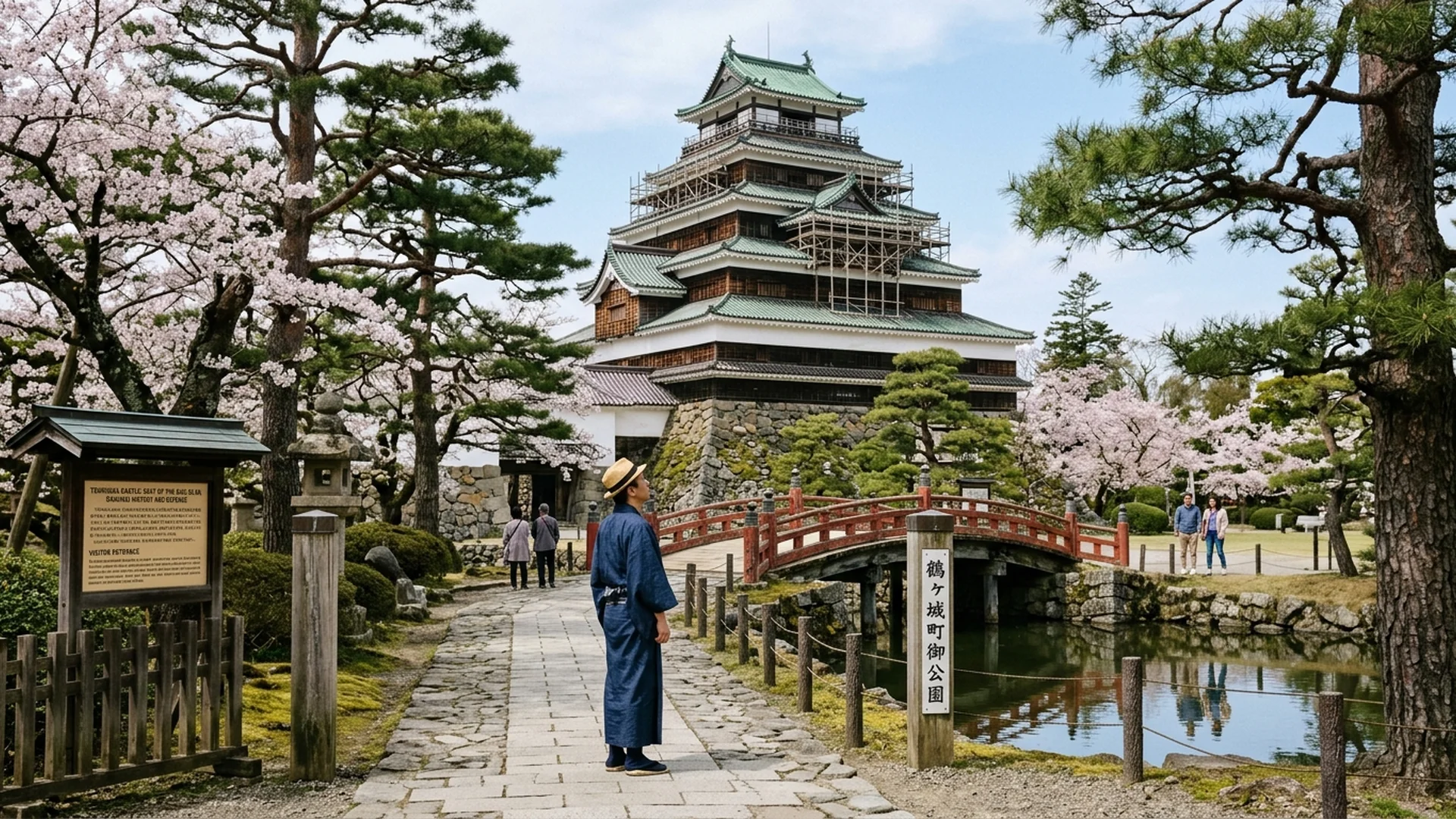
As the morning mists gently lift from the folding ridges of Fukushima Prefecture, the echoes of centuries past begin to whisper across the Aizu basin. Aizuwakamatsu is a domain where time unhurriedly slows its pace—a sanctuary where the unyielding spirit and profound devotion of the last samurai of the Edo period remain deeply embedded in every facet of the earth. Beyond its rich historical legacy, this destination seamlessly harmonizes cultural splendor, distinctive architectural ingenuity, and tranquil natural beauty into an unforgettable tapestry.
Crossing the threshold into Aizuwakamatsu is akin to turning the pages of an essential historical manuscript that every discerning traveler seeking profound meaning must experience at least once. Here, haste is absent, replaced entirely by the nostalgic scent of aged timber, the fragrant aroma from centuries-old sake breweries, and the flawless reflection of an ancient fortress mirrored upon pristine waters, narrating tales of unwavering loyalty and quintessential Japanese craftsmanship.
Tsuruga Castle and Sazaedo Temple: A Poetic Symphony of Architecture and Samurai Spirit
The heart of Aizuwakamatsu is steadfastly guarded by the quiet elegance of Tsuruga Castle, a historic bastion that has weathered the tempests of time while serving as the seat of power for influential samurai lords. Its most arresting feature is the brilliant expanse of crimson-red roof tiles—a rare departure from the somber black or gray tiles standard across Japanese fortifications. Whether blanketed in winter snows or framed by delicate spring sakura blossoms, this vivid contrast transforms the landscape into a living ink wash painting. Within its storied walls, the castle houses a deeply moving museum dedicated to the legacy of the samurai and the profound tragedies of the Bakumatsu era.
Not far away stands the Sazaedo Temple, one of the most structurally unique sacred buildings on earth. Erected in 1796, this three-story hexagonal wooden pagoda features an ingenious double-helix staircase designed with strictly separated paths for ascent and descent. Consequently, pilgrims traversing the structure never cross paths with one another. Constructed entirely without a single iron nail, the temple reflects both the genius of historical master carpenters and the Buddhist philosophy of cyclic spiritual liberation.
Craft Legacies and the Taste of Aizu: Artistry Tangible in Every Breath
The soulful essence of Aizuwakamatsu extends far beyond historical chronicles, pulsating vibrantly through the skilled hands of local artisans. Aizu lacquerware, known locally as Aizu-nuri, is a master craft spanning over four hundred years of meticulous heritage. The refined art of gold-dusted urushi application, delicate natural motifs, and the velvety smoothness felt upon first touch all speak to an enduring patience passed down through generations.
Simultaneously, the region’s pristine snowmelt and exceptional rice varieties have elevated Aizu into one of Japan’s premier sake-producing terroirs. Traditional breweries line the historic streets, inviting travelers into the delicate mysteries of artisan fermentation. To sip a glass of crystal-clear sake carrying subtle notes of orchard fruits and refined grain amidst the crisp mountain air is an unhurried, high-end pleasure found nowhere else.
Higashiyama Onsen: Serene Contemplation in the Embrace of Nature
Following days immersed in history and fine craft, a journey into the valley of Higashiyama Onsen—located just moments from the city center—offers a restorative reward for body and mind. Flowing continuously for thirteen centuries, these mineral-rich thermal waters are renowned for their therapeutic properties and skin-softening purity.
Residing in a traditional ryokan situated beside the rushing waters of the Yukawa River, where the murmur of the stream harmonizes with rustling foliage, delivers an exclusive retreat experience. Bathing in an open-air rotenburo while observing the forest foliage transition through the seasons—from fiery autumn maples to snow-laden pines under a winter moon—embodies the true definition of stepping away from the clamor into meditative stillness.