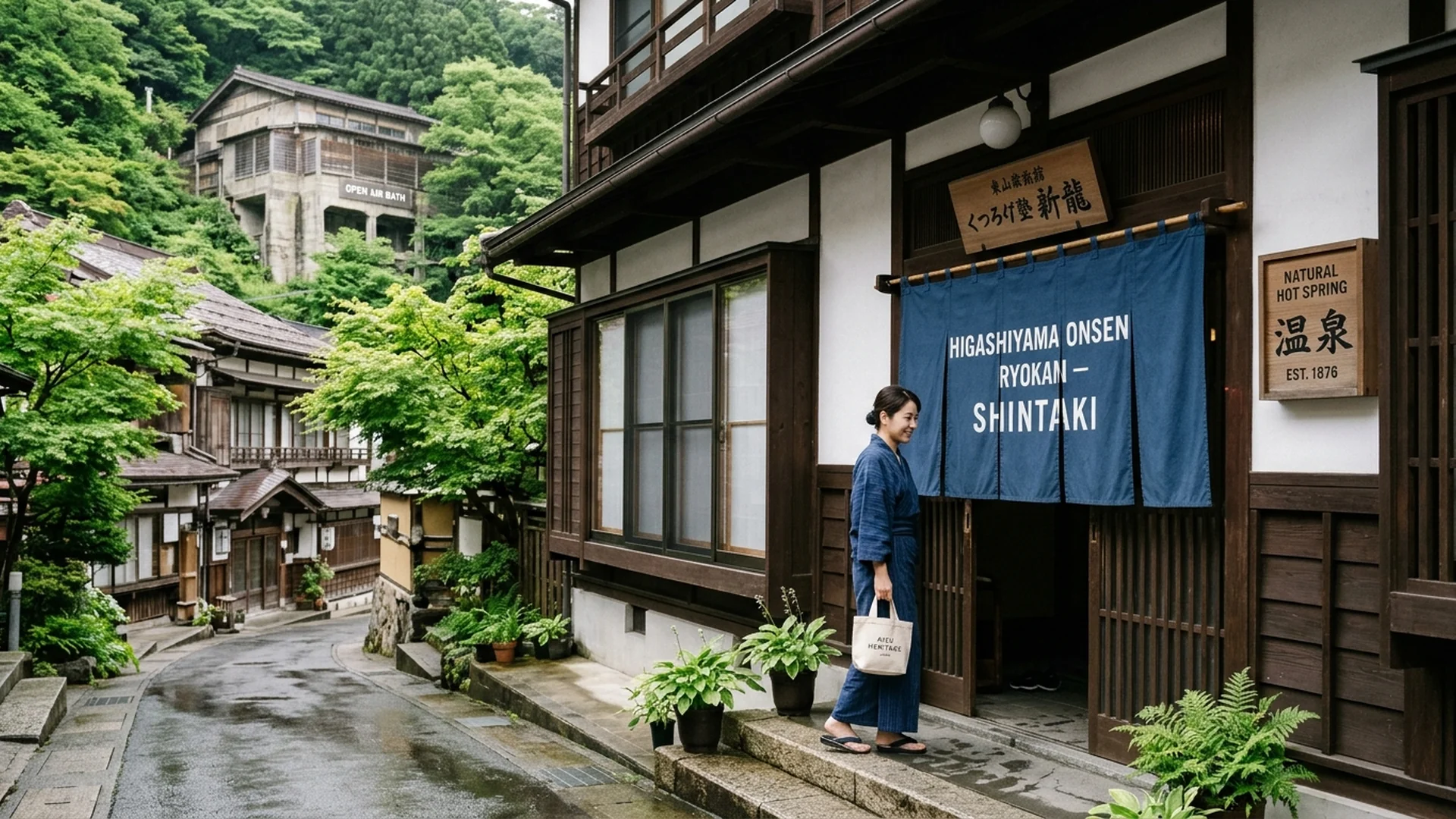
As a delicate morning mist lingers over the crystalline waters of the Yu River and the soothing steam carries the subtle, comforting aroma of ancient cedar, one senses the crossing of a profound temporal threshold. Welcome to Higashiyama Onsen, a sacred thermal enclave with a history spanning over thirteen centuries, tucked deep within the hushed valleys of Aizu-Wakamatsu in Fukushima Prefecture.
This is far more than a mere hot spring destination; it is a living archive of Japanese restorative arts. Once the exclusive sanctuary and healing refuge for the intrepid samurai of the Aizu domain, the valley retains an atmosphere of quiet valor and contemplative dignity. The murmur of rushing water weaves through the stillness of the surrounding peaks, echoing an unbroken heritage preserved with meticulous reverence.
Amidst the turning of epochs, Higashiyama Onsen has steadfastly protected its architectural soul. Traditional timber inns cascade gracefully down the undulating terrain, offering discerning travelers an authentic sanctuary of serenity and high-touch cultural immersion.
Samurai Footprints and the Thirteen-Century Legend of Higashiyama
The chronicle of Higashiyama Onsen unfolds in the Nara period around the eighth century, traditionally believed to have been discovered by the revered Buddhist monk Gyoki. Long before it welcomed leisure travelers, these mist-shrouded peaks served as a sacred hermitage for spiritual discipline and later evolved into a restorative retreat for the Azuma clan and battle-weary samurai.
To walk these paths and bathe in these thermal waters is to trace the exact footprints of elite warriors who once sought equilibrium here. The valley is steeped in an ethos of unwavering loyalty and quiet fortitude, offering modern travelers a rare opportunity to mirror the ancient ritual of calming the physical form and centering the spirit before facing the trials of the world.
Architectural Heritage and the Art of Omotenashi
The enduring luxury of Higashiyama Onsen lies in its uncompromising dedication to architectural preservation. The most striking manifestation of this ethos is Mukaitaki, a legendary ryokan constructed entirely of native Sugi cedar. The interior framework testifies to the sublime skill of ancient master carpenters, while expansive lattice windows frame living canvases of traditional gardens and seasonal waterways.
Residing within these historic walls is an exercise in the refined Japanese art of ‘Omotenashi’—anticipatory, heartfelt hospitality. Every nuance is curated with intention, from the hand-selected yukata robes and exquisitely plated kaiseki dinners featuring regional Aizu harvests to the genuine warmth of the hosts.
The Allure of Kakenagashi Waters and the Melodies of the Geisha
The defining hallmark of Higashiyama’s thermal bounty is its 100% Kakenagashi system, wherein pure mineral waters flow unhindered from underground sources directly into the baths without recirculation, filtration, or chemical treatment. Rich in aluminate and sulfate, these therapeutic waters gently soothe fatigue, soften the skin, and promote profound physiological restoration.
As dusk descends, the historic hot spring quarter awakens to the hauntingly delicate notes of the shamisen and the graceful choreography of the Higashiyama geisha. Preserving an increasingly rare classical performing art, these artists offer an intimate window into a refined cultural epoch that continues to captivate global connoisseurs of tradition.