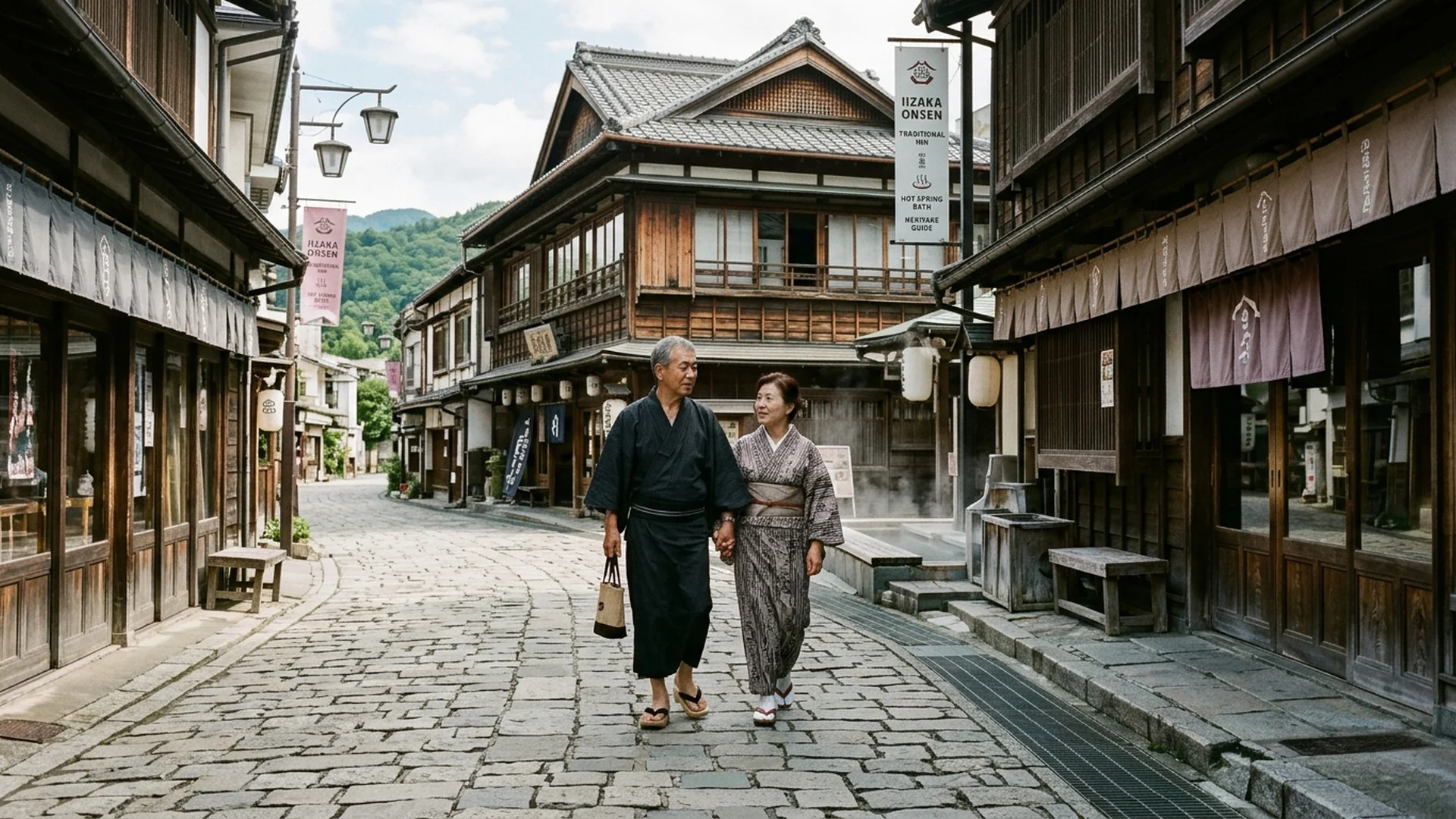
The quiet murmur of thermal waters flowing through two millennia of recorded history serves as the opening verse welcoming travelers to Iizaka Onsen. Nestled within Fukushima Prefecture, this venerable hot spring town once left such a profound impression upon Matsuo Basho—the legendary master of Edo-period haiku—that he immortalized its timeless grace within his celebrated travel journals. Far more than a mere destination for therapeutic immersion, Iizaka functions as a living museum swathed in rising plumes of white steam, the patina of historic timber architecture, and the unhurried grace of the Tohoku region.
Crossing into the historic district, time gracefully decelerates. The rhythmic clatter of wooden geta sandals striking cobblestone pathways, harmonizing with the persistent rush of the Surikami River, composes an instinctive acoustic therapy. Iizaka Onsen preserves traditional Japanese refinement within every discreet alcove: from retro public bathhouses executed in heritage carpentry to sprawling samurai manors and merchant estates meticulously preserved across generations. It stands as an invitation for discerning voyagers devoted to stillness and classical aesthetics to decode the true art of unhurried travel.
Ancient Mineral Heritage and the Footsteps of a Master Poet
Iizaka Onsen transcends the boundaries of a conventional wellness retreat, functioning instead as a storied landscape inscribed with antiquity. Local chronicles recount the ancient discovery of mineral springs bubbling up from the earth’s core, swiftly transforming the valley into a favored sanctuary for nobility and samurai. This cultural prominence crystallized in 1689 when Matsuo Basho arrived during his arduous northern journeys. The enveloping mist and mineral resonance stirred his imagination, inspiring verses that captured the quietude of the natural world. Tracing Basho’s footprints through the venerable alleyways of Iizaka offers a sublime temporal crossing, linking the modern traveler directly to the golden threads of Japan’s literary past.
Retro Architecture and the Beating Heart of Sabako-yu
The beating spirit of Iizaka Onsen finds its physical manifestation in Sabako-yu, a public bathhouse meticulously reconstructed to evoke the architectural splendor of the Meiji era. Dark timber cladding and traditional tiled roofing project an enduring elegance, sheltering one-hundred-percent pure, unadulterated thermal waters sourced directly from the subterranean source without artificial heating or dilution. The mineral-dense waters possess a characteristic high temperature designed to invigorate the physique. Descending into the hinoki cypress tub, soothing warmth instantly envelops every muscle, accompanied by the gentle murmurs of local residents engaging in daily pleasantries—a living portrait of an authentic yunomachi, or hot spring town.
The Aesthetics of Repose: Refined Ryokans and Fukushima’s Culinary Art
Beyond its nostalgic vernacular, Iizaka Onsen shelters premier ryokans discreetly embedded within the verdant foliage along the banks of the Surikami River. These sanctuaries merge contemporary discretion with immaculate omotenashi hospitality. Tatami chambers frame contemplative Japanese gardens shifting their palettes across the seasons, complemented by private outdoor rotenburo baths that invite restorative soaks beneath moonlit skies or autumn foliage. Evening kaiseki banquets elevate local dining into high art, as master chefs curate seasonal treasures of Fukushima: meltingly tender local beef, crisp wild mountain greens of Tohoku, and superlative hand-cultivated fruits harvested from the region’s fertile volcanic soils.