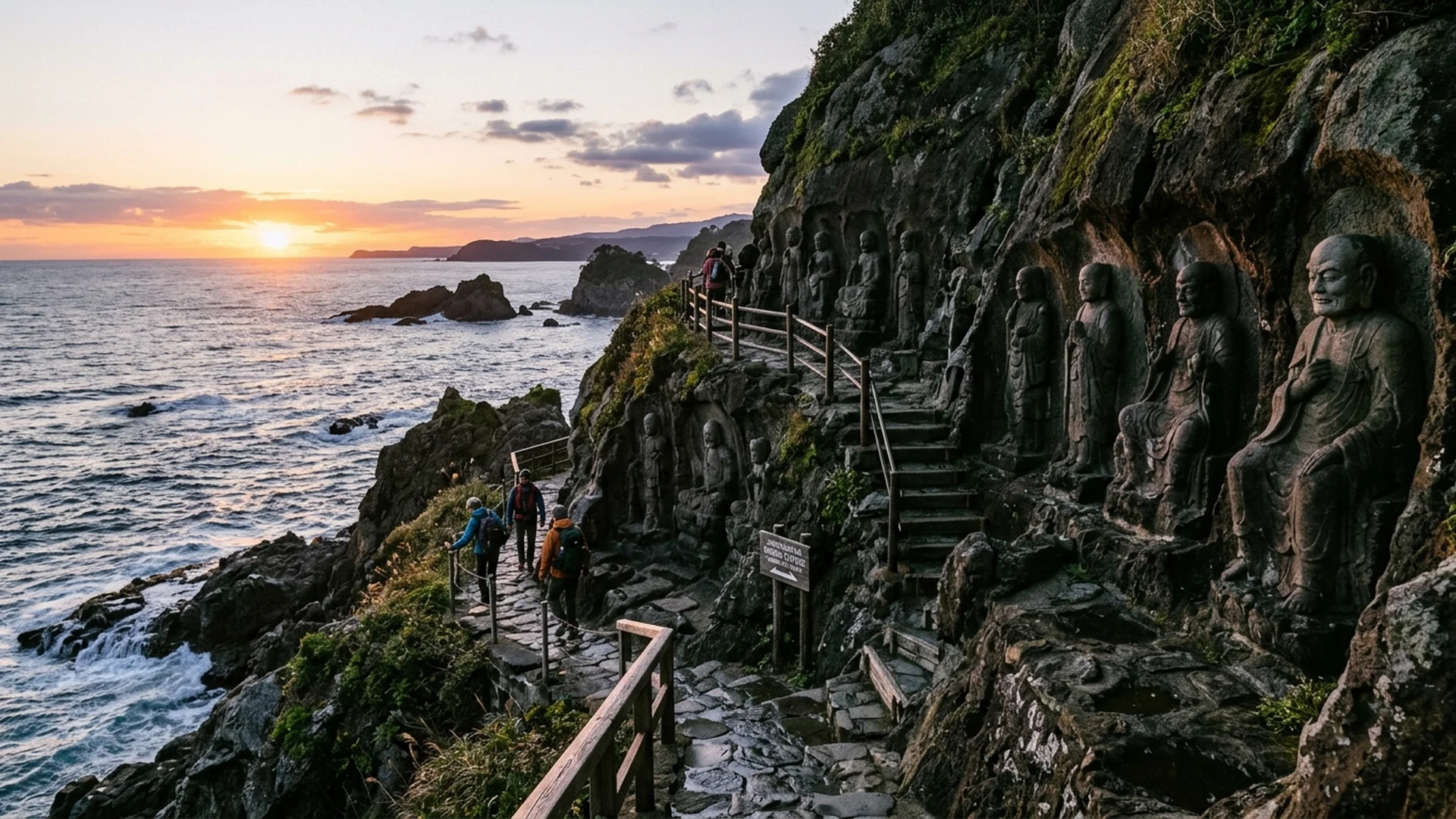
The thunderous cadence of cobalt waves crashing against ancient volcanic lava formations does more than merely voice the untamed poetry of the elements; it guards a solemn legacy of grief and transcendent devotion carved directly into the rugged sea cliffs of Yuza, Yamagata. For over a century and a half, the Jurokurakan Buddha Statues have stood as an unyielding testament to spiritual endurance where the jagged earth meets the vast, shifting expanse of the Sea of Japan.
Amidst the bracing breeze carrying a fine mist of salt spray, the serene, compassionate expressions of the twenty-two deities and arhats radiating before you instill a profound sense of stillness, as though time itself has surrendered to the tides. For the discerning cultural traveler drawn to historic depth and understated artistry, this sanctuary offers a rare pilgrimage—an intimate encounter with the eternal traces left by human devotion upon the bosom of the wild natural world.
Devotion on the Precipice: A Memorial Carved Against the Tides
The chronicle of Jurokurakan-iwa unfolds in the twilight of the Edo period, in the turbulent year of 1868. Deeply moved by the recurring maritime tragedies and coastal calamities that claimed the lives of countless local mariners and villagers along the Yamagata shores, the Buddhist monk Kumura Kankai of Honshuji Temple conceived an extraordinary act of spiritual redemption. Over five painstaking years, working alongside skilled stone artisans, Kankai directed the carving of sacred figures directly into the dark, weather-beaten lava rocks spewed forth ages ago by the formidable Mount Chokai.
The sacred number twenty-two encompasses a principal Buddha accompanied by a gathering of arhats (enlightened disciples), each possessing entirely distinct facial features, hand gestures, and meditative postures. While some figures remain locked in deep, unmoving contemplation, others subtly tilt their stone visages toward the biting sea wind, appearing to serve as eternal guardians with eyes of boundless compassion, keeping perpetual watch over a treacherous and unforgiving sea.
Buddhist Art Melting Seamlessly into Wilderness
The true wonder of Jurokurakan extends far beyond its historical resonance; it lies in the seamless, unforced harmony between human artistry and elemental creation. The rough, dark texture of the volcanic basalt and the gradual, saline erosion weathered by decades of salt-laden gales render the stone deities as though they sprouted organically from the earth itself.
As ocean swells shatter into explosions of white foam against the rock bases, the thunderous rhythm of the tide intertwines with the absolute silence of the sculpted figures. This conjures an atmosphere of raw, commanding power—a physical manifestation of wabi-sabi, capturing the profound beauty inherent in transience and the graceful surrender to the slow, relentless sculpting of time.
Yamagata’s Final Light: The Perspective from Miharashi Observatory
As the sun begins its slow descent, the Yuza coastline transforms into a dramatic canvas of shifting chromatic moods. The Miharashi Observatory and the surrounding precincts of the stone sanctuaries evolve into one of the most sublime natural stages along the entire Sea of Japan. Burning embers of crimson, orange, and liquid gold ripple across the water’s surface, casting elongated, dramatic shadows across the serene countenances of the stone pantheon.
On days blessed with pristine atmospheric clarity, the sweeping panorama reveals Tobishima Island floating in solitary grace far out upon the horizon. This vespertine tranquility, married to the acoustic cadence of crashing waves and the sublime visual theater, invites a rare quality of contemplation and introspective stillness entirely divorced from the frenetic pace of contemporary civilization.