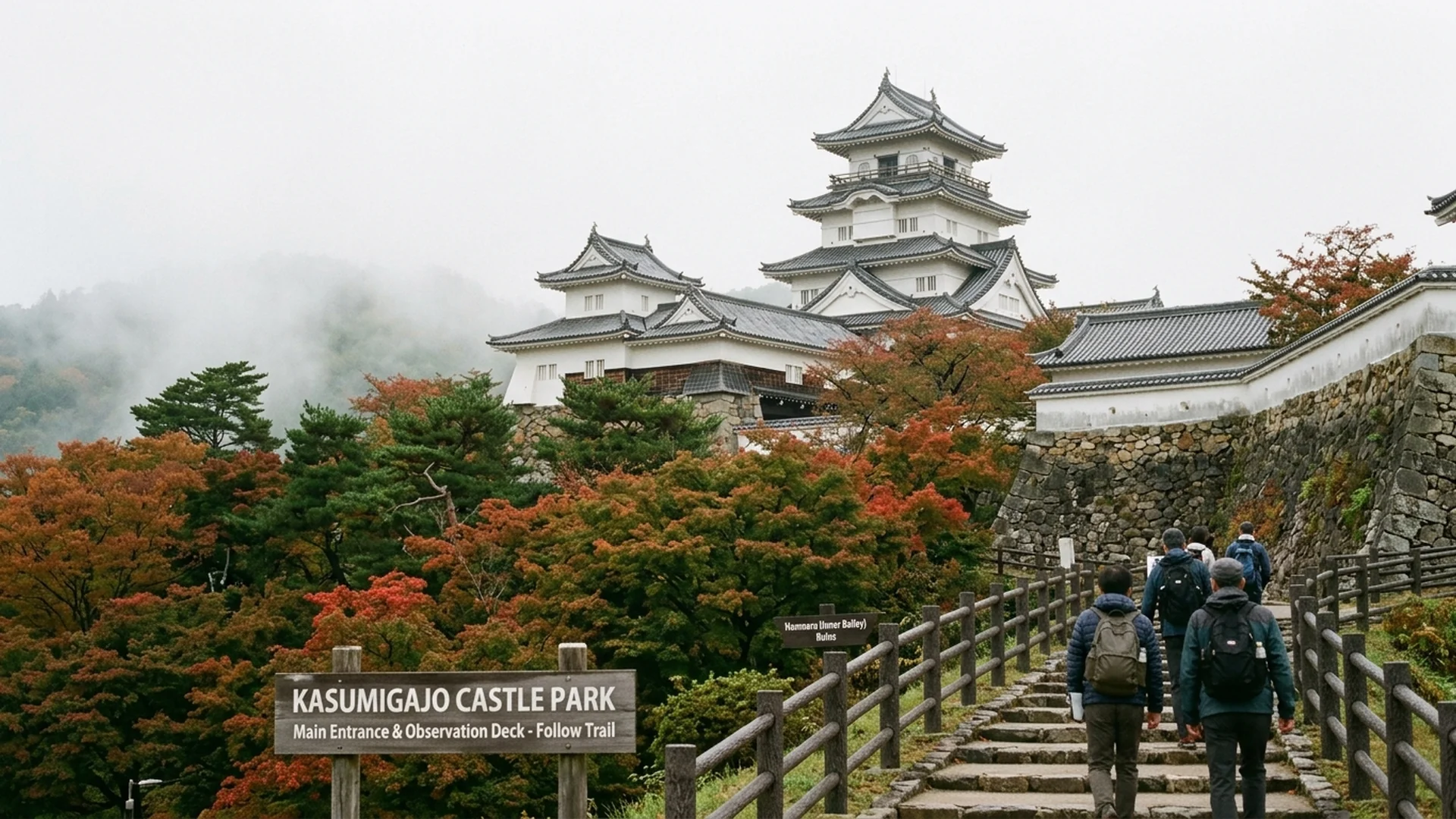
When the morning mist drifts down to enshroud the ancient stone ramparts and forested slopes of Nihonmatsu in Fukushima Prefecture, Kasumigajo Castle—affectionately known as the ‘Castle in the Mist’—emerges like a classical ink-wash painting. This storied site is far more than a mere historical ruin; it stands as a profound chronicle of samurai honor, enduring resilience, and the delicate, shifting aesthetics of the Tohoku region.
For discerning travelers seeking depths of meaning far beyond conventional sightseeing, the fortress conceals invaluable architectural heritage. Here, the legendary Anoshu dry-stone walls stand defiant against the passage of centuries, whispering tales of fierce loyalty and dramatic historical turning points. Encased in a landscape that transforms dramatically every three months, the castle invites visitors to step across a threshold of profound stillness and aristocratic grace.
Monuments of Honor: Samurai Heritage and Anoshu Stonework
The roots of Kasumigajo Castle reach deep into the age of the samurai, an era when the Nihonmatsu clan and later the Niwa family governed these northern domains. Positioned strategically upon an elevated hill, the fortress commands panoramic vistas across the sweeping Abukuma River basin. The most arresting feature upon arrival is the magnificent ishigaki (stone wall), a testament to the ingenious craftsmanship of the Anoshu guild—master masons who stacked natural boulders without a single drop of mortar. Relying entirely on gravity and precise physical equilibrium, these interlocking walls have successfully withstood severe earthquakes and the erosion of centuries.
Although the primary donjon was lost during the turbulent Boshin War of 1868, which marked Japan’s threshold into the modern era, the legacy of honor remains palpable. The Minowamon Gate, meticulously reconstructed in 1982 using traditional carpentry techniques, stands as a quiet guardian of ancient woodwork artistry. Its heavy timber beams and hand-carved brackets breathe vivid life into the glorious chapters of a bygone era.
The Cherry Blossom Sea of Mist: A Top 100 Spring Masterpiece
With the arrival of spring, the grounds surrounding Kasumigajo Castle transfigure into a realm of ethereal beauty. More than 2,500 cherry trees—predominantly Somei Yoshino and Kanhi Zakura—burst into synchronized bloom, casting a soft pink canopy over the ancient moats and stone foundations, earning the site its official designation among Japan’s premier cherry blossom destinations.
The most transcendent moment unfolds at dawn, when morning vapours drift gently across the valley, mingling with drifting petals descending upon the weathered stone ramparts. Soft golden sunlight filters through the branching canopy, casting delicate patterns of light and shadow that have long captivated photographers and poets alike. A quiet stroll along the sloping pathways, enveloped by fragrant blossoms, offers a moving meditation that connects the traveler to the fragile yet enduring vitality of the natural world.
Artistry in Resilience: The Nihonmatsu Chrysanthemum Festival
As autumn breathes crisp air across the domain, Kasumigajo Castle awakens anew with the Nihonmatsu Kiku Ningyo, one of the nation’s most venerable and elaborate floral art exhibitions, hosted continuously since 1930.
This grand celebration harmonizes the delicate horticulture of trained chrysanthemum branches with the intricate craft of life-sized doll-making. Elaborate tableaux depicting figures from folklore, samurai history, and classical Kabuki theater are painstakingly adorned with tens of thousands of living, blooming chrysanthemums rooted directly within the framework. The vibrant hues of the flowers contrast brilliantly against the fiery foliage of the surrounding parkland, embodying the unwavering spirit and refined sensibility of the Fukushima people in the face of seasonal metamorphosis.