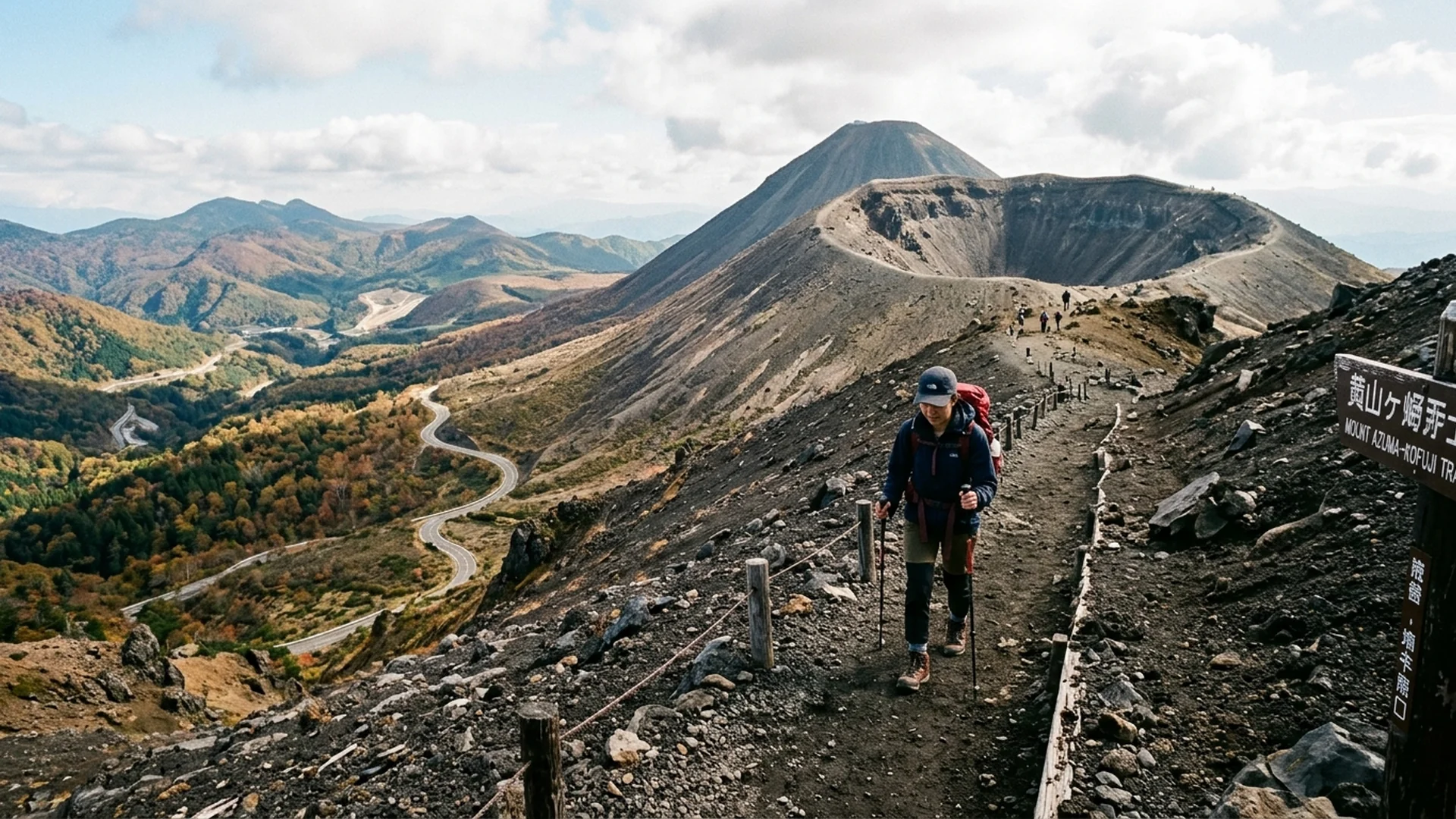
As the motor carriage steadily ascends past an elevation of 1,600 meters along the ethereal ribbon known as the Bandai-Azuma Skyline, the surrounding terrain transforms into a sweeping, majestic canvas of ancient volcanic grandeur. It is here that Mount Azuma-Kofuji reveals itself in all its quiet symmetry, its flawless inverted-cone profile earning it the affectionate and fitting moniker of Fukushima’s Little Fuji.
More than a mere geographical waypoint, this geological marvel invites the discerning traveler to step upon the lip of its pristine bowl-shaped crater, where crisp mountain air and unobstructed 360-degree panoramas await. Whether witnessing the fleeting outline of the legendary snow rabbit painted upon its slopes each spring or absorbing the blazing amber canopy of autumn, Azuma-Kofuji offers an immersive pilgrimage that effortlessly bridges raw geological power with profound alpine serenity.
Geological Architecture: The Allure of Fukushima’s Little Fuji
Rising approximately 1,707 meters above sea level within the sprawling borders of Bandai-Asahi National Park, Mount Azuma-Kofuji commands the horizon with quiet authority. The designation ‘Kofuji’ literally translates to ‘little Mount Fuji,’ a likeness that becomes immediately evident upon first sight. The harmonious curvature of its slopes descends seamlessly into a deep, perfectly circular crater, evoking the restrained elegance of a classical ink-wash painting where subterranean fire meets sublime tranquility.
Beyond its visual symmetry lies a deep-rooted connection to local agrarian tradition. Every spring, as the winter snowpack recedes, lingering snow remaining within the mountain crevices forms the distinct silhouette of a running hare. Known locally as ‘Yuki-usagi’ (the snow rabbit), this ephemeral phenomenon historically signaled to farming communities across the valley below that the agricultural season had officially commenced, weaving natural cycles into the cultural fabric of the region.
The Crater Rim Traverse: Panoramas Above the Clouds
Conquering the summit of Azuma-Kofuji is an experience defined by effortless access paired with profound scenic rewards. A brief, steady climb via stone steps from the Jododaira visitor center and parking area brings travelers directly to the precipice of the volcanic basin.
Once upon the crest, the Crater Rim Trail unfurls as a 1.5-kilometer circuit inviting a leisurely 30- to 40-minute walk. Airborne alpine breezes carry the scent of sulfur and fresh stone, while the yawning black abyss of the crater interior contrasts starkly against the infinite horizon. On clear days, the expansive gaze sweeps outward across undulating highlands and alpine meadows, eventually catching the distant, glittering geometry of Fukushima city far below.
The Bandai-Azuma Skyline: A Masterpiece of Alpine Motoring
The journey toward Azuma-Kofuji is integral to the overarching narrative of the voyage. Stretching for roughly 29 kilometers, the Bandai-Azuma Skyline is widely regarded as one of Japan’s finest scenic drives. The road winds artfully upward through rugged ravines and dense virgin forests, pausing at dramatic lookouts such as the Tsubakuro Valley, where the Fudosawa Bridge spans a dizzying gorge.
This high-altitude thoroughfare functions as an elevated viewing gallery for the changing seasons. In springtime, vehicles glide between towering white walls of packed snow, while October brings an explosion of scarlet, bronze, and gold as the surrounding woodlands ignite into a symphony of autumnal color, offering an unmatched experience for the contemplative road traveler.