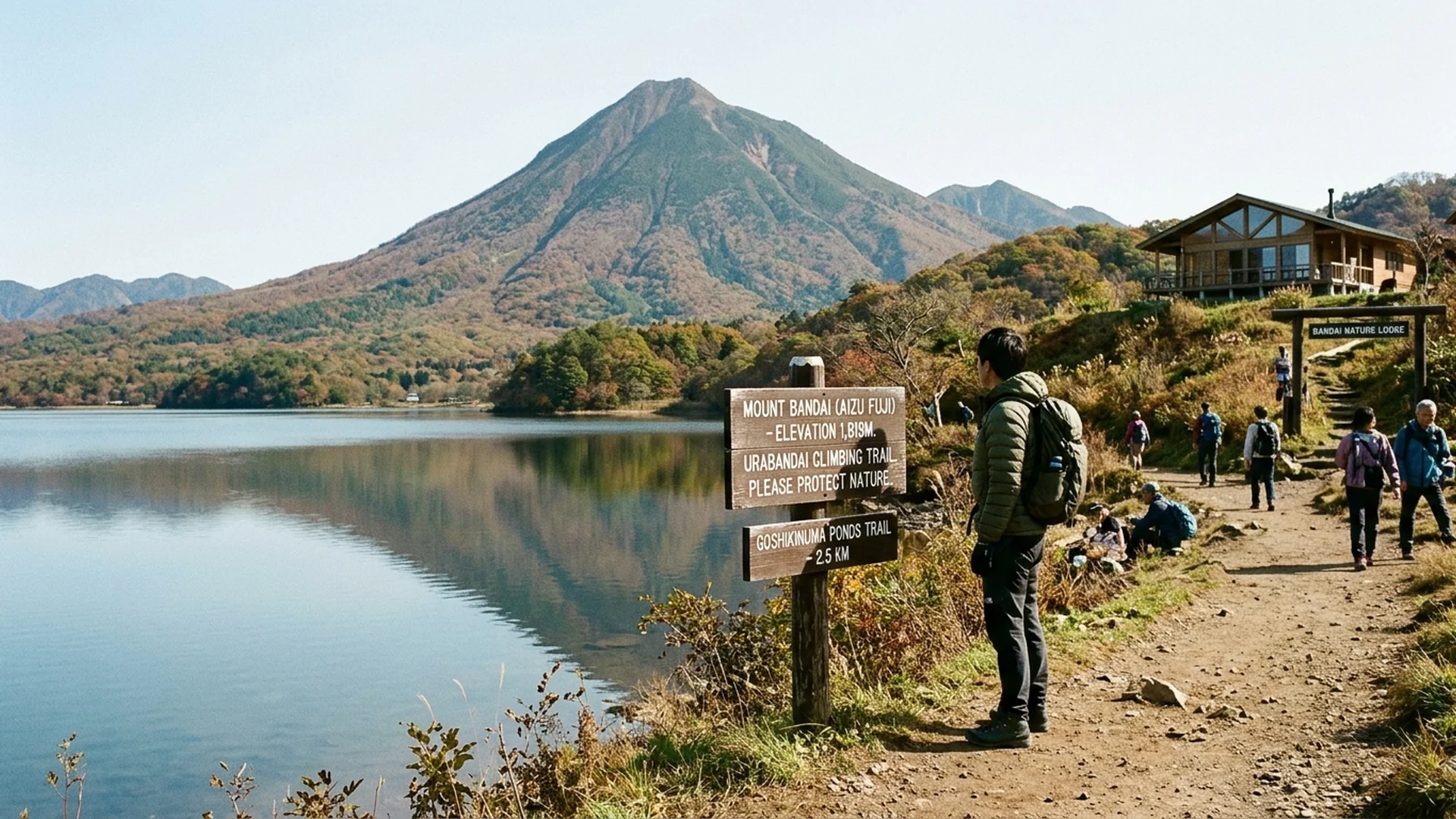
When the horizon is graced by an inverted volcanic cone as flawless as a brushstroke on ancient silk, Mount Bandai rises as the spiritual heartbeat and enduring pride of the Aizu region in Fukushima Prefecture. This venerable stratovolcano is far more than a dormant geological marvel; it is a living canvas shaped by the patient hands of time. Legends whisper of a beauty so striking that it earned the moniker ‘Aizu Fuji,’ yet the mountain conceals a dramatic, singular character entirely its own.
Beneath this serene exterior lie the profound echoes of the historic 1888 eruption, a cataclysmic reshaping of the earth that birthed Urabandai—a labyrinthine, otherworldly realm of tranquil waters and dense wilderness. To wander through this sanctuary is to step into an unhurried dimension where ancient forests, mirror-like tarns, and crystalline hot springs coalesce in absolute harmony. It is an invitation for the discerning traveler seeking deep contemplation and refined natural splendor far from the clamor of the modern world.
Geological Legacy: The Legend of Aizu Fuji and the Birth of Urabandai
The fascination of Mount Bandai begins with its arresting topographical duality. Viewed from the Aizu basin, the mountain presents an immaculate, symmetrical cone reminiscent of Fuji. Yet, upon crossing to the Urabandai sector, one encounters a dramatic amphitheater of jagged cliffs, carved away by the monumental collapse of the late 19th century. That seismic event dammed local waterways, inadvertently giving birth to hundreds of pristine lakes and tarns scattered through the dense timberlands.
Exploring the Urabandai wilderness feels akin to navigating a living natural museum. Remnants of ancient lava flows and volcanic debris are now swathed in velvety emerald mosses and towering old-growth trees, testifying to the Earth’s fierce yet profoundly restorative capacity for renewal.
The Chromatic Magic of Goshikinuma and Mirror Waters
At the beating heart of this landscape lie the ‘Five-Color Ponds,’ or Goshikinuma—a cluster of secluded water bodies hidden amidst the forest canopy. The magic of these tarns lies in their ethereal color palette, shifting seamlessly from luminous emerald and cobalt blue to deep indigo. These mesmerizing hues are born from varying mineral concentrations interacting with shifting daylight. A gentle walk along the nature trail weaving through the ponds offers a meditative immersion into the whispers of the canopy.
Nearby rests Lake Inawashiro, Japan’s fourth-largest expanse of water, revered poetically as ‘Heavenly Mirror Lake’ (Tenkyoko). On calm mornings, the glassy surface captures the imposing form of Mount Bandai in crystalline perfection, creating a sublime panorama that has captivated artists, poets, and global wanderers for generations.
Cross-Seasonal Aesthetics and the Skyline Route
Mount Bandai and its surrounding highlands offer a breathtaking transition of moods across the changing seasons. In autumn, spanning October and November, the surrounding forests ignite in brilliant crimsons and burnished golds, sharply contrasting against the nascent snow caps crowning the peak. Winter transforms the region into an exclusive highland sanctuary framed by world-class powder snow, while crisp, temperate summers invite unhurried explorations of alpine flora.
For those who appreciate scenic motoring, the Bandai-Azuma Skyline—widely celebrated as one of Japan’s premier alpine drives—winds its way upward through volcanic terrain. It offers panoramic vistas sweeping across sweeping valleys and the distant Aizu basin, creating the sensation of floating quietly amidst the clouds.