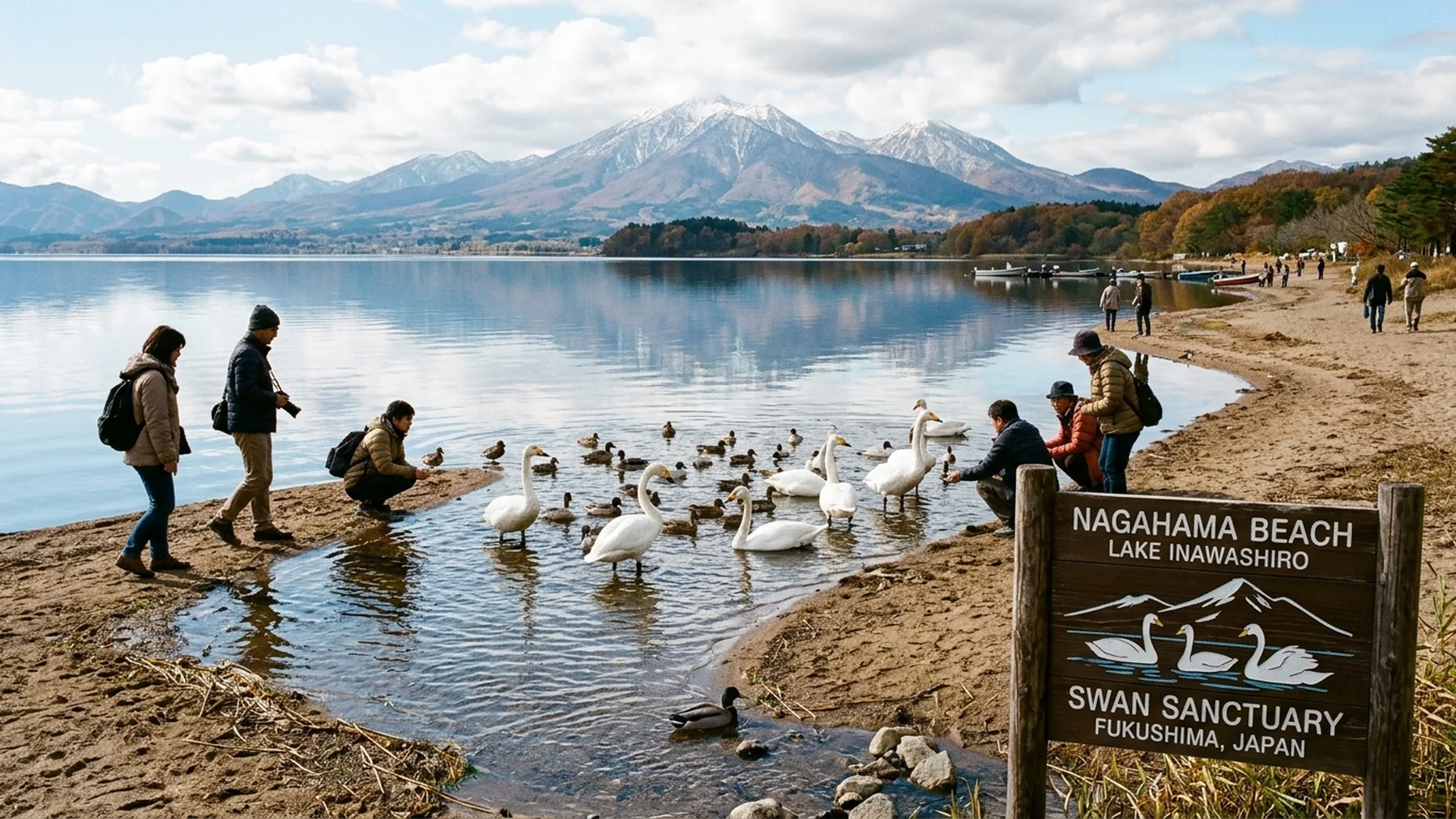
Across an expansive canvas of water polished smooth as cut crystal, Lake Inawashiro in Fukushima prefecture holds a secret of the natural world that time has scarcely altered. Known locally as Tenkyoko—the Heavenly Mirror Lake—its exceptionally pure waters serve as a flawless, liquid mirror reflecting the stately symmetry of Mount Bandai, the iconic guardian peak of the Aizu region.
Stepping onto Nagahama Beach, the northern shoreline that acts as a gateway to this untouched sanctuary, the perspective transforms into a masterclass in landscape art. Whether bathed in the brilliant shimmer of summer ripples or touched by the crisp enchantment of winter, when the frigid waters welcome thousands of migrating white swans, this is far more than a mere destination. It is a rarefied space inviting the discerning traveler to pause, breathe, and surrender entirely to the poetry of the landscape.
The Magic of Tenkyoko: A Mirror Reflecting the Changing Seasons
Lake Inawashiro commands distinction as Japan’s fourth-largest freshwater body, cradled within the volcanic contours of the Bandai-Asahi National Park. Born from ancient cataclysmic activity, its waters possess a delicate balance of mild acidity that limits aquatic flora, yielding in return an extraordinary clarity that has frequently claimed top honors for water purity in Japan.
Viewed from Nagahama Beach on a tranquil, windless morning, the surface settles into a profound stillness that justifies the moniker Tenkyoko, or ‘Heavenly Mirror.’ The reflection of Mount Bandai—affectionately styled Aizu Fuji by locals—manifests upon the liquid expanse with uncanny precision. In spring, the lakeshore unfurls delicate blossoms; summer brings refreshing breezes suited for quiet contemplation; autumn paints the surrounding ridgelines in opulent strokes of amber and crimson; and winter descends in a hushed, monochrome reverie.
The Winter Symphony: When White Swans Claim the Shoreline
With the arrival of deep winter, Nagahama Beach awakens to a dynamic grace as over two thousand white swans and migrating waterfowl complete their arduous journey from the Siberian steppes, claiming the icy shallows as their seasonal sanctuary.
The sight of immaculate white swans gliding across lapis-lazuli waters against the backdrop of snow-draped Mount Bandai forms an indelible image for landscape photographers and solitude-seekers alike. The gentle curves of the avians juxtaposed against the stoic majesty of the ancient volcano forge a rare aesthetic equilibrium. On days when temperatures plummet to their absolute nadir, the shore occasionally births Shibuki-gori—fleeting, crystalline ice sculptures formed when fierce gusts whip lake spray onto overhanging branches, encasing the littoral fringe in sparkling frostwork.
Cultural Echoes and the Surrounding Lake Circuit
To truly comprehend Nagahama Beach and Lake Inawashiro is to venture beyond the immediate shoreline and embrace the wider cultural geography of the Lake Circuit. Panoramic boat excursions open up sweeping 360-degree vistas where sky and water merge at the edge of perception.
Close to the shore stands Tenkyokaku, a venerable Meiji-era Western-style wooden mansion erected as a tranquil imperial retreat. Its classic European architecture, nestled amid mature woodlands and formal gardens, speaks of an elegant bygone era and bridges the gap between pristine wilderness and aristocratic heritage. Further enrichment awaits at the memorial museum dedicated to Dr. Hideyo Noguchi, the pioneering bacteriologist featured on the Japanese one-thousand-yen note, who spent his formative years in this very soil.