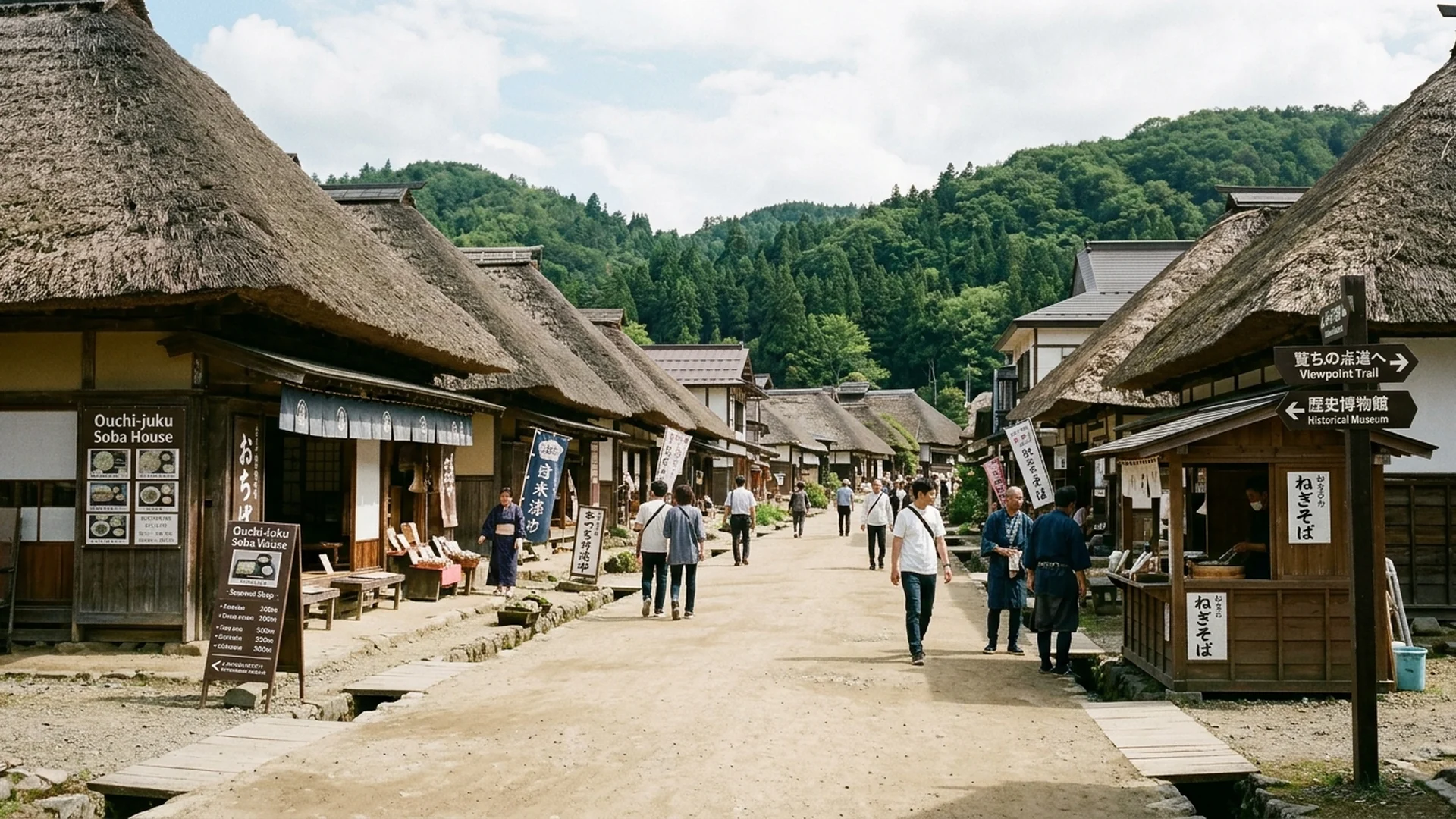
When crossing the threshold of time into Ouchi-juku, the first sensation to welcome you is not the frantic rush of modernity, but the profound, resonant quietude of a main street paved in natural river gravel. Flanking this historic thoroughfare are thatched-roof dwellings—known in Japanese as kayabuki—spanning over three centuries of uninterrupted architectural heritage, preserving their authentic Edo-period structures with immaculate precision. Here, not a single utility pole or overhead cable breaks the horizon, allowing the entire landscape to remain suspended in the contemplative atmosphere of centuries past. It is an immersive journey that transports the discerning traveler far from contemporary urban clutter, inviting them into the pure, unadulterated aesthetic of traditional Japanese culture in Fukushima Prefecture.
Originally serving as a vital resting station along the historic Shimotsuke Kaido highway, Ouchi-juku once echoed with the footsteps of feudal lords, traveling merchants, and weary pilgrims traversing the mountainous expanse between Aizu and Edo. Today, the village endures as a masterclass in living heritage, where strict preservation codes ensure that daily life unfolds much as it did during the height of the Tokugawa shogunate. For the global traveler seeking substance, historical gravity, and unspoiled scenery, this secluded valley offers a rare window into Japan’s feudal golden age.
1. The Historic Route and Kayabuki Architecture of the Edo Period
During the Edo period, Ouchi-juku functioned as a vital post town (shukuba) along the Shimotsuke Kaido, connecting the prosperous Aizu domain with the bustling capital of Edo. Daimyo lords, itinerant merchants, and ordinary travelers of the era relied upon its inns to rest, exchange horses, and find shelter from the elements. The buildings were constructed according to a precise urban plan, featuring steep, thickly thatched roofs designed to withstand the crushing weight of heavy winter snows. Thanks to the unwavering dedication of local residents, every single structure maintains its original timber framework, lattice windows, and open verandas, creating an ambiance reminiscent of a living period film set.
2. The Culinary Artistry of Aizu: The Negi Soba Phenomenon and Mountain Flavors
A pilgrimage to Ouchi-juku is incomplete without tasting ‘Negi Soba’, or scallion soba. The distinctiveness of this dish lies not merely in the springy, handmade noodles served in a delicate, clear broth, but in the method of consumption: diners use a full-length, raw Japanese leek instead of chopsticks to lift the noodles, taking crisp, pungent bites of the scallion in tandem with each mouthful. This creates a playful and invigorating sensory contrast. Alongside the noodle shops, rustic storefronts emit the savory aromas of ‘iwana’ river fish grilled with a fragrant miso glaze, and charcoal-roasted mochi that warms the spirit against the crisp mountain air.
3. The Rhythms of the Seasons: A Living Canvas of Natural Splendor
Ouchi-juku possesses an aesthetic that shifts seamlessly with the turning of nature’s wheel. Spring paints the valley in delicate cherry blossoms and vivid green rice paddies, while summer offers deep, cooling shade against azure skies. In autumn, the surrounding mountains ignite in brilliant shades of gold and crimson, resembling a natural masterwork. When winter arrives, a blanket of pristine white snow drapes softly over the thick thatch, transforming the village into a serene snowscape. Most notably, February brings the annual Snow Festival, where glowing lanterns pierce the evening chill, casting a warm luminescence across the glittering snow for an unforgettably romantic atmosphere.