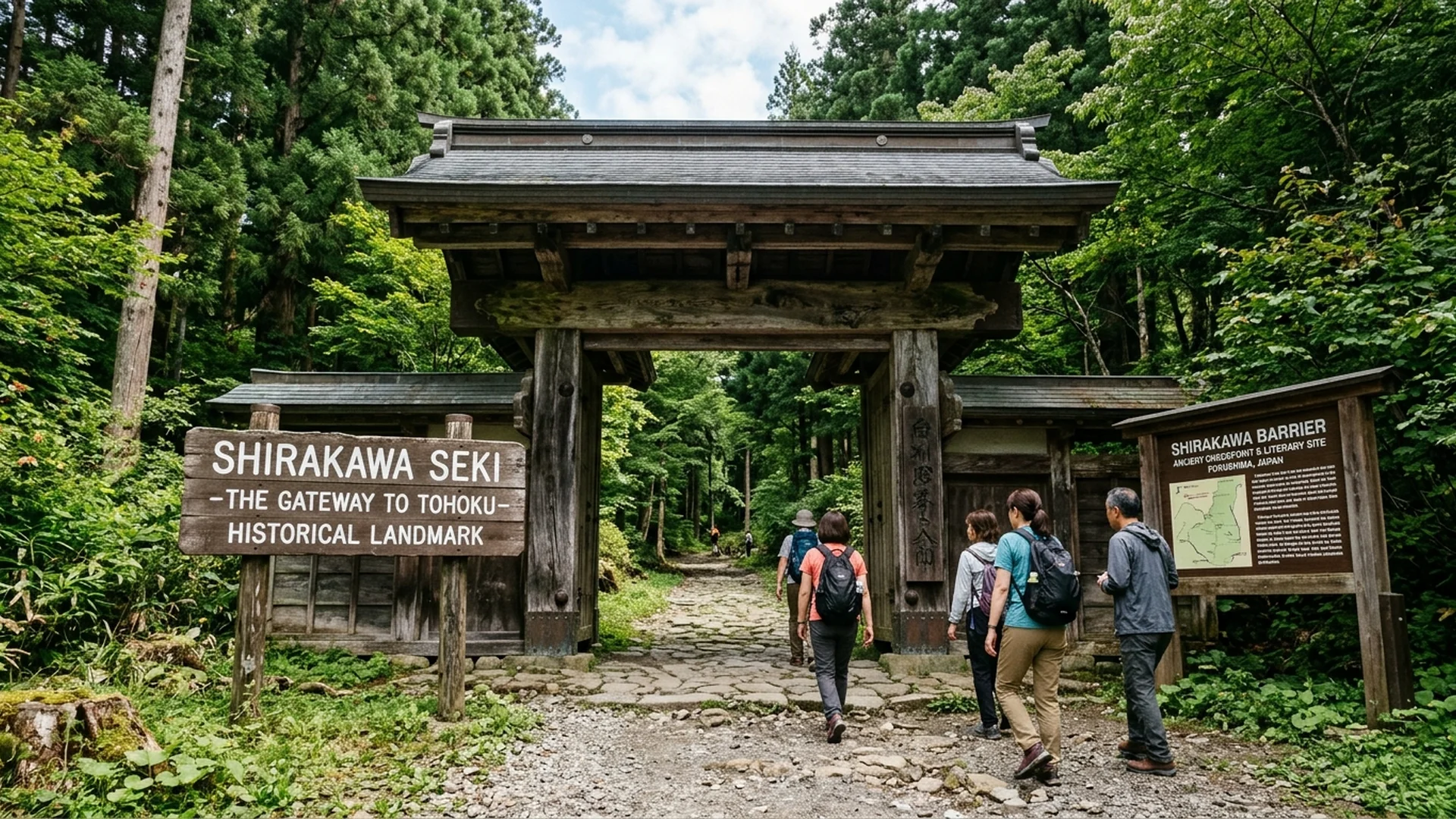
Amidst the quiet, mist-draped woodlands of Fukushima prefecture lies a profound threshold that once drew a definitive line between the imperial court in Kyoto and the wild, untamed expanses of the northern frontier. Shirakawa Seki is far more than the mere ruin of an ancient military checkpoint; it is a spiritual and literary sanctuary that has fueled the imagination of Japanese travelers, scholars, and wanderers for centuries. As you step beneath the heavy, cathedral-like canopy of ancient trees that shroud the shrine, the whispering wind seems to carry the echoes of immortal haiku composed by wandering masters, compelling the discerning traveler to pause, breathe, and reflect upon the very essence of the journey.
Strategic Frontiers and the Legend of the Three Great Barriers
In the annals of classical Japanese history, an era when travel was strictly monitored for state security and taxation gave rise to defensive demarcations known as ‘San-seki’, or the three great barrier stations. Comprising the Nakoso, Suzuka, and Shirakawa checkpoints, these formidable outposts forged an ironclad defense. Shirakawa Seki, in particular, operated as a powerful guardian gateway dividing the Kanto plain from the vast expanse of the northern Tohoku territories. Crossing this barrier in antiquity signified much more than a mere geographical transition; it was an initiation into a remote realm possessing its distinct vernacular, customs, and untamed nature. Though time has softened the earthen ramparts and swallowed the old moat lines, an undeniable gravity remains, bearing silent witness to the meticulous administrative reach of ancient Japan.
Footsteps of the Poets and the Echoes of ‘Oku no Hosomichi’
The true resonance of Shirakawa Seki transcends military history, elevated instead to the realm of high literary art. When Matsuo Basho, the quintessential master of Edo-period verse, arrived here in the summer of 1689 during his arduous poetic pilgrimage, he recorded his profound emotional displacement at stepping past this threshold into the distant north. The poignant loneliness and exquisite beauty of the surrounding frontier were immortalized in brushstrokes that continue to captivate readers today. Before Basho, legendary poets such as Saigyo had also made the arduous trek to compose melancholic tanka verses regarding the isolated majesty of this borderland. Consequently, Shirakawa Seki transformed into a sacred pilgrimage site for lovers of Japanese literature—a realm where time stands still, allowing visitors to deeply immerse themselves in the quiet aesthetic of mono no aware, the poignant awareness of impermanence.
Spiritual Landscapes: Shirakawaseki Shrine and the Sekinomori Forest
Today, the grounds of Shirakawa Seki have been meticulously preserved as a tranquil historical sanctuary. The modest Shirakawaseki Shrine stands in quiet dignity amid the primeval Sekinomori forest, whose verdant canopy transforms into breathtaking palettes of crimson and gold with the turning of the seasons. The atmosphere within the grove is hushed and reverent, entirely detached from the frantic pace of modern metropolises. Visitors can meander along soft-footpath nature trails winding past ancient archaeological remnants, discovering weathered stone monuments engraved with Basho’s verses that blend effortlessly into the surrounding moss-draped topography, reflecting an unbroken cultural reverence for both history and the natural world.