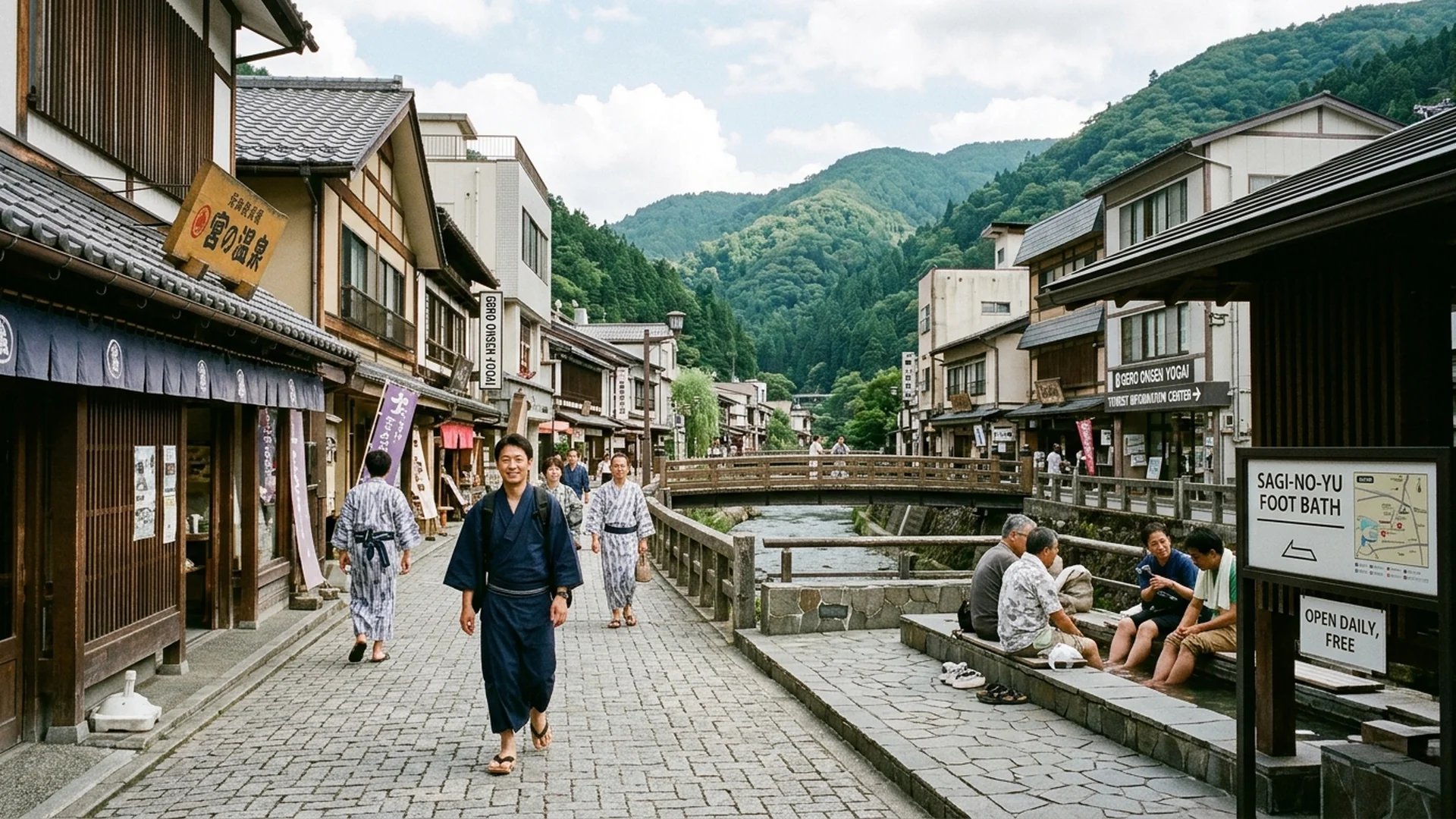
Framed by emerald-clad peaks and the gentle, persistent rush of the Hida River, Gifu Prefecture conceals a thermal sanctuary that has beckoned discerning travelers for centuries. Gero Onsen is not merely a destination for a restorative soak; it stands proudly as one of Nihon Sanmeisen—Japan’s historic triad of legendary hot spring towns, sharing sacred lineage alongside Arima and Kusatsu. Here, the atmosphere is wreathed in delicate rising mist, the rich scent of polished cedar from traditional ryokan, and a lineage of relaxation passed down through millennia.
As early as the Edo period, the esteemed Neo-Confucian scholar Razan Hayashi recorded the miraculous properties of Gero’s waters, spreading its renown throughout the imperial court. Today, Gero Onsen preserves this timeless elegance flawlessly, marrying contemporary refinement with an unhurried, meditative rhythm. It invites the traveler to slip out of traditional wooden geta, step into a world of profound stillness, and surrender to the restorative wonders of the natural world.
The Magic of ‘Bijin no Yu’: Waters That Sculpt Silk-Soft Skin
The beating heart of Gero Onsen’s enduring appeal to luxury travelers lies in the peerless quality of its thermal waters. Characterized by a gentle alkalinity, the spring water is entirely colorless and odorless, offering a remarkably soft touch upon the skin that feels akin to bathing in a natural lotion. It is little wonder that generations of Japanese have revered Gero as ‘Bijin no Yu’—the Bath of Beauty.
Bathing here transcends mere physical relaxation; it is an act of deep somatic and spiritual alignment. Most premier ryokan carefully curate their open-air rotenburo baths to dissolve the boundary between architecture and wilderness. Whether soaking while gazing out at the rushing currents of the Hida River or resting within a secluded bamboo grove where leaves whisper in the alpine breeze, the experience delivers an exquisite sense of solitude.
Stepping Back in Time: The Gassho Village and Riverside Heritage
Beyond the restorative baths, Gero unfolds a rich cultural tapestry waiting to be uncovered. The Gero Onsen Gassho Village gathers steeply thatched, prayer-hands-style farmhouses relocated from the UNESCO-listed region of Shirakawa-go. This living museum vividly recreates rural Japanese heritage, complete with traditional handmade paper workshops, ceramic studios, and ancient shrines sheltered beneath deep forest canopies.
Within the town proper, the urban landscape is thoughtfully designed for contemplative strolls. More than ten complimentary public footbaths (ashiyu) are scattered throughout the streets, each possessing a distinct architectural character. Pausing to warm one’s feet while conversing quietly with local residents amidst the crisp mountain air captures the unpretentious elegance of the Gero experience.
Gastronomic Masterpieces: Hida Beef and River Valley Delicacies
A sojourn in Gifu is entirely incomplete without savoring its crown culinary jewel: Hida beef. Celebrated for its extraordinarily fine marbling that melts effortlessly upon the palate, this prized black-haired Wagyu is presented by Gero’s finest ryokan in exquisite kaiseki courses. Guests may enjoy it grilled over a traditional magnolia leaf infused with artisanal hoba miso, or gently simmered in a delicate shabu-shabu broth that accentuates the meat’s intrinsic sweetness.
Conclude an afternoon of exploration with the silken indulgence of Gero Pudding, a celebrated local confection, or sample artisanal matcha and vanilla soft-serve crafted from pristine regional ingredients. Every culinary offering reflects the profound craftsmanship and hospitality of this alpine community.