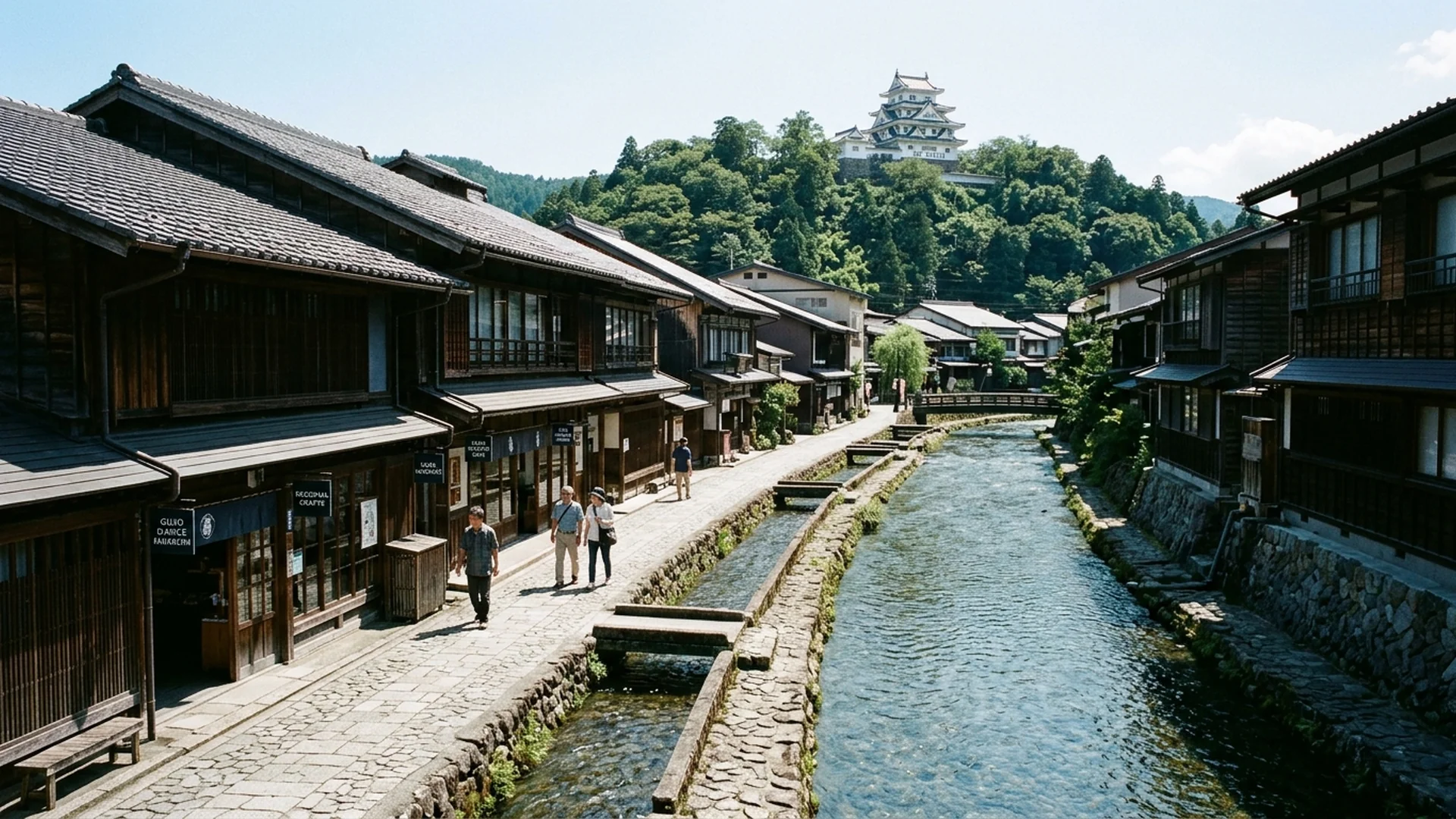
As the morning mist gently clings to the emerald peaks and crystal-clear streams mirror the facades of historic timber dwellings, Gujo Hachiman reveals a profound identity that transcends its reputation as a mere transit stop in Gifu Prefecture. This is far more than a living Edo-period museum; it is a realm where the collective pulse of the community harmonizes with the gentle murmur of natural waterways, sustained by an ingenious ancient irrigation network, a venerable mountaintop fortress floating in the clouds, and an unbroken lineage of master artisans whose creations captivate the world.
For discerning travelers seeking profound stillness, cultural enrichment, and the tactile romance of meticulous craftsmanship, Gujo Hachiman invites you to slow your pace, shed the frantic urgency of the modern world, and awaken your senses to a pure, unhurried beauty that has sustained generations.
Symphony of the Streams: The Heart and Soul of Gujo Hachiman
If Gujo Hachiman were a classical composition, flowing water would be its foundational melody, animating the daily life of the entire settlement. Throughout the historic district, crystalline irrigation channels known as ‘suido’ trace precise pathways directly past traditional threshold steps. These waterways are far from mere aesthetic ornaments; they constitute an intricate, communal ecosystem lovingly preserved by residents since feudal times. At the spiritual and literal heart of this network lies Sogisui Spring, recognized as one of Japan’s one hundred most pristine natural waters. Here, rigorous community stewardship divides water usage strictly between drinking, vegetable washing, and laundering—a living testament to sustainable coexistence with nature and profound reverence for natural abundance. These gentle currents imbue Gujo Hachiman with perpetual coolness, providing an uninterrupted natural soundtrack for every traveler.
The Sky Castle and Mountain Heritage: Gujo Hachiman Castle
Rising triumphantly above the surrounding forests and drifting vapors upon Mount Hachiman stands Gujo Hachiman Castle, the oldest wooden reconstructed castle in Japan, originally founded in 1559. Its brilliant white exterior walls, contrasting sharply against deep green pine groves, present a breathtaking vista that earned it the poetic moniker of the ‘Castle in the Sky.’ During the crisp dawns of autumn or spring, dense sea mists blanket the base of the mountain, rendering the fortress an apparition floating amidst the clouds. The steep pilgrimage up through ancient timberlands evokes a tangible sense of temporal displacement, while the sweeping panorama from the donjon tower reveals the serpentine majesty of the Yoshida River embracing the valley below.
The Soul of Craftsmanship: From Local Artistry to Global Food Models
Beneath its tranquil historic facade, Gujo Hachiman serves as the clandestine birthplace of the global ‘food replica’ industry, supplying hyper-realistic culinary displays to dining establishments across Japan and international markets. The tradition originated from local artisans who adapted traditional wax-casting techniques to model enticing storefront dishes with astonishing fidelity. Modern travelers may partake in participatory workshops, mastering the delicate art of dripping molten wax into warm water to recreate the ruffled texture of crisp lettuce leaves or shaping golden, tempura batter with exacting precision. This niche mastery not only crowns the town with unique cultural prestige but underscores the unwavering commitment of its people to preserve rare, tangible craftsmanship in an increasingly automated world.