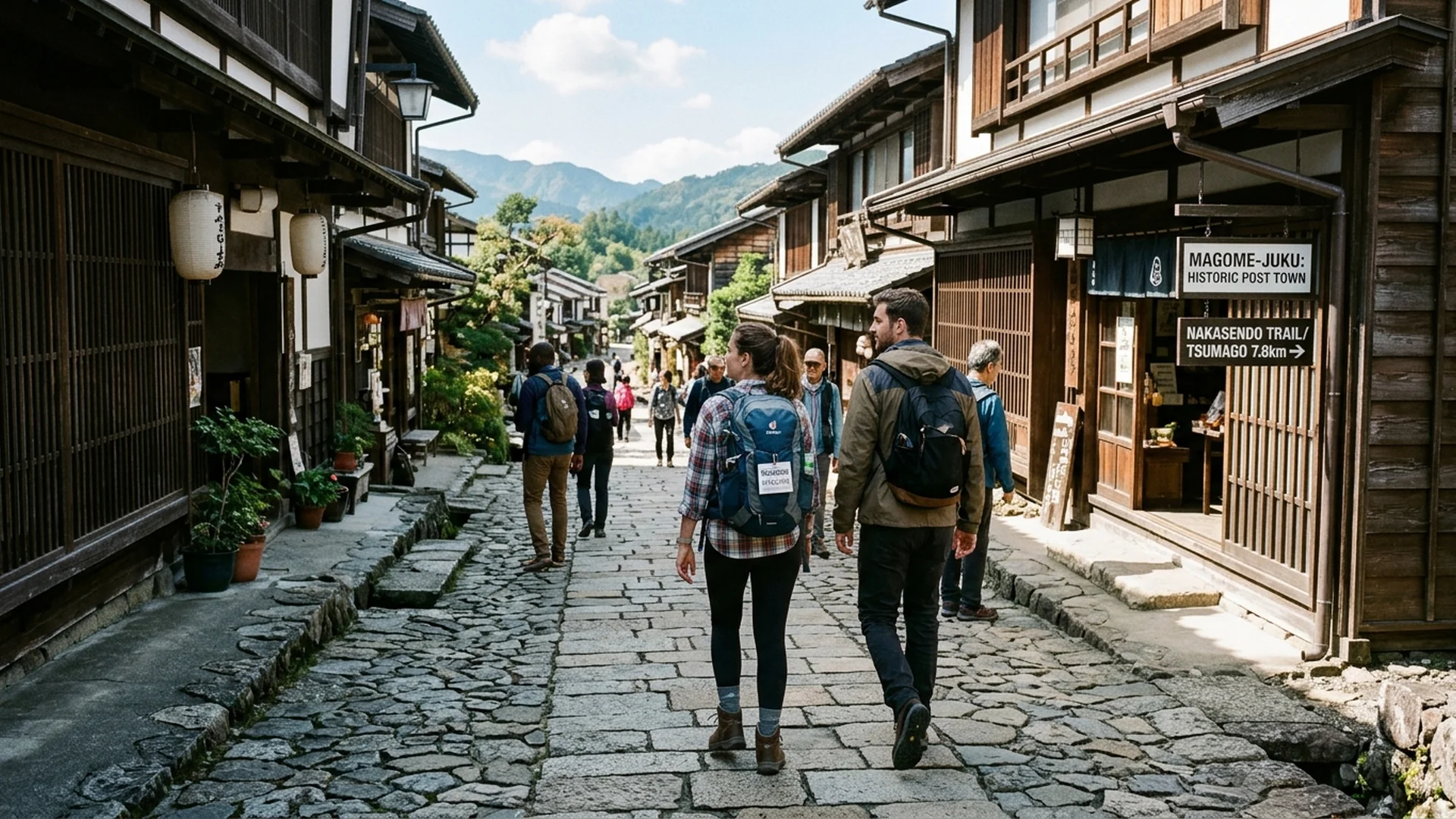
When footsteps fall upon the ancient, upward-sloping stone slabs of Magome, time itself seems to gently recede some three centuries into the Edo period. Once a thriving post-town along the illustrious Nakasendo Trail connecting Kyoto and Edo, Magome is far more than a mere historical waystation. Nestled within the folding contours of the rugged Kiso Valley, it is a living museum where the breath of antiquity lingers still. Dark-timbered lattice houses cascade down the hillside in immaculate harmony, accompanied by the perpetual murmur of crystal-clear water flowing through stone channels beside the lane. For the discerning traveler seeking stillness and deep cultural roots, this mountain sanctuary offers an incomparable aesthetic journey.
Architecture and Spirit of Magome-juku
Along the pristine main thoroughfare of Magome-juku, unsightly utility poles are entirely absent, preserving an unblemished horizon. Following a devastating fire in the twentieth century, every structure was meticulously rebuilt with unwavering fidelity to traditional Edo-period architectural codes. Narrow-fronted, deep-set two-story timber buildings feature dark, subdued plaster facades and intricate wooden lattice windows known as koshi, gently adorned with seasonal flora and paper lanterns that speak to an enduring devotion to detail. Magome is also the birthplace of Shimazaki Toson, a monumental poet and novelist who immortalized the melancholic beauty of the Kiso Valley in his masterpiece Before the Dawn. Visitors can explore the Toson Memorial Museum to intimately connect with this profound literary lineage.
Walking the Heritage Trail: From Magome to Tsumago
An exploration of Magome reaches its zenith when laced into sturdy walking boots for the journey along the most breathtaking stretch of the Nakasendo. Between Magome and Tsumago-juku lies an eight-kilometer trail winding through emerald cedar forests, terraced rice paddies, and pristine mountain streams. Along the way, bronze bells hang at intervals, inviting travelers to ring them softly as a traditional precaution against local wildlife, adding a poetic note to the trek. A remarkably civilized luggage-forwarding service between the two towns allows wanderers to traverse the path unburdened, breathing in the crisp mountain air and immersing themselves fully in the pristine landscape without the weight of heavy bags.
Flavors of the Mountains: Culinary Traditions of Kiso
True cultural immersion must inevitably engage the senses through gastronomy. The cuisine of the Kiso region honors simplicity derived from the formidable bounty of the surrounding highlands. Chief among local specialties is Gohei Mochi, hand-shaped rice cakes skewered and roasted over charcoal embers, lavishly brushed with a fragrant sauce crafted from ground walnuts, sesame, and miso. The resulting harmony of a crisp exterior and tender interior is unforgettable. Equally comforting is hand-kneaded soba noodles crafted from exceptional highland buckwheat, served alongside a traditional dashi broth designed to warm the spirit against the cool alpine breeze.