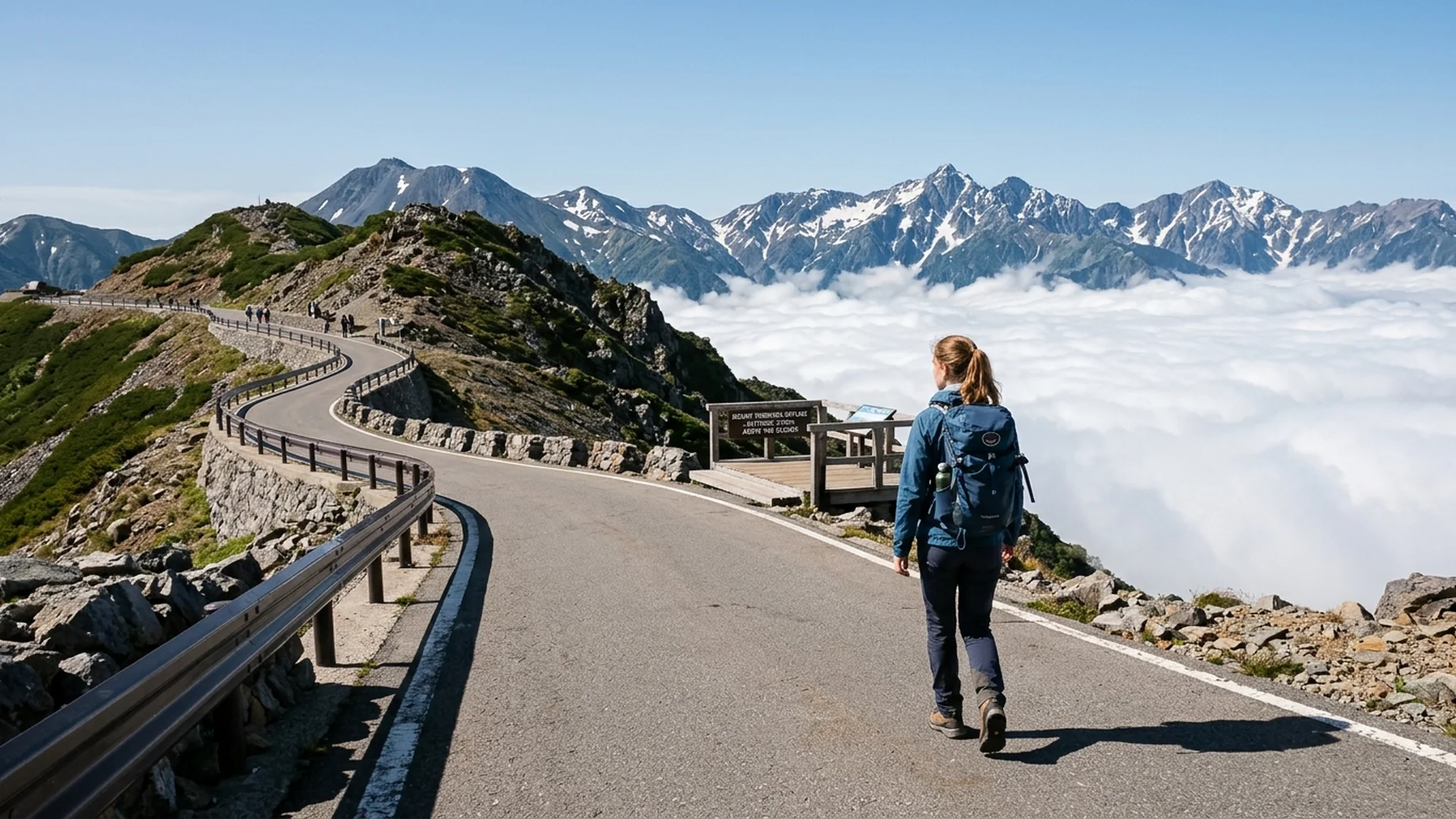
Amidst the vast indigo skies of the Japanese archipelago, a single ribbon of asphalt climbs unhurriedly to meet the drifting clouds, tracing the ancient spine of the Northern Alps. The Mount Norikura Skyline is far more than a strategic mountain pass; it is a clandestine portal to the upper realms, where the frantic tempo of the world below dissolves completely. At 2,702 meters above sea level, crisp, crystalline air meets the traveler, accompanied by uninterrupted panoramas of jagged peaks soaring past three thousand meters. This is a sanctuary of profound stillness sculpted entirely by nature, welcoming those who seek untamed beauty without the grueling demands of a multi-day wilderness trek.
This ascent stands as a testament to enlightened ecological stewardship. Through a thoughtful coalition between regional governments and local communities, private vehicular access has been permanently restricted to safeguard the fragile volcanic ecosystem of Mount Norikura. Consequently, the journey to the summit has been transformed into a meditative pilgrimage aboard meticulously organized public transit. The abrasive roar of combustion engines is replaced by the whispering wind sweeping across alpine meadows, accompanied only by the collective intake of wonder from travelers stepping out onto the roof of Japan.
Architecture of Time: From Strategic Pass to Masterclass Panoramic Corridor
The Mount Norikura Skyline initially opened as a pragmatic thoroughfare connecting Gifu and Nagano prefectures before its eventual evolution into a premier educational and scenic route. Recognizing the profound fragility of the high-altitude alpine ecology, Japanese authorities made the definitive decision in 2003 to bar private automobiles from the corridor. This visionary restriction not only initiated a swift ecological recovery and welcomed back rare indigenous wildlife—such as the Japanese ptarmigan—but also restored an atmosphere of uncompromised tranquility to the journey.
Modern air-conditioned eco-shuttles guide travelers through dozens of sweeping hairpin turns. With every incremental gain in elevation, the surrounding forest morphology shifts dramatically. Dense, primeval coniferous woodlands gradually yield to stunted krummholz timberlines before finally opening onto expansive highland tundra. Inside the cabin, a collective hush falls over passengers as the vehicle breaches dense strata of white mist, suddenly breaking through into brilliant golden sunlight cascading across snow-dusted summits.
Tatamidaira Station: Where Heaven, Earth, and Alpine Flora Converge
Arriving at Tatamidaira Station, situated at the highway’s zenith of 2,702 meters, travelers encounter the highest operational transit station in the country. Stepping onto the observation platforms reveals a staggering 360-degree panorama of the Hida Mountains stretching into the infinite horizon. Through early summer, from June to July, the environs surrounding the station erupt in delicate pigmentation as alpine flora—such as bright yellow komikusa and soft violet wildflowers—blossom resiliently against the brisk highland breeze.
For ambulatory explorers, Tatamidaira serves as the ultimate alpine basecamp. The ascent to Mount Kengamine, the supreme apex of the Norikura massif at 3,026 meters, requires a remarkably accessible round-trip trek of roughly two hours. The trail is meticulously maintained, tracing gently undulating volcanic ridges that allow explorers of varied fitness levels to experience standing upon Japan’s high rooftop in complete safety, while mirrored tarns like Oi-ga-ike reflect the pristine azure sky below.
A Seasonal Symphony: From Monumental Snow Walls to the Earliest Autumn Canopy
The enduring allure of the Norikura Skyline lies in its dramatic, cyclical metamorphosis throughout the operational months. When the route first clears and reopens in mid-May, visitors are greeted by towering snow corridors—locally known as Yuki no Kabe—carved deep through accumulated winter drifts, standing as monumental white sculptures born of relentless seasonal blizzards.
By September, as summer yields its warmth, Mount Norikura claims the distinction of welcoming Japan’s earliest autumn foliage. High-altitude rowan and birch trees ignite in brilliant hues of copper, crimson, and amber, starkly contrasting against the emerald gloom of evergreen pines. This fiery visual cascade gradually descends the mountain slopes over subsequent weeks, offering an unforgettable spectacle for devoted admirers of seasonal landscapes.