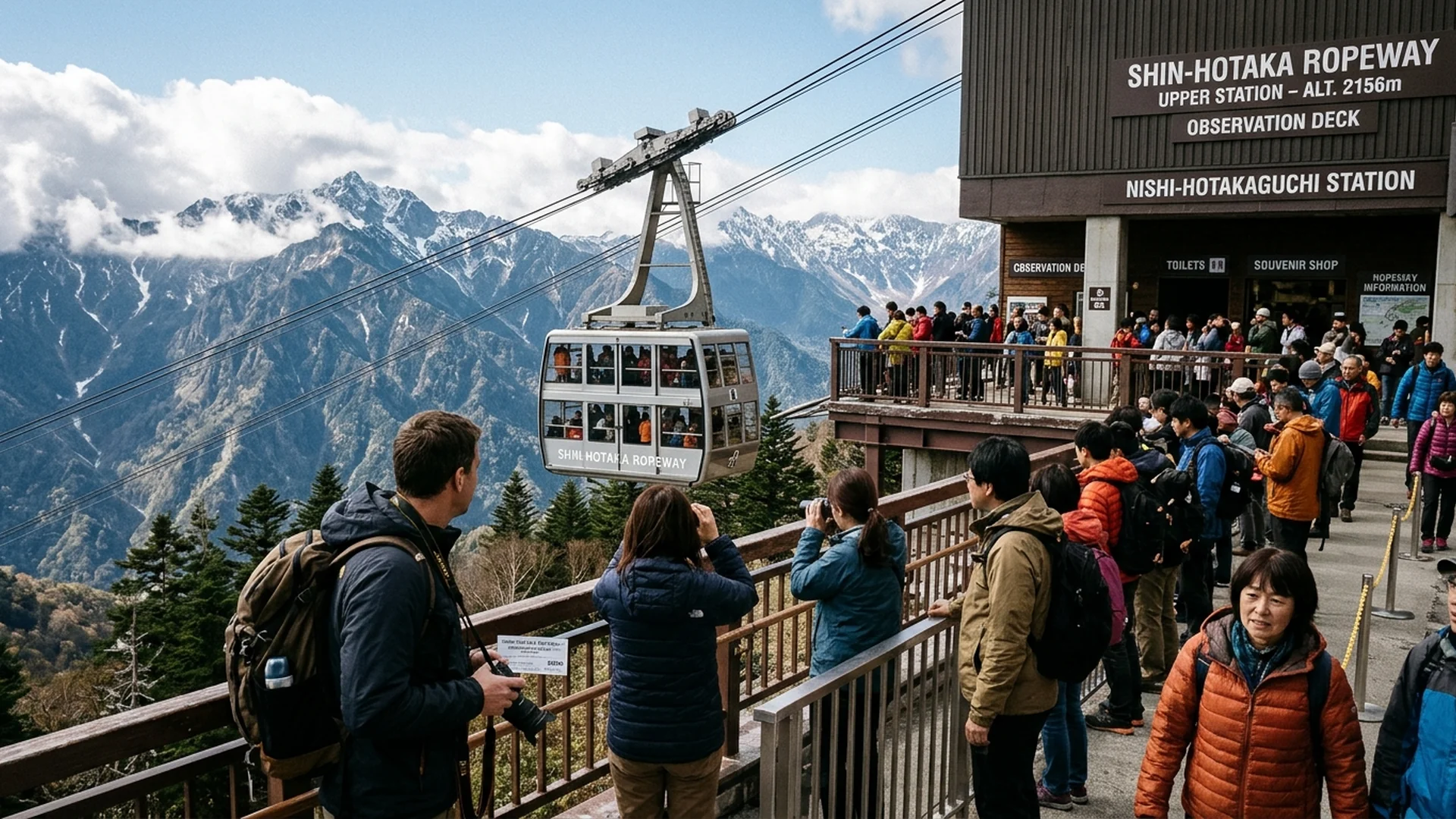
As the crimson gondola glides effortlessly above the dense canopy of the Okuhida valley, the world below gracefully recedes into a living canvas brushed by elemental hues. Encircled by precipitous stone precipices and eternally snow-crowned peaks, one senses the staggering majesty of nature’s architecture. The Shin-Hotaka Ropeway is far more than a mere conveyance; it is a grand portal opening onto a tranquil sanctuary high above the cloud line, resting at an elevation of 2,156 meters above sea level. Proudly bearing the distinction of being Japan’s sole double-decker cable car system and honored with two Michelin Green Guide stars, this destination invites discerning travelers into a realm of rarefied beauty.
Journeying toward the summit station of Nishihotakaguchi feels akin to traversing the boundaries of time and season. Whether witnessing the pristine brilliance of winter snows, the vibrant carpet of alpine wildflowers in summer, or the blazing autumnal fires sweeping across the valleys, every fleeting second inside the all-glass panoramic cabin delivers an immersive 360-degree spectacle that lingers indelibly in the memory of the devoted traveler.
Engineering at Altitude: The Innovation of the Double-Decker Gondola in the Japanese Alps
The Shin-Hotaka Ropeway journey unfolds in two distinct stages, commencing at Shinhotaka Onsen Station and ascending to Nabedaira Kogen Station aboard a standard cabin before transferring to the crown jewel: the double-decker gondola for the final leg toward the summit. This inspired two-tier cabin architecture affords passengers complete freedom in perspective, with the upper deck featuring oversized panoramic glass panels that sweep the eye across the sprawling Hida mountain range, creating an uncanny sensation of floating weightlessly through the stratosphere above ancient pines and sheer cliffs.
Throughout the transit, the low hum of precision mechanics yields to gentle murmurs of awe from fellow passengers as soft mists drift past the windows and the formidable silhouettes of Mount Kurohime and the Hotaka peaks gradually emerge. This sophisticated choreography of engineering, executed with profound reverence for a fragile terrain, transforms a vital transport link into a masterpiece designed to harmonize human curiosity with untamed wilderness.
A New Dimension of Leisure Above the Clouds: AlpScape and Itadaki no Mori
Contemporary visits to Shin-Hotaka are enriched by sweeping architectural enhancements rooted in a philosophy of quiet luxury that merges modern comfort with raw alpine topography. The rooftop observation deck of the summit station has been meticulously reimagined as the AlpScape Rooftop Observation Deck, an unobstructed open-air terrace where crisp summit winds brush against the skin while uninterrupted vistas of the alpine chain stretch toward the horizon. It is an invitation to stand in stillness, surrendering entirely to a profound quietude accompanied only by the whisper of high-altitude breezes.
Close at hand, the Itadaki no Mori (Forest of the Peaks) nature trail encourages travelers to lace up their walking shoes and step along raised wooden boardwalks that merge seamlessly with the alpine pine forest. Strolling through this elevated ecosystem reveals the resilient biodiversity of the high mountains, carrying the rich scent of rich earth and pristine pine needles while interpretative markers share tales of botanical survival under harsh climatic conditions. It is a nuanced encounter with nature that speaks directly to the contemplative soul.
The Aesthetics of Relaxation: The Confluence of Mountains and Okuhida Thermal Springs
No profound exploration of Shin-Hotaka is complete without pairing visual grandeur with restorative immersion. Okuhida Onsenkyo, the mountainous hot spring district cradling the ropeway, gathers five celebrated thermal villages—Hirayu, Fukuji, Shin-Hotaka, Tochio, and Nakao—renowned for abundant mineral-rich waters and dramatic rotenburo (open-air baths) enveloped in pristine wilderness.
Lowering oneself into steaming natural mineral waters under a canopy of falling snowflakes at dusk, or greeting the morning mists while silhouetted alpine ridges loom in the distance, captures the refined essence sought by discerning global travelers. Combining aerial alpine vistas with an overnight stay at a traditional ryokan serving masterfully curated kaiseki dinners—featuring local delicacies like hoba-miso grilled Hida beef and seasonal mountain herbs—weaves this journey into a multisensory masterpiece of taste, sight, and tactile grace.