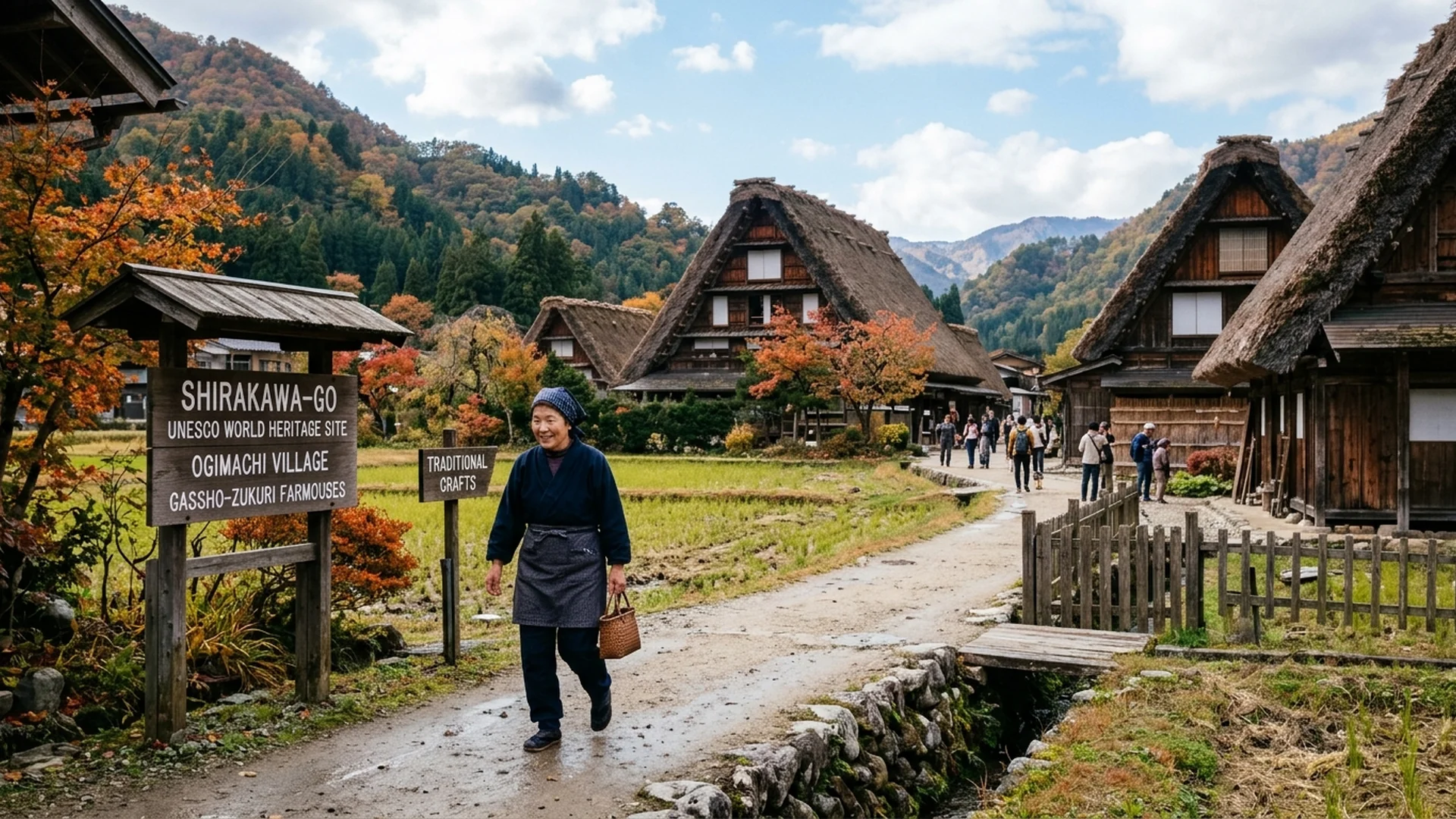
As the morning mists gently lift from the glassy currents of the Shogawa River, the first golden rays of dawn brush against steeply pitched, thickly thatched roofs that rise like hands clasped in prayer. Shirakawa-go reveals itself not merely as a celebrated destination, but as a living tableau where time stands still. Here, the breath of antiquity whispers through ancient pine structures and a way of life that exists in profound harmony with the untouched wilderness of the deep valleys in Gifu Prefecture.
Crossing the threshold into this UNESCO World Heritage village is far more than standard sightseeing; it is an unhurried pilgrimage into a philosophical mastery of survival against the harshest of winters. Each Gassho-zukuri residence was built not simply for shelter, but as an architectural masterwork passed down through generations—a testament to an ingenious vernacular tradition that rejects the use of a single iron nail. This editorial transcreation invites discerning travelers to decode this enduring beauty, experiencing Shirakawa-go with unprecedented depth and refined grace.
Gassho-zukuri Architecture: The Prayerful Engineering of Snow Resistance
The beating heart of Shirakawa-go’s global allure is its distinct Gassho-zukuri architecture. The term ‘gassho’ translates to ‘hands pressed in prayer,’ descriptive of the steep, sixty-degree angles of the straw roofs that mimic the posture of Buddhist monks chanting in devotion. This dramatic pitch is far from an aesthetic choice alone; it represents an ingenious structural solution engineered by ancestors to counter the heavy snowfalls accumulating in the Shogawa River valley, allowing dense drifts to slide off naturally before weight can compromise the framework.
Within these immense timber skeletons, bound entirely by straw ropes and ancient joinery without a single metal fastening, lie vast loft spaces once dedicated to sericulture and gunpowder production. Today, these airy attics serve as living museums, welcoming travelers to inspect the intricate joinery of the ceiling beams while absorbing the soothing warmth radiating from the sunken hearth, or irori, which permeates the ancestral home.
A Symphony of Seasons: From Emerald Paddies to Crystalline Snow
Shirakawa-go undergoes a breathtaking metamorphosis with the turning of nature’s wheel. Through the verdant months of summer, from June to August, the terraced rice paddies encircling the hamlet shimmer with emerald seedlings mirrored in pristine water. It is a season of profound serenity, perfectly suited for unhurried strolls that absorb the authentic pastoral rhythm of rural Japan.
When autumn arrives between October and November, the surrounding mountain forests ignite in fiery hues of crimson maple and golden amber, starkly contrasting against the dark timber beams of the historic dwellings like a classical oil painting. As winter descends from December through February, the village is blanketed in a soft duvet of snow. The premier highlight remains the twilight panorama from the Shiroyama Viewpoint, where warm amber lights glowing from within the farmhouses evoke the surreal charm of a living fairy tale.
Savoring Highland Heritage: The Culinary Art of Hida
Fully embracing Shirakawa-go demands a complete sensory immersion, extending naturally to its regional gastronomy. The Hida region is legendary for Hida Beef, a premier Japanese Wagyu boasting fat marbling as delicate as spun silk. To taste Hida beef grilled slowly upon a hoba leaf with regional miso over a miniature ceramic brazier is a refined indulgence that mirrors the richness of the surrounding earth.
Complementing this are fermented mountain vegetables, crystal-clear freshwater river catches, and artisanal local sake brewed from pure melted snows, rounding out an epicurean culture that satisfies both body and soul.