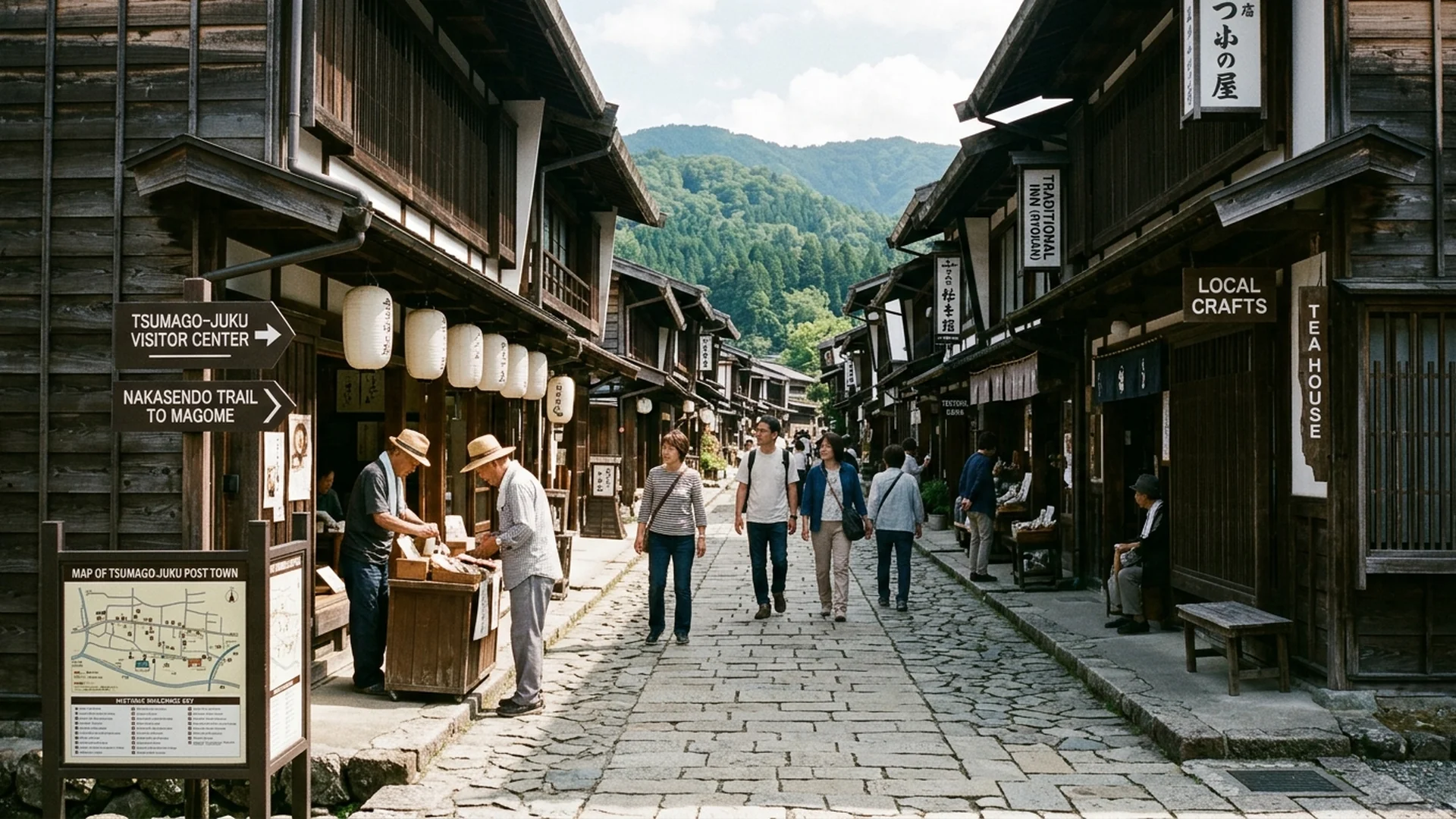
Crossing the threshold of the ancient wooden gate into the Kiso Valley, the rhythm of the modern world immediately begins to dissolve. The harsh lights and mechanical hums of contemporary life are left far behind as Tsumago-juku emerges, a living museum along the historic Nakasendo highway that was never artificially reconstructed for tourism, but rather preserved as a living heartbeat of the past under three unyielding community edicts: no selling, no renting, and no destroying.
This is a sanctuary where utility poles are buried underground to restore an unbroken horizon to the surrounding nature, and private automobiles are kept strictly at the perimeter to leave the polished cobblestone streets and dark timber lattice houses exclusively to the quiet echoes of samurai, merchants, and travelers of centuries gone by. Tsumago is far more than a fleeting stopover; it is an invaluable pilgrimage for discerning travelers seeking the genuine, unadorned soul of old Japan through a harmonious blend of sublime stillness, master architectural craft, and high-end slow living.
The Philosophy of Preservation: Where Time Stands Still in Tsumago
In an era where rapid material progress has swept away nearly all physical traces of the past, Tsumago has chosen to stand resolute against the current of time. During the Edo period, the Nakasendo served as a vital arterial highway connecting Kyoto and Edo (modern-day Tokyo), with Tsumago functioning as a juku, or post town, where weary travelers rested and messengers exchanged horses. Yet as modern railways and highways eventually bypassed the rugged Kiso Valley, Tsumago gradually slipped into quiet obscurity—a stroke of historical misfortune that ultimately proved to be its greatest preservation.
In the 1960s, local residents awakened to a powerful conservation movement, collectively refusing the kind of development that would erase their ancestral roots. They instituted strict communal laws: no selling, no renting, and no destroying. The traditional timber residences, known as magaki, were meticulously restored using ancient joinery techniques. Cedar-bark and clay-tile roofs, wooden lattice windows, and pebble-strewn pathways were safeguarded down to the final detail. Free from the visual clutter of modern wiring, the afternoon light casts a golden, uncompromised warmth over the weathered facades, allowing Tsumago to reflect the absolute purity of the Edo period.
Footsteps on History: The Eight-Kilometer Trail from Magome to Tsumago
The true heart of any journey to Tsumago lies in traversing the ancient footpath of the Nakasendo Trail. Its most celebrated and pristine stretch connects Magome-juku and Tsumago-juku, an eight-kilometer route that meanders through deep cedar forests, terraced rice paddies, and secluded rural hamlets.
The journey begins in Magome, a hill town of steep, stone-paved slopes, before gently descending into the idyllic countryside. Along the way, bronze bells hang at regular intervals—meant to be lightly rung to deter local wildlife—alongside historic waypoints such as traditional rest houses and the refreshing cascade of the Shigoku Waterfall. Walking this path is not merely physical exercise; it is a moving meditation, where the crunch of gravel underfoot and the whispering pine canopy attune the senses away from the frantic pace of contemporary life. For travelers unaccustomed to carrying luggage over mountain passes, reliable baggage-forwarding services operate between the two towns, ensuring an unburdened and seamless exploration.
Architecture and Living Heritage
Every structure within Tsumago bears a narrative of exceptional craftsmanship. Among its architectural crown jewels is the Waki-Honjin Okuya, a stately residence historically reserved for high-ranking nobility and dignitaries. Its massive oak pillars, polished tatami chambers, and discreet defensive features offer a tangible window into the stratified elegance of samurai society.
Nearby, the Tsumago-juku Museum and local historical archives curate an extensive collection of Edo-period documents, textiles, and everyday implements. Exploring these intimate galleries while observing the intricate joinery of the miyadaiku (traditional shrine carpenters)—who constructed these dwellings without the use of a single iron nail—serves as a profound testament to the genius of early Japanese builders.
The Flavors of the Kiso Valley: Gohei Mochi and Ryokan Evenings
As dusk descends, Tsumago transitions into absolute tranquility. Once the daytime visitors depart, the village falls completely silent, illuminated only by the soft glow of paper lanterns reflecting upon the wet stone pavement. Staying overnight in a minshuku or traditional ryokan operated by local families offers an elite hospitality experience entirely distinct from modern corporate hotels. Hosts welcome guests with genuine omotenashi, preparing multicourse seasonal banquets sourced directly from the surrounding Kiso mountains.
Among the culinary highlights is Gohei Mochi—skewered rice cakes brushed with a savory sauce of ground sesame, walnuts, and ginger, then charcoal-grilled until delightfully fragrant. Paired with hand-crafted buckwheat soba noodles served in a delicate, crystal-clear broth, this simple yet sublime meal provides the ultimate comfort on a crisp mountain evening.