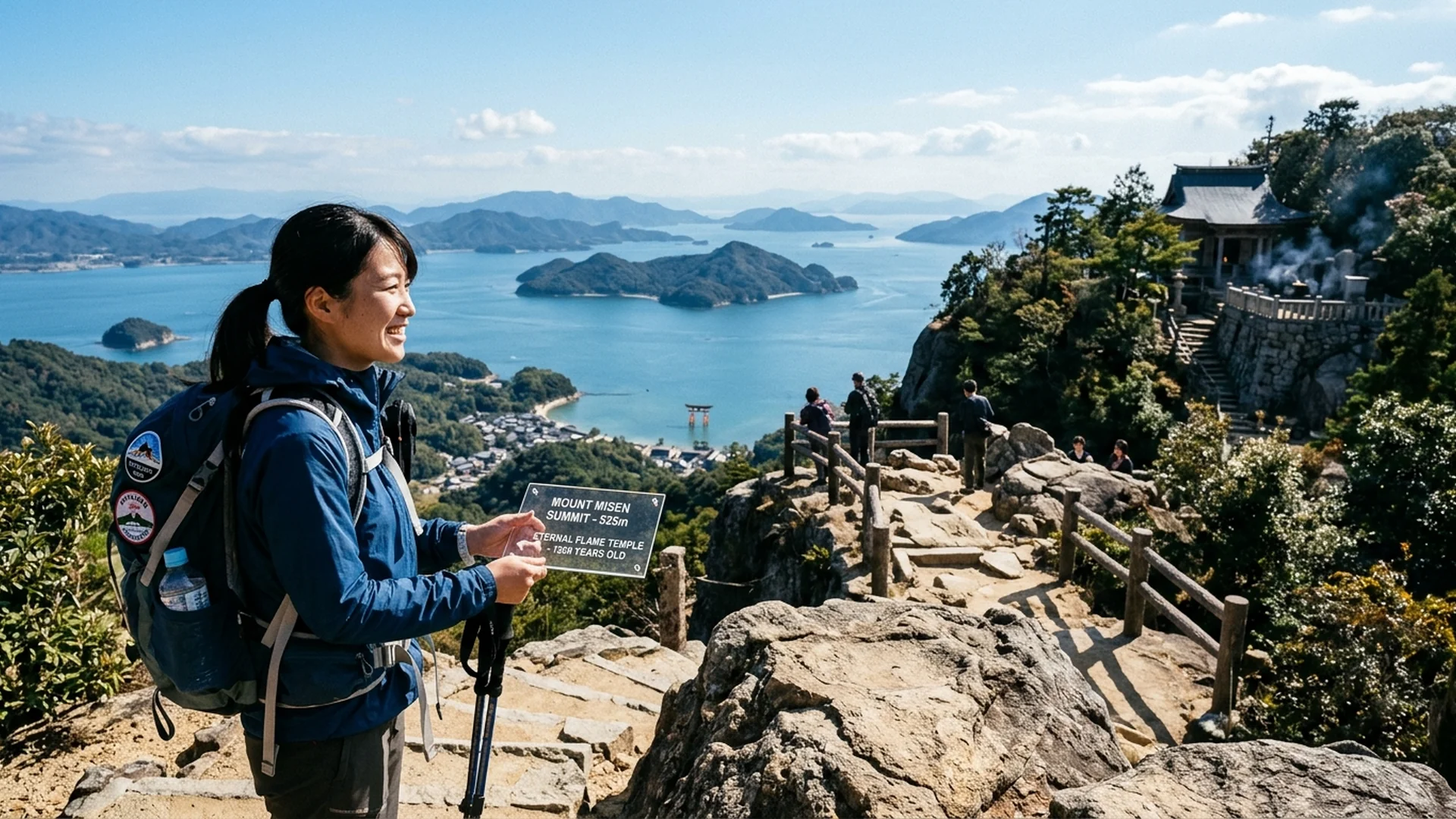
When the morning mist slowly lifts above the azure expanse of the Seto Inland Sea, the vermilion torii gate of Itsukushima Shrine often captures the wandering traveler’s primary gaze. Yet, commanding the horizon behind this iconic masterpiece stands Mount Misen, the highest peak on Miyajima Island, which has served as an inviolable spiritual fortress and natural sanctuary for well over a millennium.
Journeying into these elevated sanctuaries is an unhurried pilgrimage across ancient, mist-draped primeval forests preserved under UNESCO World Heritage status. Here, esoteric Shingon Buddhism converges seamlessly with pristine wilderness. The summit offers far more than Michelin three-star panoramic vistas; it shelters the glowing embers of an unbroken spiritual devotion kindled more than 1,200 years ago.
Spiritual Heritage: The Footsteps of Kūkai and the Eternal Flame
The sacred lineage of Mount Misen plunges deep into Japanese history, tracing back to 806 AD when the revered monk Kūkai (Kōbo Daishi), founder of Shingon Buddhism, ascended the peak to undertake ascetic training and perform the sacred Goma fire ritual. At that exact sanctuary, the flames he ignited sparked the ‘Kiezu-no-hi’—an eternal flame that has refused to extinguish for over a millennium. Despite the passage of centuries and multiple restorations of the Reikado Hall, this devotional fire is vigilantly tended by monks from Daisho-in Temple. Notably, embers from this sacred flame have provided the foundational spark for the Peace Flame at Hiroshima Peace Memorial Park, carrying a timeless message of tranquility across the globe.
Architecture of Wind and Light: The Misen Observatory and the Seto Inland Sea
Reaching 535 meters above sea level culminates at an architectural viewing platform redesigned by renowned Japanese architect Hiroshi Sambuichi, whose work masterfully honors the natural elements of wind, light, and water. The Miyajima Misen Observatory is conceived around the concept of ‘Za’—an unconstrained resting place designed to invite travelers to pause, breathe, and attune themselves to the breezes sweeping across the scattered islands of the Seto Inland Sea. The unfolding panorama presents shimmering sapphire waters contrasting with distant mountain ranges, a landscape rightfully honoured with three stars by the Michelin Green Guide for its sublime environmental architecture.
Primeval Botany and Cryptic Megaliths: The Natural History of the Summit
Beyond its spiritual significance, the Misen Primeval Forest serves as a vast, living classroom designated as a special natural monument. The ecosystem’s extraordinary character lies in the harmonious coexistence of temperate and cold-climate flora, a rare botanical tapestry celebrated by naturalists worldwide. Along the ascent, travelers encounter enigmatic megaliths sculpted by millennia of natural erosion, intricately woven into local folklore known as the ‘Seven Wonders of Misen.’ Each weathered stone adds an aura of primordial mystery and reverence to the journey.