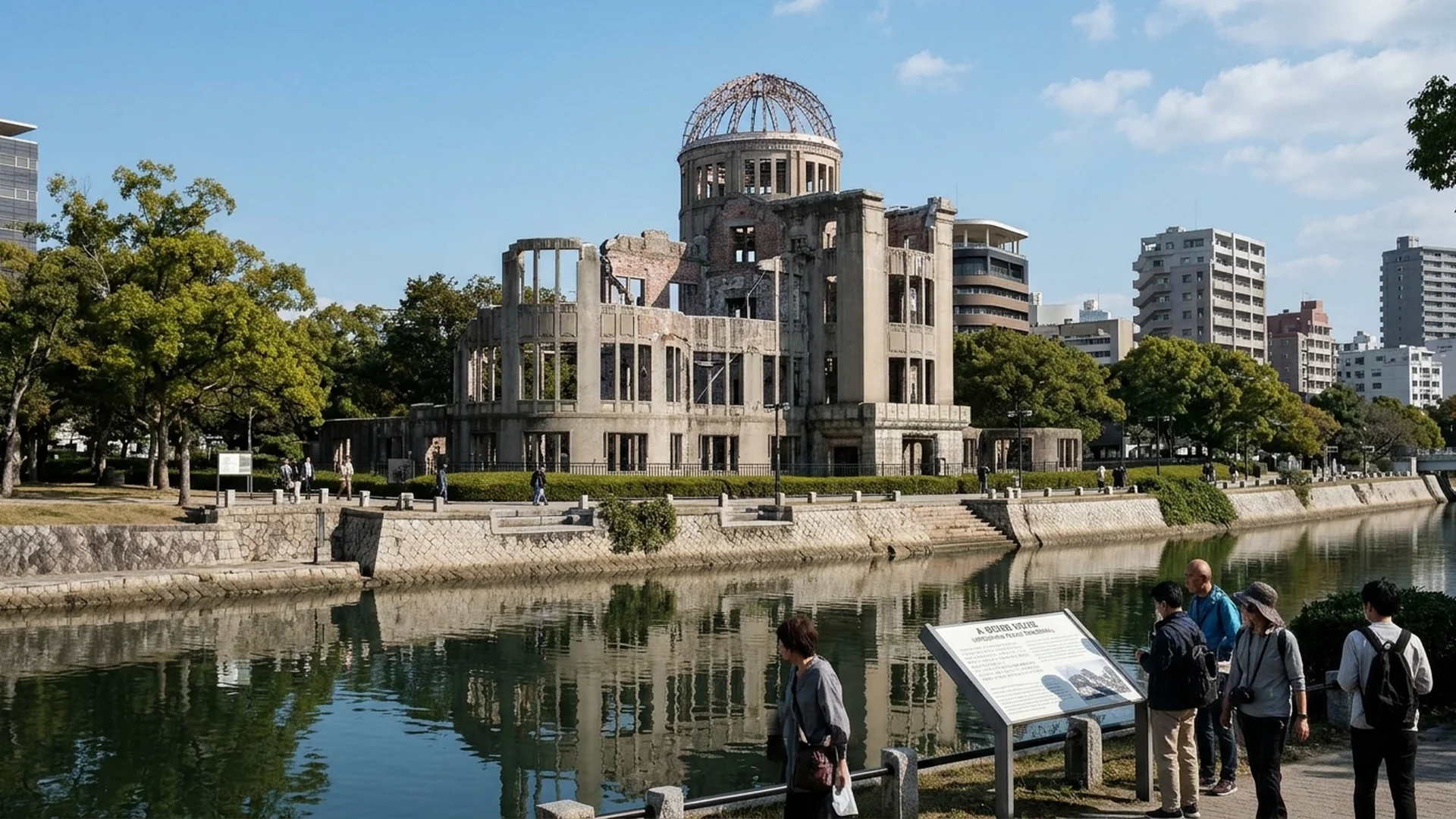
As the mist lifts over the Motoyasu River—waters once scorched by the searing heat of history—they now flow gently, reflecting the silent, steadfast ruins standing along the bank. Crossing the threshold into the Hiroshima Peace Memorial Park is far more than a routine sightseeing excursion; it is a journey across the borders of time to confront humankind’s deepest wound while discovering the most magnificent and powerful resurrection of the 20th century.
Amidst the quiet stillness enveloping this 120,000-square-meter expanse, every footstep resonates with remembrance. Meticulously designed by renowned Japanese architect Kenzo Tange, this vast spatial composition serves as a bridge connecting a painful past, an aware present, and a future liberated from the shadow of nuclear armament. For discerning global travelers seeking meaning far beyond conventional leisure, this is a sacred sanctuary inviting stillness, contemplation, and an open-hearted listening to the whispers of history.
Architecture of Memory: The Vision of Kenzo Tange
Following the conclusion of the Second World War, Hiroshima consciously chose not to revert its hypocenter district into a commercial sprawl, instead dedicating the expanse to a public domain for global peace. Pritzker Prize-winning architect Kenzo Tange was commissioned to shape this ground into an enduring memorial. The central axis of the park is arranged in absolute linear alignment, extending from the Cenotaph for the A-bomb Victims, passing through the Flame of Peace, and terminating at the Atomic Bomb Dome on the northern bank.
The architectural language of the museum and monuments draws profound inspiration from traditional Japanese raised-floor dwellings, honoring indigenous heritage while employing exposed concrete. This raw material communicates substantial structural gravity yet remains airy and luminous, inviting visitors to simultaneously contemplate the profound weight of loss and the persistent light of hope.
The Atomic Bomb Dome: Witness to Silent Testimony
The Atomic Bomb Dome, formerly the Hiroshima Prefectural Industrial Promotion Hall, stands resiliently along the riverbank. Located a mere 160 meters from the hypocenter, the near-vertical descent of the blast wave uniquely preserved its skeletal steel dome framework and fractured walls amidst the widespread destruction of the city.
The conscious decision to preserve this structure in its ruined state avoids invoking bitterness; instead, it operates as the world’s most powerful ‘silent witness.’ The rusted steel girders and weathered brickwork articulate the catastrophic violence of war far more eloquently than any textbook. When evening sunlight strikes the curved iron ribs, the resulting silhouette is one of tragic beauty, perpetually reminding humanity of the fragile sanctity of global peace.
Hiroshima Peace Memorial Museum: Decoding Wounds into Universal Lessons
Entering the Hiroshima Peace Memorial Museum is akin to passing through a temporal portal to August 6, 1945. The interior exhibitions are curated with exquisite sensitivity, intentionally avoiding gratuitous emotional manipulation in favor of direct storytelling through genuine artifacts salvaged from the devastation.
Tattered school uniforms, children’s personal toys, pocket watches permanently frozen at 8:15 AM, and intimate personal journals convey the sudden erasure of human lives. This museum transcends local municipal history to address urgent contemporary global nuclear discourse, inviting international travelers to critically examine the trajectory of planetary peace and our collective responsibilities as global citizens.