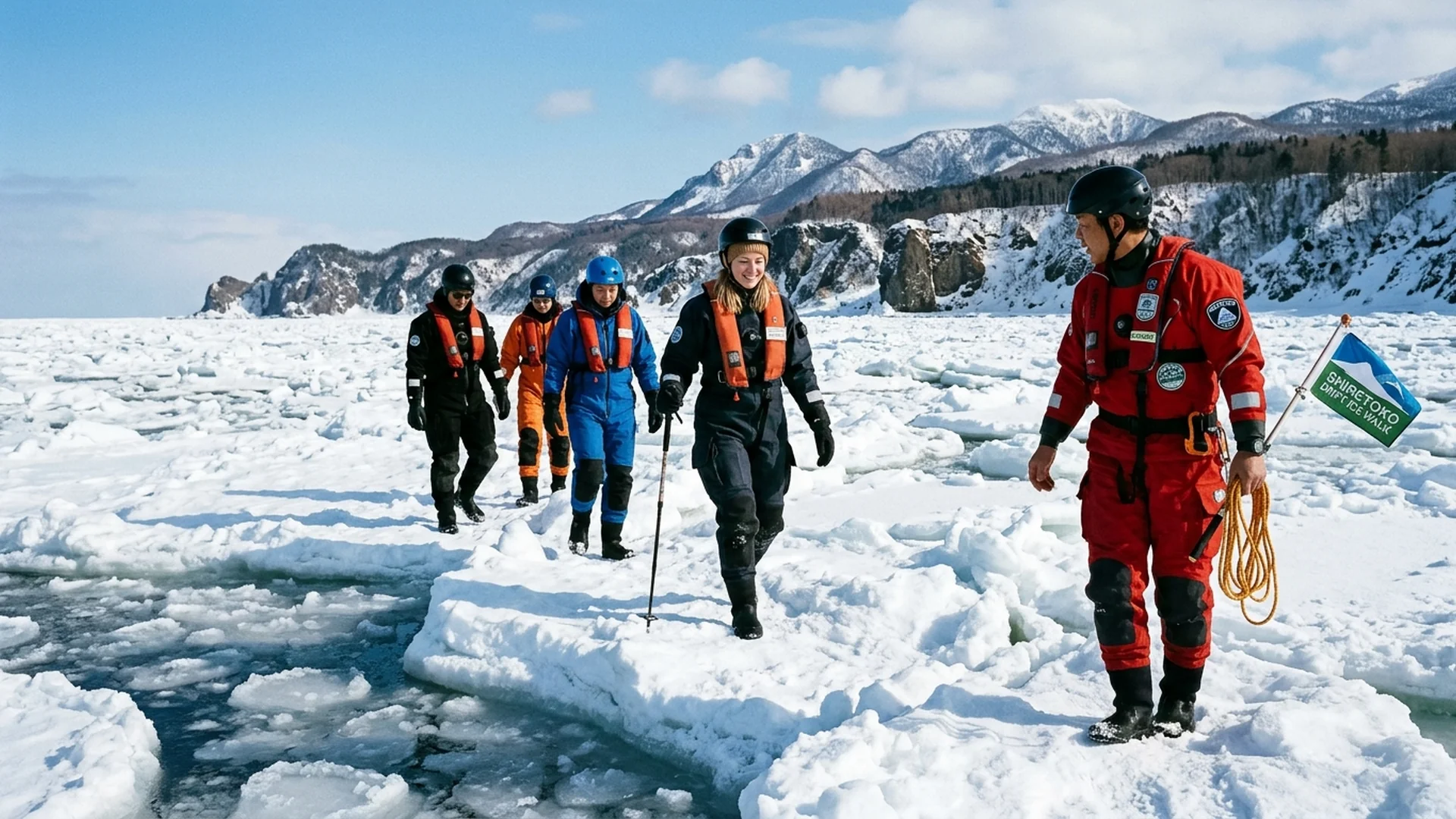
When biting Siberian gales sweep across the frozen expanse, driving icy currents toward the pristine shores of Shiretoko—Hokkaido’s treasured UNESCO World Heritage sanctuary—the vast Sea of Okhotsk undergoes a mesmerizing metamorphosis. The deep indigo waters transform into an endless, shifting canvas of pristine white drift ice, alive with the slow, majestic momentum of the wild north. This is a planetary phenomenon of rare magnitude, summoning intrepid travelers from across the globe to test their boundaries by walking and floating directly upon the polar ice sheets.
Pulling on a vibrant, buoyant drysuit and taking that first deliberate step onto crystalline, free-floating ice redefines the very essence of high-latitude winter exploration. Here, the raw, formidable temperament of the natural world converges with breathtaking serenity, forging an indelible memory at the edge of the world. Every stride across the frozen crust is an intimate dialogue with the monumental forces that shape our earth.
Nomads of the Deep: The Genesis of Okhotsk Drift Ice
The odyssey of Ryuhyo—the wandering drift ice—begins thousands of miles away along the Amur River basin in Russia. As freshwater feeds into the Sea of Okhotsk during the harshest months of winter, it freezes into sheets before arctic winds and ocean currents carry them southward across maritime borders toward the rugged Shiretoko Peninsula in Japan. This annual migration cloaks the expansive sea in a stark, blinding white akin to the high Arctic.
The unique geographical signature of Shiretoko—a slender peninsula jutting boldly into the sea—creates natural eddy currents that trap and consolidate the drifting ice into dense, navigable expanses. Gazing across a seamless panorama of jagged ice fields framed by snow-draped alpine peaks beneath a piercing cobalt sky reveals a raw, unyielding cycle of wilderness that remains gloriously untamed.
The Art of Equilibrium: The Science of Drysuits and Buoyancy
Venturing onto a shifting marine ice sheet is not an act of reckless bravado, but an exercise in meticulous safety design. At the heart of the experience is the advanced drysuit—a hermetically sealed, full-body garment engineered from neck to toe to repel the sub-zero bite of the ocean. The suit encapsulates a cushion of air, ensuring that the wearer remains entirely buoyant and insulated, capable of reclining effortlessly on the freezing surface of the sea.
The initial contact with the undulating ice instantly displaces apprehension with exhilaration. Expert guides brief participants on reading the terrain, as the floes constantly fracture and drift under the influence of unseen tides. Once a stable expanse is reached, adventurers are invited to slip through the gaps in the ice, surrendering themselves completely to the deep azure water and floating amidst crystalline shards of the far north. To linger suspended in the middle of the Sea of Okhotsk without a shiver is a surreal, peerless communion with the elements.
A Symphony of Winter: Ecosystems Along the Frozen Shore
Beneath the austere veneer of the frozen ocean, Shiretoko harbors a remarkably vibrant marine biosphere. The drifting ice delivers more than mere cold; it transports copious nutrients and plankton blooms that draw in schools of fish and majestic raptors. The magnificent Steller’s sea eagle and the white-tailed eagle frequently circle above the ice floes, scanning the fissures for prey, transforming the white desert into a paradise for wildlife naturalists and photographers alike.
Embarking on the Ryuhyo Walk transcends mere adventure; it is an awakening of the senses. One hears the subtle, rhythmic crunch of compressed ice crystals, the low whistle of mountain winds, and the sharp, clean scent of pristine sea salt. It stands as a profound reminder of the delicate fragility of our planet and the vital imperative to preserve our last untamed frontiers.